
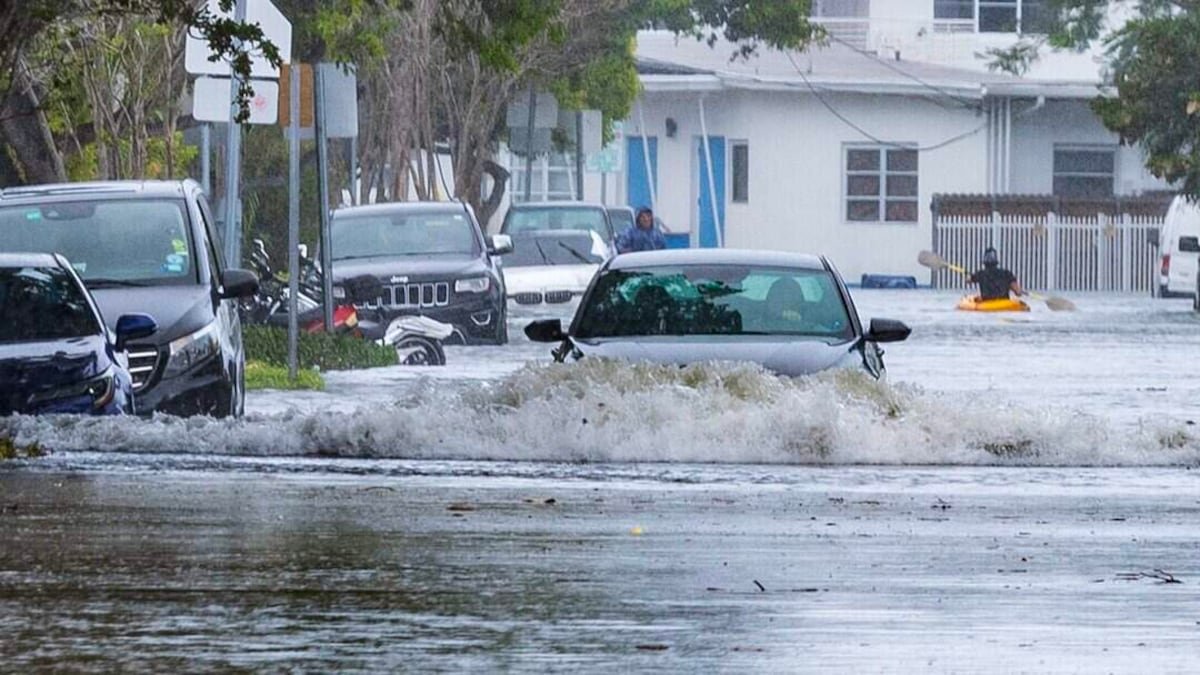
Historic, chart-topping king tides submerged South Florida recently, flooding more places deeper and longer than they’d ever seen before. Last week, double-digit rainfall filled in the blanks, swamping inland and coastal areas.
South Florida is soggy, and all the science says its only going to get worse. That’s bad news for anyone who lives in, works in, owns property in, visits or even passes through South Florida. So, millions of people.
In response, local governments have poured hundreds of millions into solutions over the last few years. Keeping dry for the next decade alone would take billions more — if not tens of billions.
They’re elevating roads, buffing up stormwater pumps and replacing drainage pipes with new ones so big an NBA player could walk upright in them. They’re converting golf courses into part-time flood parks to soak up neighborhood drainage. They’re raising seawalls.
And the projects appear to be working.
Tiffany Troxler, director of science at Florida International University’s Sea Level Solutions Center, said she’s seen projects in Miami neighborhoods that have drastically cut down on flooding.
“That’s a really positive sign. We need more of that,” she said. “Without more adaptation projects, we’ll continue to see more flooding.”
In Miami Beach, the raised roads and more powerful pumps have averted hundreds of floods, according to city officials. In at least one neighborhood — in Sunset Harbour — a study found the projects also raised property values.
But these projects are pricey and take years to design and build. Residents are tired of waiting.
During last month’s record-breaking king tide, longtime Fort Lauderdale resident Gonzalo E. Vazquez, whose neighborhood was inundated, expressed the frustration that many South Floridians feel whenever the streets flood, and implored authorities to get moving faster on solutions.
“We need the city to take care of it,” he said. “We need something to alleviate this area because this is going to continue year after year.”
First line of defense
For king tides in particular, the problem is mostly water seeping in from the coast. Floodwaters sneak backwards through drainage pipes, flooding the streets they’re supposed to drain. It’s how an octopus ends up floating in a Miami Beach garage.
The answer, coastal cities have learned, is adding a device that only allows the water to drain out toward the coast but blocks it from burbling back up. They’re called backflow preventers, and Fort Lauderdale has installed 215 of them, said Nancy Gassman, the city’s chief resilience officer.
“The first line of defense is to try to keep the ocean from using our storm infrastructure to access out city,” she said.
City employees also examine those valves at least four times a year to keep them clear of trash. Notably, a clogged backflow preventer in Miami once led to intense street flooding that stalled cars in intersections on Brickell Key.
The next phase of the battle against rising tides is perhaps the most obvious, armoring the coast with seawalls. Seawalls have been around for decades in South Florida, but many are old, broken or — thanks to sea level rise — too low to keep the sea at bay. And last month’s record king tide offered a glimpse of that high-water future.
“There were neighborhoods and there were properties whose seawalls were overtopped that had never been overtopped before,” Gassman said.
Of the 165 miles of waterway in Fort Lauderdale, only 6 miles are publicly owned. So the fix falls mostly on private owners. A decade ago, Fort Lauderdale passed a law requiring residents to fix and raise their seawalls if they were so degraded that they caused flooding to their neighbors.
“Some of these finger isles, one single property is causing that nuisance flooding for the entire neighborhood,” she said. Fixing that one outlier seawall has made “an enormous difference” for those communities.
But backflow valves and seawalls are just table stakes for flood prevention. And they don’t help with the extreme rainfall that’s growing more common.
Pump it up (and out)
The next step is flood pumps and pipes that suck floodwater off the street and send it elsewhere. These drainage projects involve years of construction and high price tags.
Fort Lauderdale spent about $200 million to upgrade the drainage in the Edgewood and River Oaks neighborhoods, which were some of the hardest hit in the 2023 rain bomb that flooded more than 100 homes.
But there are at least 22 more projects Fort Lauderdale needs to design, build and pay for to keep the city dry in the coming years, according to the city’s plan to tackle flooding.
“We are expecting to spend $1.6 billion on the stormwater master plan improvements over the course of the next 20 years,” Gassman said.
In Miami, that price tag is much higher.
Two drainage projects in the city are under construction now, in the floodprone neighborhoods of Edgewater and Shorecrest — about $75 million of work that is estimated to protect 1,143 homes and businesses.
The city’s master plan to tackle flooding, from 2021, found Miami needs to spend $3.8 billion to keep the hardest-hit neighborhoods reasonably dry by 2060. If Miami installed all 100 stormwater pumps, miles of 6-foot high seawalls and a network of massive pipes, some of its neighborhoods would be protected from rainstorms that could drop as much as 7 inches of rain in a day, plus king tides and sea level rise.
Key word, some.
The master plan, like those from other South Florida cities, acknowledges that all of those pumps and pipes will only buy so much time. Even with all those fixes, some neighborhoods would still see regular flooding.
Miami Beach has the same problem. For a century, the city largely relied on gravity to drain floodwater off the streets. But rising seas and heavier rainfalls has upended that calculus, so the island city has increasingly turned to stormwater pumps and pipes to keep neighborhoods dry.
The city’s flooding plan, last updated in 2024, called for $2.3 billion in drainage upgrades across the city over the next 50 years.
Currently, the city’s project on West Avenue is under construction. It and other projects have faced years of delays under intense resident pushback due to worries about construction chaos, loss of parking and installing crucial pump equipment in public areas.
These projects take time
But smaller cities are also facing rising seas. And unlike their larger, more monied cousins, they have fewer tax dollars to rely on.
North Bay Village Mayor Rachel Streitfeld said the most recent king tide brought water to places she’d never seen it before. And an unfortunately timed collapse of an injection well meant one of the village’s main stormwater pumps was offline during the inundation.
North Bay Village has installed backflow preventers throughout most of the village, she said, thanks to money from state resilience grants. But the rest need to be custom-designed and built, a process that has taken years to kickstart. The council was set to approve moving forward with designing them.
“We’re very very excited about getting those designed and installed,” she said. “This has been a priority for me since I was elected in 2020.”
Streitfeld has made flooding a priority in her time in office, but even with political will and some grant money, it’s slow going. The village is permitting a new stormwater pump for North Bay Island and looking for a new engineering firm to design a plan to tackle flooding — and raise roads — on Treasure Island.
She worries about her older residents in low-lying homes who plan to stay there for decades more, even as sea rise and storms worsen.
“Given that I’ve been in office for six years and we don’t have a single project in the ground, I’m feeling quite overwhelmed by how high the water was,” she said. “And knowing how long these projects take… it’s concerning.”



