
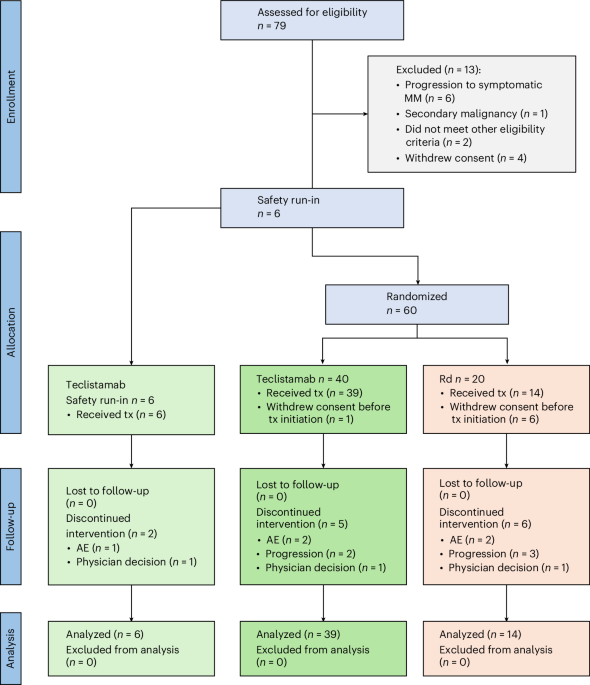
Patient disposition and baseline demographics
Between 15 April 2023 and 3 July 2025, 64 patients with HR-SMM were enrolled in this randomized phase 2 trial of teclistamab versus Rd. The initial teclistamab dosing schema included a safety run-in of six patients, in which patients received a lower cycle 1 dose of 720 μg kg−1 weekly, followed by 1.5 mg kg−1 weekly for 2 cycles, 3 mg kg−1 every 2 weeks for 4 cycles and then 3 mg kg−1 monthly to complete 24 cycles (Extended Data Fig. 1). After an observed efficacy signal and to reduce cumulative treatment exposure in this precursor-disease population, the protocol was amended to limit teclistamab therapy to a maximum of 12 cycles or a total of 15 months of treatment. Patients assigned to Rd received lenalidomide 25 mg orally on days 1–21 of each 28-day cycle for cycles 1–12, together with dexamethasone 40 mg orally on days 1, 8 and 15. For cycles 13–24, patients continued lenalidomide alone at 15 mg orally on days 1–21 of each 28-day cycle. Dexamethasone dose modification or discontinuation was allowed for intolerance, with continuation of lenalidomide monotherapy allowed per protocol.
At the data cutoff for this analysis, on 26 May 2026, 59 patients had completed at least one cycle of assigned treatment and were included in the primary analysis population (Fig. 1). Of these, 45 patients received teclistamab, including those treated during the safety run-in, and 14 received Rd. In the teclistamab group, 20 patients were treated before and 25 after the protocol amendment limiting treatment duration. At data cutoff, 8 teclistamab-treated patients remained on treatment, 30 had completed the planned number of cycles according to their assigned protocol version and 7 had discontinued teclistamab early because of progressive disease (n = 2), adverse events (AEs; n = 3) or physician or patient decision (n = 2). Both patients who discontinued for physician or patient decision had achieved MRD-negative CRs; one discontinued because of an unrelated medical condition requiring prioritized management, and one elected to stop after 9 cycles before the planned 12 cycles. In the Rd group, four patients remained on treatment, four had completed protocol-defined treatment and six had discontinued treatment because of CRAB progression (n = 3), AEs (n = 2) and one following a joint patient-physician decision to stop therapy after 21 cycles while in adequate response. Moreover, in the Rd arm, four patients required lenalidomide dose reductions beyond the planned protocol-specified reduction from 25 mg to 15 mg beginning at cycle 13, with documented reasons including fatigue/brain fog, gastrointestinal symptoms, rash and recurrent neutropenia.
CONSORT flow diagram. Numbers of participants screened, enrolled, treated and included in analyses are shown, with reasons for exclusion and allocation to each protocol phase. CONSORT, Consolidated Standards of Reporting Trials. tx, treatment.
The median age of treated patients was 65 years (range = 34–79), and 23 patients (39%) were female (Table 1). Median bone marrow plasma-cell (BMPC) involvement was 25% (interquartile range = 20–40). Cytogenetic data were available for 55 patients, of whom 26 (44.1%) had high-risk abnormalities, including del(17p), t(4;14), t(14;16), t(14;20) or gain or amplification of chromosome 1q. According to the 20-2-20 risk model, 38 patients (64%) were classified as high risk (Supplementary Table 1). Baseline imaging to exclude myeloma-defining bone disease, using PET/CT or whole-body magnetic resonance imaging (MRI) in accordance with International Myeloma Working Group (IMWG) guidelines, was performed in all patients according to the protocol criteria, with PET/CT performed in 53 patients and MRI performed as the primary or additional imaging modality in 6 patients. The baseline characteristics were balanced in both treatment arms.
Primary outcome: CR rate
The primary endpoint of this study was CR rate in the randomized population, defined as the proportion of patients achieving CR or better. At a median follow-up of 24.5 months, 29 of 39 patients (74%) randomized to receive teclistamab achieved CR or better compared with none among patients treated with Rd (Fig. 2a,b).
a, Swimmer plots showing longitudinal IMWG response categories for each treated participant from treatment initiation to last follow-up, stratified by treatment arm. Bars indicate response category over time, and diamonds indicate MRD status at a sensitivity threshold of 10−5. Black crosses indicate first documented progressive disease. Teclistamab-treated patients include participants treated in the safety run-in and randomized teclistamab cohorts; the control arm includes patients treated with Rd. b, Best overall response by treatment arm, shown as the proportion of patients achieving sCR/CR, VGPR, PR or stable disease (SD). The teclistamab group includes all treated patients, including those enrolled in the safety run-in. c, MRD-negativity rates among MRD-evaluable teclistamab-treated patients over time at sensitivity thresholds of 10−5 and 10−6. Bars show the proportion of evaluable patients who were MRD-negative or MRD-positive at each prespecified time point; fractions indicate the number of MRD-negative patients among evaluable patients. The median month of MRD assessment from randomization is shown below each time point. d, Kaplan–Meier estimates of PFS among all teclistamab-treated patients and patients treated with Rd. Tick marks indicate censored observations. The two-sided log-rank P value is shown. MR, minimal response; PD, progressive disease.
Because the safety run-in cohort had comparable baseline characteristics and outcomes to the randomized teclistamab cohort, we also performed additional analysis including all teclistamab-treated patients. In this expanded teclistamab-treated population, 35 of 45 patients achieved a CR or better, corresponding to a CR rate of 77.8%.
Secondary efficacy outcomes
Secondary efficacy endpoints included overall response rate, MRD negativity, PFS, duration of response, TTP and overall survival. Additional planned secondary endpoints not reported in this manuscript are PFS after initiation of active myeloma therapy (PFS2), measures of teclistamab pharmacokinetics and immunogenicity. Secondary efficacy outcomes are reported descriptively for all teclistamab-treated patients, including those treated in the safety run-in, and compared with the Rd control arm, unless otherwise indicated.
The distribution of best overall responses differed between treatment groups (Fig. 2b). In the teclistamab group, 39 patients (86.7%) achieved a very good partial response (VGPR) or better, while 3 patients with a partial response (PR) remained on treatment and had nine cycles or less, and 3 patients were nonresponders, achieving best response of stable disease. Among Rd-treated patients, 2 patients achieved a VGPR (14.3%) and 12 patients (85.7%) achieved a PR. In prespecified subgroup analyses, best response did not differ by age group or cytogenetic risk status (Extended Data Fig. 2).
MRD negativity at a sensitivity threshold of 10−5 by next-generation sequencing (NGS) differed among treatment groups—37 of 45 (82.2%) teclistamab-treated patients and none of the Rd-treated patients achieved MRD negativity during treatment (Fig. 2c). The MRD-negativity rate at a sensitivity threshold of 10−6 in the teclistamab arm was 77.8% (35/45). Overall, 33 of 45 patients achieved both a CR or stringent CR (sCR) and MRD negativity, corresponding to a combined sCR/CR with MRD-negative rate of 73.3%. Among the 35 patients who achieved sCR/CR, 33 (94.3%) were MRD-negative. The median time to MRD negativity was 6.2 months. Among 28 patients with serial MRD assessments who were MRD-negative at the first assessment, MRD negativity was sustained in 100% patients through the latest available assessment.
At the time of data cutoff, nine patients had progressed by either SLiM-CRAB and/or biochemical progression, including three teclistamab-treated and six Rd-treated patients. Five patients developed a myeloma-defining event, two in the teclistamab arm and three in the Rd arm. All progressions involved myeloma-related bone disease measured by MRI (n = 2) or PET-CT (n = 3); two patients also had an involved/uninvolved free light-chain (LC) ratio of >100.
Median PFS was not reached in the teclistamab arm compared with 20.3 months in the Rd arm, with significantly improved PFS observed for teclistamab versus Rd (log-rank P = 0.002; Fig. 2d). In a Cox proportional hazards model, treatment with teclistamab was associated with a lower risk of progression or death compared with Rd (hazard ratio = 0.15; 95% confidence interval (CI) = 0.04–0.59; P = 0.007). The Kaplan–Meier-estimated 2-year PFS rate was 92% (95% CI = 84–100) with teclistamab and 49% (95% CI = 26–91) with Rd. There were no differences in PFS when stratified for age group or cytogenetic status (Extended Data Fig. 3). Duration of response was significantly improved in the teclistamab versus Rd arms; among responders, the estimated 24-month probability of maintaining response was 100% with teclistamab and 49% with Rd (P < 0.001; Extended Data Fig. 4). Results were consistent when analysis was restricted to the randomized population (Extended Data Fig. 5). No deaths occurred in either arm (Extended Data Fig. 6).
In post hoc exploratory subgroup analyses, response rates and PFS were consistent across clinically relevant subgroups, including prior therapy exposure, duration of therapy with teclistamab preprotocol and postprotocol amendment, and baseline 20-2-20 risk category. No significant differences in response distribution or PFS were observed across these subgroups (Extended Data Figs. 7–9).
Secondary safety outcomes
AEs were reported in all treated patients (Table 2 and Supplementary Table 2). No patient in the safety run-in cohort met protocol-defined dose-limiting toxicity criteria.
Hematologic AEs were common and were primarily driven by neutropenia. Any-grade neutropenia occurred in 28 teclistamab-treated patients (62%) and 11 Rd-treated patients (79%). Grade 3 or 4 neutropenia occurred in 16 teclistamab-treated patients (35.6%, grade 3 = 8, grade 4 = 8), and in 4 Rd-treated patients (29%, all grade 3). Severe thrombocytopenia was uncommon, with grade 3 or 4 thrombocytopenia occurring in two patients in each arm (teclistamab 4%, Rd 14%). No grade 3 or 4 anemia was observed.
Most infections were grade 1 or 2 with any-grade infections in 54 of 59 patients (91.5%) and similar frequencies across treatment arms. Grade 3 infections occurred in nine teclistamab-treated patients (20%) and three Rd-treated patients (21%). Among teclistamab-treated patients, grade 3 infections included respiratory infections, including COVID-19, influenza A, upper respiratory infections and pneumonia, as well as gastrointestinal infections, including Salmonella-associated and astrovirus-associated diarrhea. In the Rd arm, grade 3 infections included an acute infection of unknown origin, infectious enterocolitis and one febrile gastrointestinal infectious episode. All grade 3 infections resolved, and no grade 4 infections were observed. Per protocol, immunoglobulin replacement was recommended for hypogammaglobulinemia, generally defined as IgG <400–500 mg dl−1, with initiation at the discretion of the treating physician. In the teclistamab arm, every patient received at least one dose of intravenous immunoglobulin. Grade 3 infections were not temporally associated with initiation of intravenous immunoglobulin replacement.
Teclistamab-associated immune effector cell-related toxicities were predominantly low grade. Cytokine release syndrome (CRS) occurred in 32 teclistamab-treated patients (71.1%), including 29 grade 1 events (64.4%) and 3 grade 2 events (6.7%); no grade 3 or higher CRS was observed. No patients received prophylactic tocilizumab. Tocilizumab was administered after CRS onset in five patients (11.1%), two of whom also received dexamethasone (4.4%). No immune effector cell-associated neurotoxicity syndrome or other treatment-emergent neurotoxicity was reported.
In the teclistamab arm, nonhematologic laboratory abnormalities included grade 3 alanine or aspartate aminotransferase elevations in five patients in the context of CRS. One patient developed grade 3 pancreatitis with concurrent lipase elevation that was attributed to trimethoprim–sulfamethoxazole. One patient had a grade 3 maculopapular rash that was deemed unrelated to teclistamab. All of these toxicities were completely resolved.
Serious AEs considered unrelated to study treatment in the teclistamab arm included three skin-localized malignancies, comprising two basal cell carcinomas and one squamous cell carcinoma, as well as one umbilical hernia and one episode of atrial flutter with rapid ventricular response. Separately, in the Rd arm, one patient developed a transient ischemic attack despite thromboprophylaxis.
Stem-cell mobilization and collection were allowed while patients remained on study and could be performed after four cycles, at best response, or at the investigator’s discretion as part of standard-of-care planning. Among treated patients, 24 underwent stem-cell mobilization and all successfully completed collection, with a median collected CD34-positive cell yield of 8.8 × 10⁶ kg−1 (interquartile range = 6.2–10.9). Mobilization was performed with filgrastim alone, filgrastim plus plerixafor or plerixafor alone in 6, 4 and 13 patients, respectively. Treatment was resumed after collection and recovery according to protocol-defined timelines.
Step-up dosing was initially conducted in the inpatient setting and later transitioned to outpatient administration for eligible patients. All six patients in the safety run-in and 21 randomized patients in teclistamab arm completed step-up dosing inpatient. Among randomized teclistamab patients treated at the DFCI, ten initiated step-up dosing outpatient and six completed step-up dosing outpatient without CRS-related hospitalization, whereas four required subsequent admission for CRS.
Correlative analyses of residual disease and teclistamab resistance
We first examined the subset of patients who remained MRD-positive after teclistamab (Table 3). These patients comprised biologically and clinically distinct groups. Three patients were primary nonresponders, refractory to treatment initiation, and not achieving an objective response. An additional three patients had received fewer than nine cycles of teclistamab at the time of analysis and remained on active treatment, leaving open the possibility of further response deepening with continued therapy. The remaining two patients achieved CR but had persistent molecular disease by NGS. In one patient, three of six baseline B cell receptor clonotypes became undetectable, whereas the remaining three decreased but remained measurable (Fig. 3a). In the second patient, three of four baseline clonotypes became undetectable, whereas the remaining clonotype decreased but remained measurable (Fig. 3b). To determine whether persistent molecular MRD was accompanied by a detectable residual plasma-cell population, we performed exploratory multiparameter flow cytometry on CD138-enriched, cryopreserved BM samples. No residual viable phenotypically identifiable plasma-cell population was detected in either patient at the corresponding MRD-assessment time point (Supplementary Fig. 1), indicating that these cells may not represent residual malignant plasma cells. In summary, persistent MRD positivity reflected heterogeneous clinical states, including primary refractoriness, ongoing response maturation and residual subclones by NGS.
a,b, Longitudinal clonal abundance of baseline B-cell receptor clonotypes measured by NGS in the teclistamab-treated patients IP 023 (a) and IP 049 (b) with persistent MRD positivity and mixed clonal responses. Individual clonotypes are shown as separate lines and annotated by immunoglobulin locus. c,d, Baseline sBCMA concentrations according to depth of response. sBCMA concentrations are shown for patients achieving sCR/CR versus VGPR or less (c) and for patients achieving MRD negativity versus those remaining MRD-positive (d). Boxes indicate the median and IQR, whiskers indicate 1.5× IQR and points represent individual patients. P values were calculated using two-sided Wilcoxon rank-sum tests. Baseline sBCMA was available for 25 patients. e–g, Longitudinal sBCMA concentrations in the three teclistamab-treated primary nonresponders IP 027 (e), IP 038 (f) and IP 053 (g). Treatment cycles are indicated by arrows above each plot. In patient IP 038 (f), the boxed annotation indicates the timing of TPE. h,i, Longitudinal CTC levels during treatment. Data are presented as median values, with error bars indicating the IQR (25th–75th percentiles), by treatment arm (h) and by best IMWG response category among teclistamab-treated patients, stratified as sCR/CR, VGPR or ≤PR (i). Samples were grouped into the indicated treatment windows. Numbers adjacent to each time point indicate the number of patients included in the analysis. TPE, therapeutic plasma exchange.
To explore potential determinants of primary nonresponse and persistent MRD positivity, we performed correlative analyses of baseline tumor burden, genomic features, soluble BCMA (sBCMA) concentrations and circulating tumor cells (CTCs). The three teclistamab-treated primary nonresponders did not differ from the remainder of the teclistamab cohort in conventional disease-burden markers, including M-protein concentration and involved/uninvolved free LC ratio. Baseline whole-genome sequencing (WGS) did not identify BCMA mutations, structural alterations or BCMA loss in any of the three nonresponders, excluding an obvious tumor-intrinsic mechanism of antigen escape as a mediator of primary resistance (Table 3). Of note, one nonresponder had received prior therapy for SMM and harbored high-risk genomic alterations, including gain (1q) and deletion (17p). Other recurrent genomic alterations in this patient and the remaining nonresponders were consistent with known driver lesions and did not reveal a shared resistance-associated genomic pattern7,9. As part of postprotocol treatment, two primary nonresponders achieved deep responses to conventional myeloma induction regimens, including daratumumab, lenalidomide, bortezomib and dexamethasone and autologous stem-cell transplantation. These postprotocol outcomes suggest that primary nonresponse to teclistamab did not preclude subsequent disease control with alternative antimyeloma strategies.
Given prior evidence that elevated sBCMA may attenuate the activity of BCMA-directed antibodies, we then assessed baseline and longitudinal sBCMA concentrations25,26. Baseline sBCMA was available for 25 patients. Patients who achieved sCR/CR had lower baseline sBCMA levels than those with a best response of VGPR or less (P < 0.001; Fig. 3c). Similarly, patients who achieved MRD negativity had lower baseline sBCMA concentrations than those who remained MRD-positive (P = 0.012; Fig. 3d). Longitudinal profiling showed that sBCMA levels generally remained stable or increased during teclistamab treatment in nonresponders (Fig. 3e−g). In patient 38, sBCMA levels initially increased, followed by a decline between cycles 4 and 7. At cycle 11, plasmapheresis was additionally performed as a rescue strategy to reduce circulating sBCMA and potentially mitigate soluble antigen-mediated neutralization of teclistamab activity27. However, sBCMA levels increased again after cycle 12, without evidence of clinical benefit from the intervention.
We also evaluated CTCs as a complementary marker of disseminated disease and a proliferative tumor biology28. Baseline CTC burden did not differ significantly between teclistamab responders and nonresponders (Supplementary Fig. 2a). However, during treatment, CTC burden declined more substantially with teclistamab than with Rd (Fig. 3h), consistent with systemic tumor clearance. Among teclistamab-treated patients, lower on-treatment CTC levels were observed in patients achieving CR or better compared with those with PR or less (Fig. 3i). In contrast, longitudinal CTC trajectories did not clearly distinguish patients who achieved MRD negativity from those who remained MRD-positive (Supplementary Fig. 2b).



