
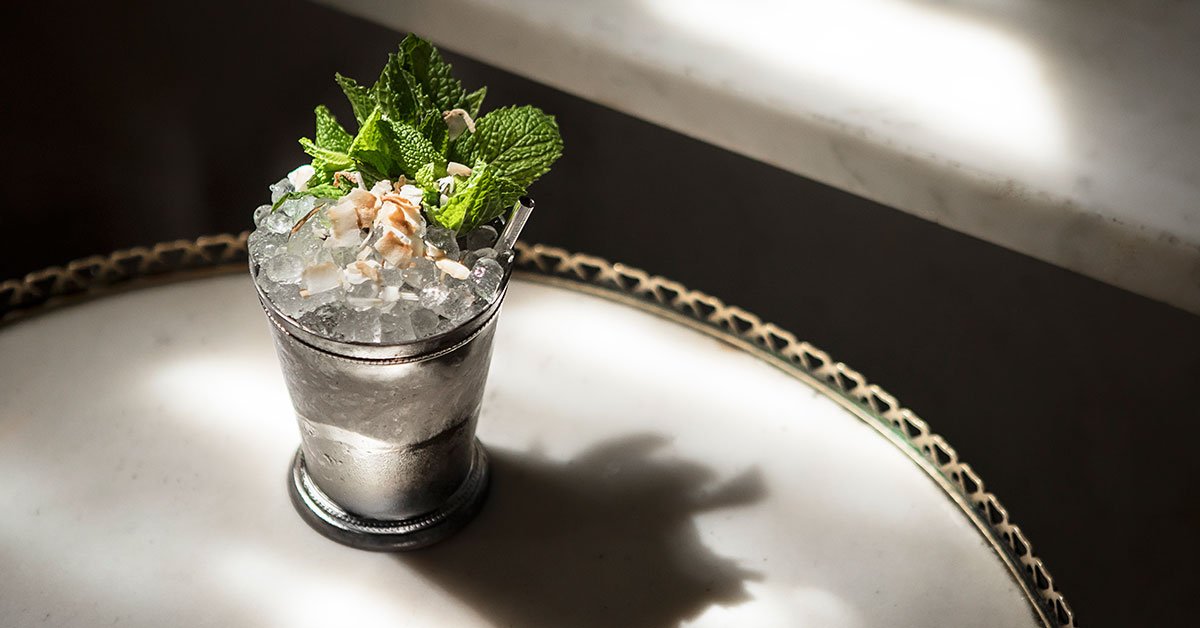
The first true American drink, the julep still wears the crown as the king of summer cocktails, and, in real royal fashion, it typically gets dressed up and paraded around just once a year. Promoted as the official drink of the Kentucky Derby since 1938, it traces its lineage back to well before Churchill Downs adopted the ubiquitous Mint Julep as its drink of choice.
Of all the names for mixed drinks—cocktails, slings, daisies, mules—the word “julep” claims the oldest heritage. Etymologically, it derives from the Persian gulab, a medicinal mixture of violets, water and sugar that traces its history back more than a millennium. Even in the 17th century, when spirits (brandy, rum and gin) were added to the base recipe, the julep was still considered remedial. It wasn’t uncommon for juleps to be prescribed by doctors in attempts to heal ailing patients; created in the 19th century, the Prescription Julep, a classic variation of the drink, nods to these medicinal origins.
In the late 18th century, the julep transformed, perplexingly, into a morning beverage not unlike coffee, designed to help early risers face the day. But it was not until the 1810s, with the advent of the American ice industry, that the julep would become an iconic summertime cocktail. Mint became the drink’s calling card, and several decades later, whiskey would surpass brandy, gin and rum as the base spirit of choice. Still, variations made with other spirits abound, like the Champagne Julep (which calls for Cognac and dry sparkling wine) and the Dabney (which is built on a mix of amari and rum).
Other modern interpretations call for lowering the proof, introducing modifiers like golden pineapple syrup and even mashing up the classic with tropical staples like the swizzle. Its enduring legacy is proof that the 19th-century template continues to be an inspiration, even into the 21st century. Here are some of our favorite takes on the template.



