
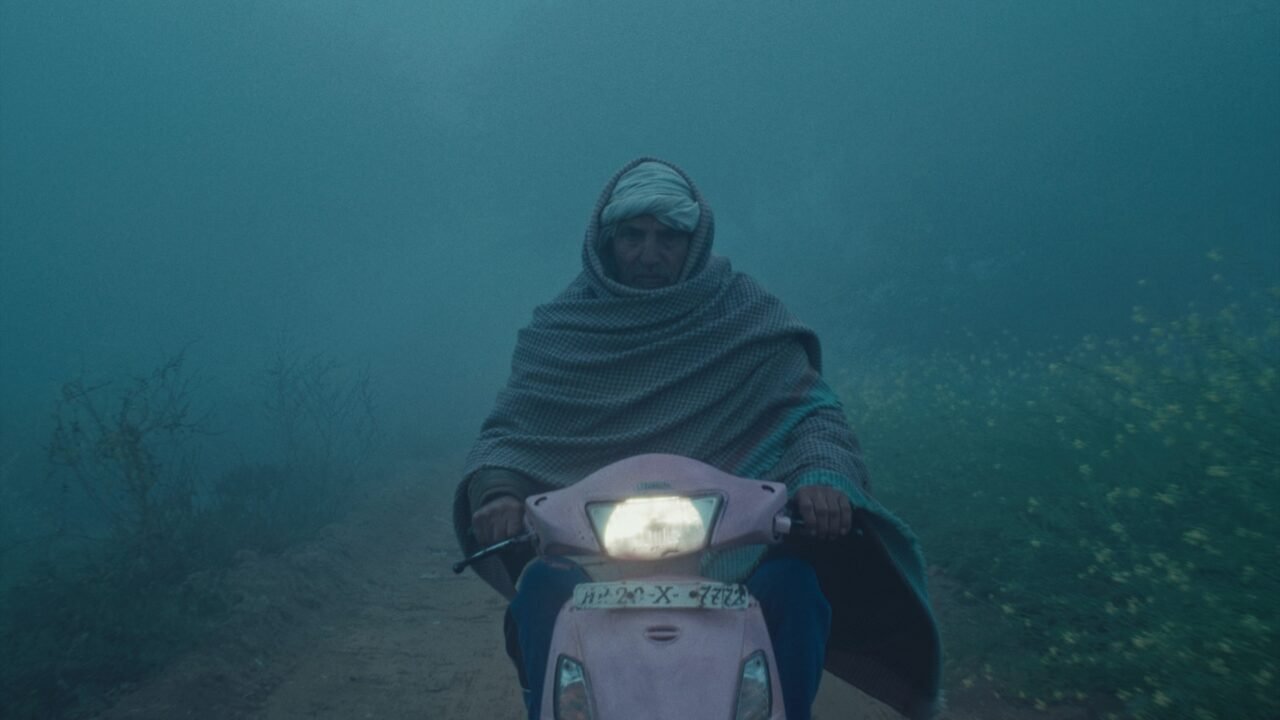
Fog wraps the fields of Haryana, a region in India, setting the stage for a meditative story about grief and modernity catching up with the environment. “Calf Doll” opens with the birth of the eponymous character gone awry. The event sends shockwaves through the life of the professor (Satbir Singh Hooda). Dabbu (Dheeraj Kumar) who helps him in running the farm decides to abandon the project and moves to the city. The young man makes a comeback later in the story when we get to watch TikToks he records after the big move. Despairing protagonist is also faced with the possibility of his current cow not giving milk, with its child lost during the delivery. Satbir, desperate to wrestle something out of fate’s hands, decides to create a doll out of the dead calf to turn his fortunes around. The practice, outlawed in the region, is a clandestine act of grief that film never fully exploits as a layer of tension.
The Calf Doll review is part of the Submit Your Film Initiative
The film’s story is embedded in the social realism tradition, but the poet-director Ankur Hooda attempts to muddy the waters, using simplicity as a starting point in experiments in hybrid filmmaking. Actors play characters based on themselves, or versions of themselves. Genuine story is mixed with improvisation and social commentary becomes entangled with fantasy. However, whilst all of those ingredients sound enticing on paper, the formal machinations are so decontextualised, the film’s crucial interplay of fact and make-believe never fully lands as a legible strategy. Besides, the improvisatory aspect of the film doesn’t lend itself to any scenes that would really explode the “Calf Doll’s” realism. Actors play characters who would normally, in those situations, behave in similar fashion. This therefore begs the question of whether all of these experiments ultimately lead up to anything new or revelatory on screen.
Ankur Hooda’s “Calf Doll” is a documentary blurring the line between candid observational mode and performance. At some point the fourth wall is broken, we hear the protagonist complaining about having to perform whilst going about his daily duties as a farmer. The fact that this is also coming from father to son convolutes the dynamic even more, turning it from an object vs camera dichotomy into a generational clash within which the daily agricultural churn becomes an object of artistic fetishisation. The movie, shown in the same CPH:Dox NEXT:Wave competition, is bent on exploring similar cinematic ideas as “I Heard That They Are Not Going To See Each Other Anymore”, and does that to a similarly confusing effect.
Putting those considerations aside, the documentary finds many clever ways to work ‘in-betweenness’ as a plot point and a stylistic device. The earlier mentioned TikToks recorded by Dabbu serve as intrusions into the meditative, composed (and horizontal) world of Satbir. The calf, whilst dead, comes back in a taxidermied form. The already discussed hybrid form points to the reality’s incompleteness as well. These themes align in the most disturbing scene in which a cow is presented with its calf, now immortalised as a doll. Let’s just say that the facsimile is not a faithful reproduction of the original, perhaps instead being a nightmare fuel for the poor cow.
This is also one of the few striking moments in the film, where the themes of grief (and not letting go) coalesce into a disturbing image. The same trope of grief, however, never quite lands with regards to the protagonist. Satbir’s introspective nature makes for an inaccessible watch, leaving the viewer wondering if they have witnessed a genuine portrait of loss, or merely a poet-son’s attempt to impose a narrative onto a father who just wants to finish his chores.



