
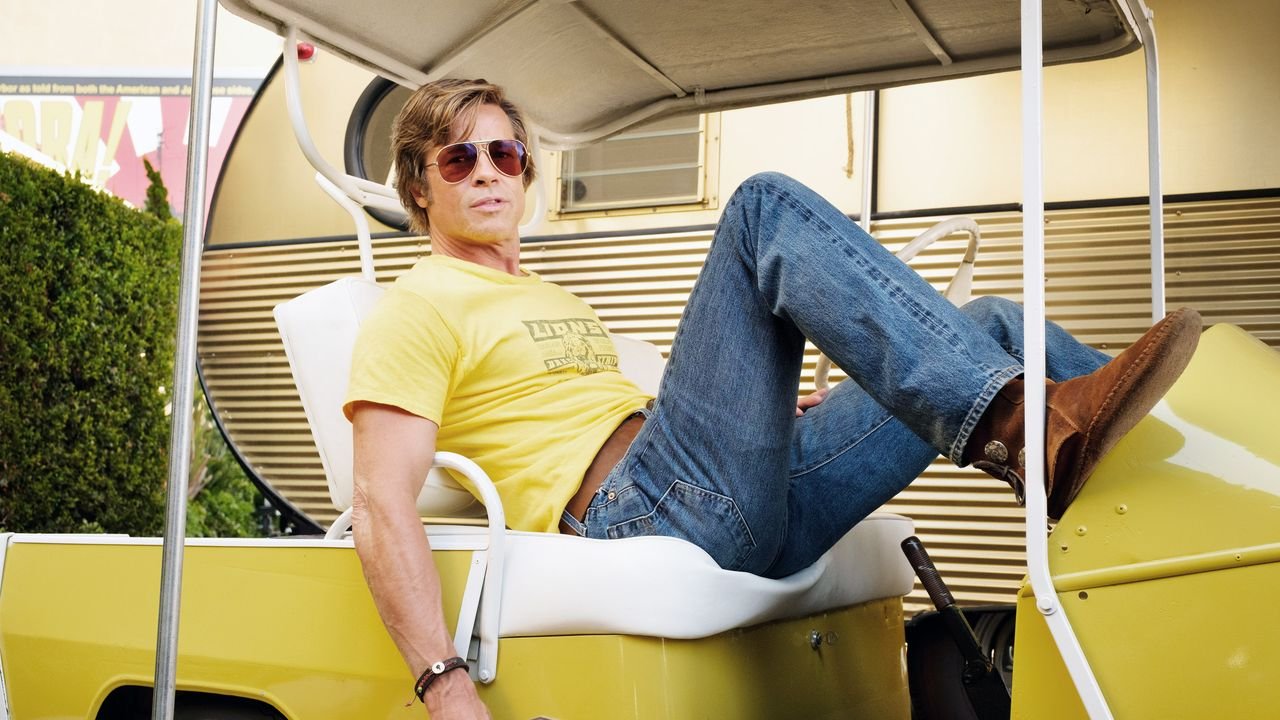
It’s been a year or so since news broke that Brad Pitt would reprise the role of stuntman Cliff Booth in a Once Upon a Time in Hollywood sequel directed by David Fincher, and more than six months since that sequel’s first teaser rolled out during the Super Bowl. Now, at long last, the movie in question has a title: The Further Mis-Adventures of Cliff Booth.
Pitt and Fincher’s fourth team-up, which hits IMAX theaters worldwide for a two-week engagement on November 25 before bowing on Netflix on December 23, is a basically-unprecedented cinematic event: a handoff between two of the best directors of their generation (Fincher is seven months older), with one master stepping in to take the directorial reins of a sequel written by the other. Tarantino reportedly sat next to Fincher on set for most of the shoot (a detail that led some fans to accuse Tarantino of finding a loophole in his stubborn self-imposed 10-film mandate by “shadow directing” the film, and that it will be a Fincher movie in name alone.)
But with some imagination, the project is an intuitive fit that makes sense for both collaborators. It’s not a stretch for Tarantino, who rose up the Hollywood ranks first as both a screenwriter and uncredited script doctor, writing Bonnie-and-Clyde flavored love-on-the-run capers and inserting comic book lore into nuclear submarine thrillers, although it’s been thirty years since he wrote a script he didn’t direct (1996’s neo-exploitation vampire-stripper classic From Dusk Til Dawn.) Tarantino has also always been up for a bizarre experiment, like directing a Mother’s Day episode of Must See TV, a two-part CSI, or his 2007 double feature with Robert Rodriguez.
Lately, in what may be an attempt to stay busy doing literally anything except making his tenth and final movie, he’s penned an homage to mass-market paperback literature with the novelization of OUATIH (published in 2021, several years after the film) and published a collection of movie criticism, Cinema Speculation; he’s suggested that his next project as a writer-director will be a stage play called “The Popinjay Cavalier,” described as a “swashbuckling comedy” set in 1830s Europe. It premieres in London in 2027; Tarantino told an audience at Sundance last year that if “if it’s a smash hit? It might be my last movie.”
The master technician David Fincher, on the other hand, has never fashioned himself as a writer. He never takes credit on screenplays, though he works closely with screenwriters to help shape the narratives for all his films. In the past, he has been best served by taking on writers with strong, distinct voices and editing them to dig out the best, smartest versions of themselves in the scripts they write for him. But in adapting a Tarantino screenplay, he’s taking on the strongest authorial voice of his career—and maybe his greatest challenge.
This is part of what makes The Further Mis-Adventures of Cliff Booth so intriguing. Although they’re very different directors stylistically, they share an affinity for old-Hollywood lore, something Tarantino showcased in the first installment of this series, a movie obsessed with recreating the context of its moment, from its LA streetscapes painstakingly dressed with period-accurate movie billboards from the summer of ‘69 to the crackling diegetic music, ads, and DJ shpiel floating out of cars and radios into the air. “Alfonso Cuaron had Roma and Mexico City, 1970,” Tarantino said at the time. “I had LA and 1969.”



