
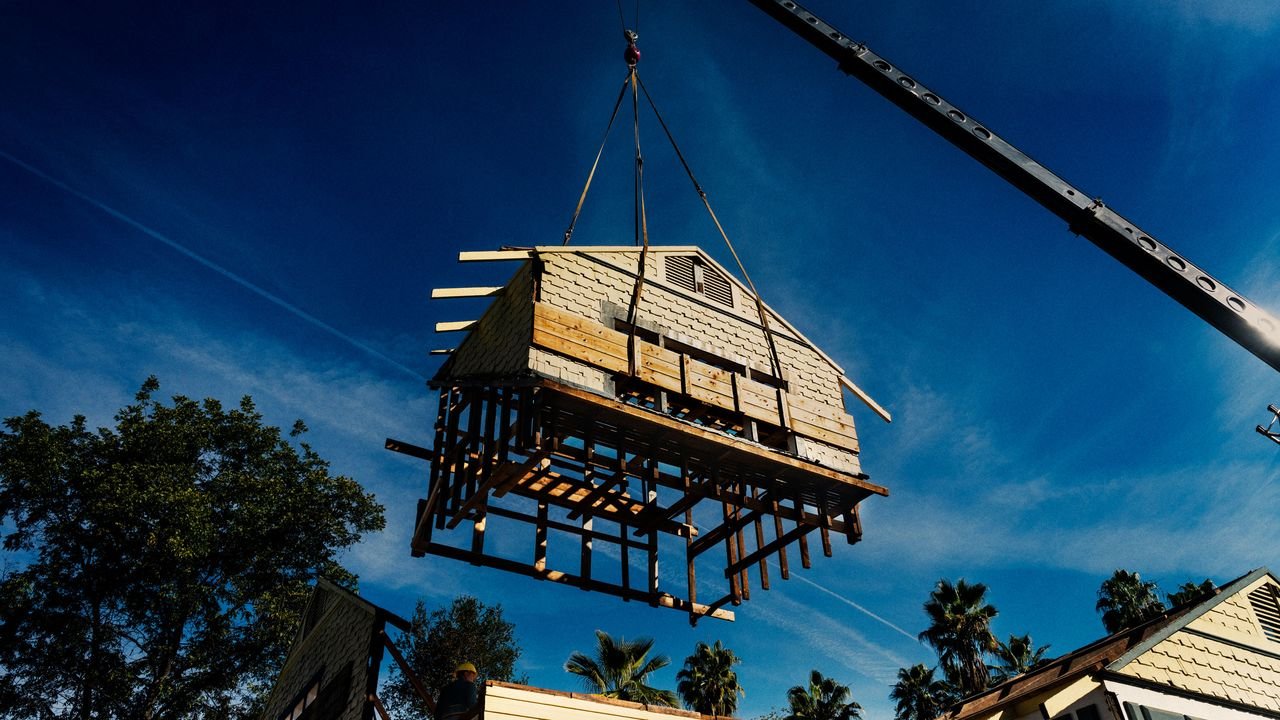
Around the same time, the idea of moving a house suggested itself to Caitlin Chambers, Evan’s wife. Their home had been a lovingly restored 1921 bungalow. “It was already on our radar,” Caitlin told me. “Evan’s dad”—a stonemason—“helped move a house to Porter and East Altadena Drive back in the eighties.” After the fire, Caitlin had been lying in bed one afternoon, scrolling through Instagram, when she saw a post about three historic Craftsman homes on Taft Avenue, which were set to be demolished for an affordable-apartment complex. Without thinking, she replied, “I would love to move these homes to our lot in Altadena.” This comment—made from a horizontal position, half jokingly—was seen by a couple of friends, one of whom connected Caitlin to Jaybush, and the other to a former banker named Brad Chambers (no relation), who’d previously moved a handful of Victorian houses to plots he’d acquired in the Garvanza neighborhood of Los Angeles.
House moving was once routine in America. When the Scottish engineer David Stevenson published an account of his travels in the country, “Sketch of the Civil Engineering of North America,” in 1838, he devoted an entire chapter to the phenomenon. “In consequence of the great value of labour, the Americans adopt, with a view to economy, many mechanical expedients, which, in the eyes of British engineers, seem very extraordinary,” he wrote. “Perhaps the most curious of these, is the operation of moving houses.” Stevenson recounted the journey of a four-story brick house in New York City as it was pushed, in the course of seven hours, nearly fifteen feet back to make way for a newly widened street, supplying the reader with detailed diagrams and an astonished note that the building’s occupants hadn’t taken down their pictures and mirrors beforehand.
But it was Los Angeles, not New York, that became the house-moving capital of the world in the late nineteenth and early twentieth centuries. The wood-framed houses common in the city sit less heavily on the land than the masonry and brick of the East Coast; they’re easier to lift off their foundations and more flexible in motion. Before trucks, freeways, and shipping containers—and before L.A., a city without a natural harbor, constructed a port—building materials were also hard to come by. “When you had those, you didn’t waste them,” Brad Chambers said. “But what was plentiful was land.”
So were people. The population of L.A. grew from around six thousand residents, in 1870, to more than a million by 1930. “It was doubling every decade,” Rodney Kemerer, a real-estate investor, told me. Kemerer became the unofficial archivist of Los Angeles’s king of house moving, George Kress, after buying Kress’s former home. Kress learned the trade in Pittsburgh and went West in 1913. “He saw the opportunity,” Kemerer said. “The city was expanding so rapidly that people could not keep up with it.”
As business districts spread, lots that had been zoned for single-family homes were reclassified for commercial use. “People found themselves sitting on very valuable dirt,” Kemerer said; they could sell their land, pay for house moving, and still pocket a tidy profit. Meanwhile, as cars replaced horses, streets had to be widened, and several of the city’s many inconvenient hills were flattened—some houses were demolished, but plenty were simply rolled out of the way. Kemerer estimates that Kress moved roughly two hundred and fifty structures a year through the nineteen-twenties, and he was just one of many names in the business. “There were others, but if you had money, or if you had a difficult move, you went to him,” Kemerer said.
In his prime, Kress was a kind of P. T. Barnum figure, dazzling the city with his ambition and showmanship. He moved greenhouses without breaking a pane, entire high schools in one piece, and office buildings while workers remained at their desks. In 1924, his clients hosted a party—with the mayor in attendance—inside a nine-bedroom Queen Anne-style building while Kress moved it more than two miles west, on Wilshire Boulevard, from the newly commercial neighborhood of Westlake to the upscale Windsor Square. The same year, he used horses to haul the Alhambra Hotel—six stories and around eleven thousand tons of steel and concrete—up Broadway, to make way for the city’s new Hall of Justice.



