
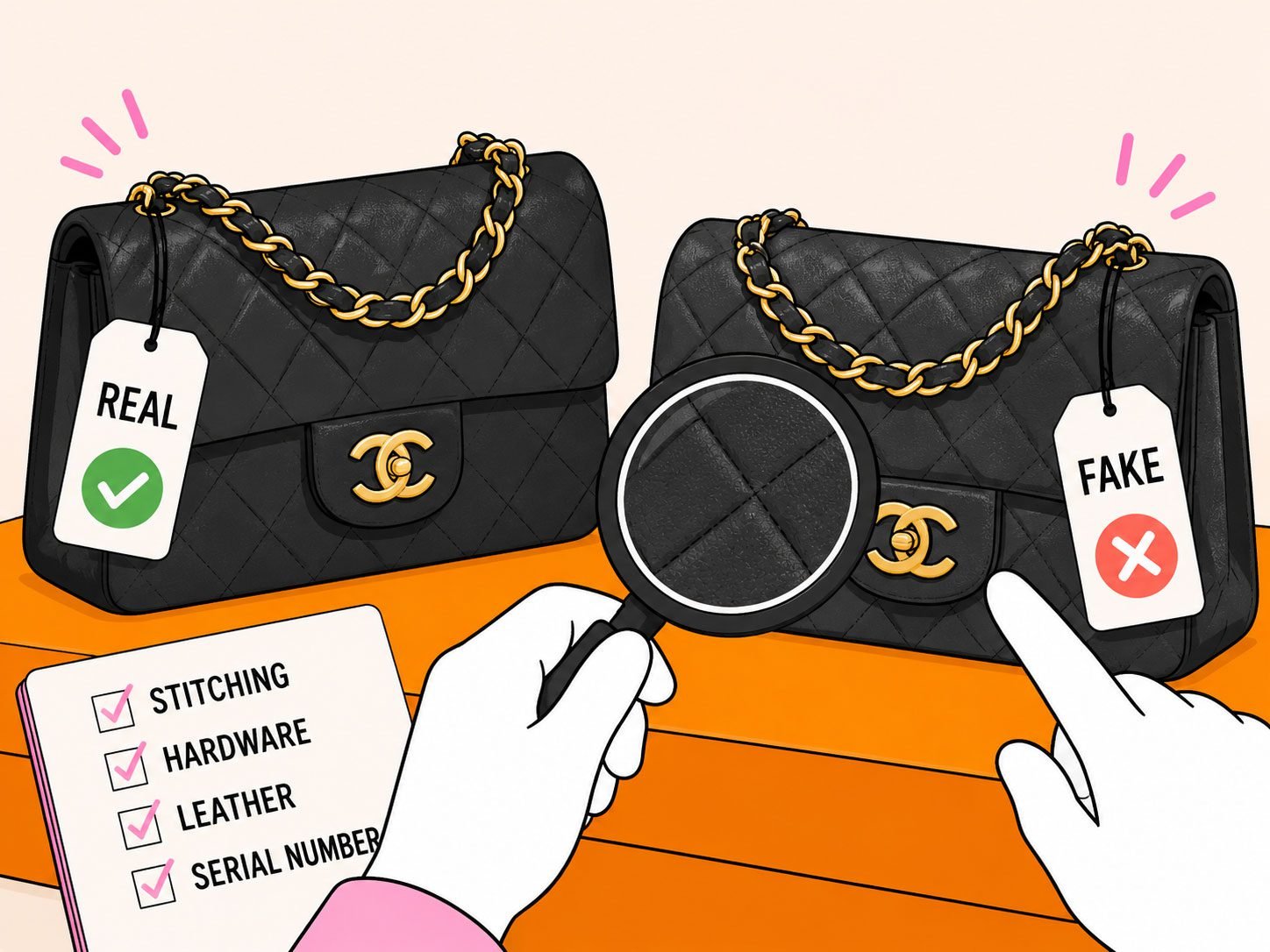
The rising cost of designer bags has become one of fashion’s most reliably covered stories. The Chanel Classic Flap, which retailed for just over $5,000 in 2017, now costs $11,700 in 2026 – a 134% price increase in nine years.
It’s not just Chanel, though: between 2019 and 2024, the price of Prada’s Galleria Saffiano bag increased by 111%, Louis Vuitton’s Speedy 30 by 100% and Gucci’s GG Marmont by 75%. For context: U.S. inflation over that same period was 22%, which means that brands aren’t just passing along costs but engineering exclusivity.
The Rise of Superfakes: When Counterfeits Fool Even the Experts
It should come as no surprise, then, that a parallel market has exploded alongside the business of luxury brand bags. In 2024 alone, U.S. Customs and Border Protection seized over $380 million worth of counterfeit handbags, wallets and accessories… and that is just what was caught.
Counterfeit handbags now account for nearly 30% of all global counterfeit goods seizures. Whether shoppers are knowingly buying fakes or getting fooled, the emergence of high-quality “superfakes,” which are bags that closely mimic stitching, hardware and even serial numbers, has made authentication increasingly difficult even for seasoned buyers.
The internet has turned the whole dynamic into a spectator sport. Across TikTok, Reddit and other social media platforms, entire communities have formed around spotting fakes and, just as often, celebrating them. There are accounts devoted to exposing counterfeits, viral videos of people discovering mid-wear that their bag isn’t quite what they paid for and an equally enthusiastic contingent who bought their fake deliberately and couldn’t care less. It’s this last group that’s shifted something culturally: the dupe is no longer just a knock-off. For many shoppers, it’s a choice.
How Authenticators Spot a Fake Designer Bag
Which raises the question of how anyone, proud dupe buyer or otherwise, is supposed to know what they’re actually holding.
Although there are a variety of ways to spot fakes, many involving relatively new technology and highly dependent on the brand in question, most authenticators seem to rely, at least at first impact, on their own senses.
Demetra Arvanitis, founder of a Chicago-based luxury consignment and resale business, says that she “listens” to Louis Vuitton bags: the genuine canvas makes a soft, cloth-like sound when bent, while fakes tend toward something crackly, almost like cardboard. Arvanitis also smells the products, checks the weight of hardware, which should feel definitively metal, and looks at the gold tone: vintage Chanel pieces were plated in 24-karat gold, for example, which produces a true, warm gold color. Counterfeits, she says, tend to run orange.
“The color of the hardware is a dead giveaway,” she says. “And the texture of the leather, to the feel and to the touch. Plasticky bags, when they wear over time, will crack and break. But leather will tear and crease, and that’s natural.”
For more complex cases, she reaches for technology.
She uses an Entrupy scanner, a high-resolution device that captures between ten and fifty images of a bag and runs them through AI trained on proprietary brand data. “It’s looking for errors in the pattern, in the weave, in the stitching,” says the pro. At that level of magnification, even the depth of a stamped letter becomes evidence: how far the imprint goes into the leather, for example, or whether the incision matches what an authentic die would produce. “Even if one thing looks off, the system won’t authenticate,” she explains.
Andrew Brown, who runs a luxury resale operation focused on Hermès, Chanel and Louis Vuitton and has been in the business since 2012, takes a more analog approach.
His team uses loupes, blacklights, mirrors and flashlights. “You can be sure a human has looked at your bag,” he says. For Hermès specifically, he focuses on the saddle stitch: hand-stitched, which can take up to sixteen hours per bag, and flipped upward rather than running straight across. “If you see something that looks low quality, it’s a good guess that you’re probably looking at a counterfeit,” he claims.
Serial Numbers, Microchips and Blockchain: The New Authentication Frontier
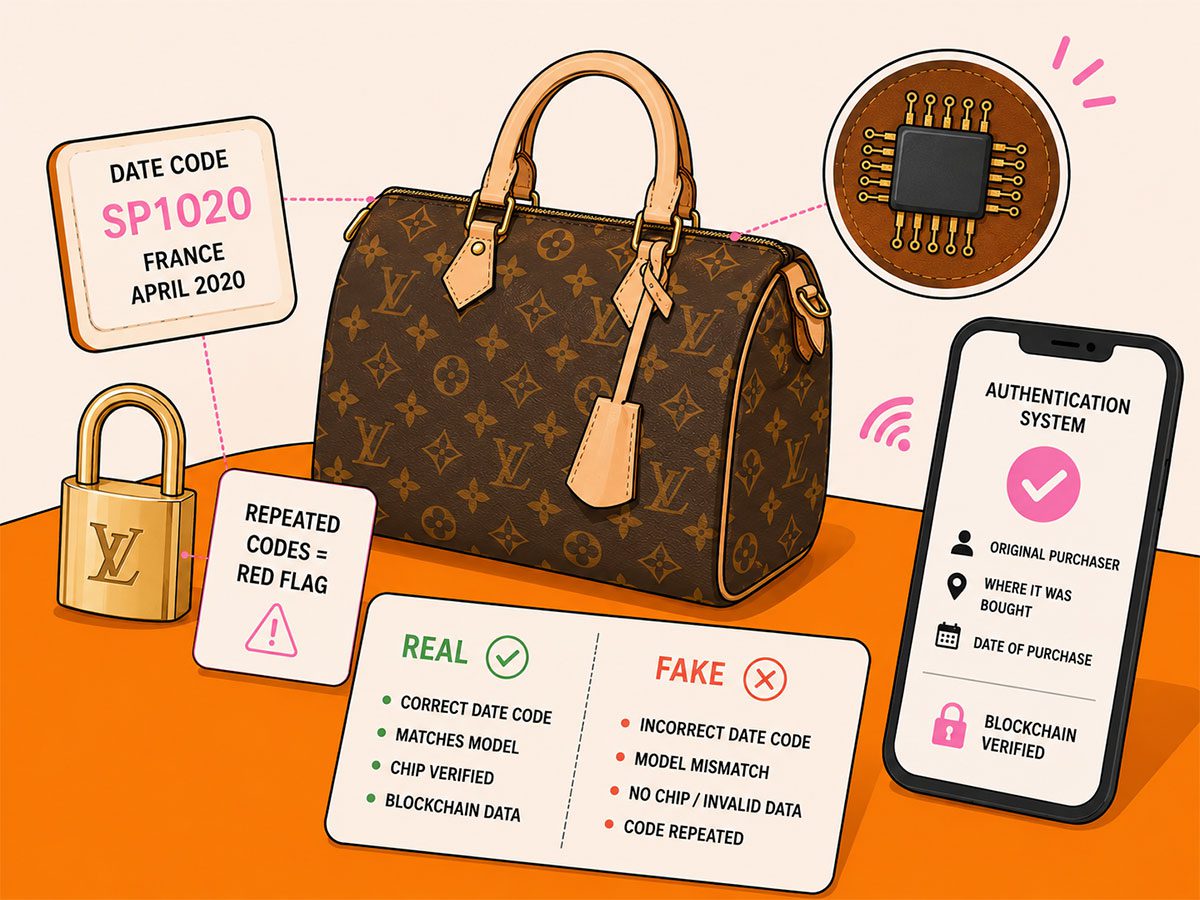
Serial numbers are another checkpoint, with significant caveats. Louis Vuitton, prior to switching to embedded chips in 2023, used date codes that could be cross-referenced online to determine country of manufacture, month and year.
A bag claiming to be from France in April 2000 but carrying a silhouette that wasn’t released until 2018 is an immediate red flag, for example.
For you to know: counterfeiters frequently duplicate the same date codes across large production runs, which eventually causes those codes to get flagged. “A lot of the times counterfeiters will manufacture the same number on that lock,” says Arvanitis. That means that a Hermès lock stamped “111” has become, in certain circles, its own tell.
Luxury houses have been slow to enlist the resale market as an ally, but they have been aggressive in developing their own authentication infrastructure. The shift has moved largely toward microchips and blockchain.
Brown has seen this firsthand. “Chanel and Louis Vuitton have replaced serial stickers with microchips,” he says. “It’s blockchain-based and they have their own proprietary system that allows them to scan the item and see everything about it: who the original purchaser is, where it was bought.”
A chip that returns no or inconsistent data is a counterfeit. His team can read the chips, enough to verify that the chip belongs to the correct brand, but not with the depth of access the brands themselves have. “You would think that the brands would assist resale companies to keep fakes off the street,” he says. “But they don’t, unfortunately.”
How Chanel, Louis Vuitton and Hermès Are Fighting Back Against Fakes
Versace has taken a more consumer-facing approach: customers can hold a phone to the bag, which triggers a chip detection prompt and entering the interior serial number will pull up the bag’s production date and release information. Arvanitis also notes that Patou, owned by LVMH, has rolled out similar technology, and that Chanel is developing its own proprietary version.
Hermès operates differently.
The brand doesn’t offer public authentication services but bring a Hermès bag in for cleaning or leather conditioning and the store will quietly pull the product code and cross-reference it against the bag’s hardware, leather texture and history. If anything doesn’t match, the bag doesn’t get serviced… and the owner goes home knowing something they may not have wanted to know.
The posture, across brands, is essentially fortress architecture: they’re building systems that make fakes easier to detect without publishing the rulebook. “It’s a race for technology,” Arvanitis says. “Who is going to put more money into it: the counterfeiters or the brands?”
The Dupe Buyer Who Paints Over Counterfeits… and Doesn’t Apologize
Not everyone who ends up carrying a fake went looking for one.
A 42-year-old professional from Miami who asked to remain anonymous has spent years buying authenticated vintage Chanel. When a woman who was relocating abroad offered her a batch of donations to give out, she spotted a Louis Vuitton Alma in the pile and nearly set it aside for Dress for Success, a nonprofit that provides professional attire to women entering the workforce.
Something stopped her, though. As she recalls it, the trim didn’t look right and the leather felt off. She’d handled enough authenticated bags to feel the dissonance, even if she couldn’t name it precisely. “I paused,” she says. “I put the other donations together, kept the bag aside.”
She couldn’t reach the woman who had given it to her and she couldn’t bring herself to pass it along. “Even if I only suspected that it was a fake I didn’t think it was ethical to give it to someone,” she says. “If I’m perpetuating this, I’m not fixing a problem. I’m just having someone else carry a bag that they may or may not know is fake.”
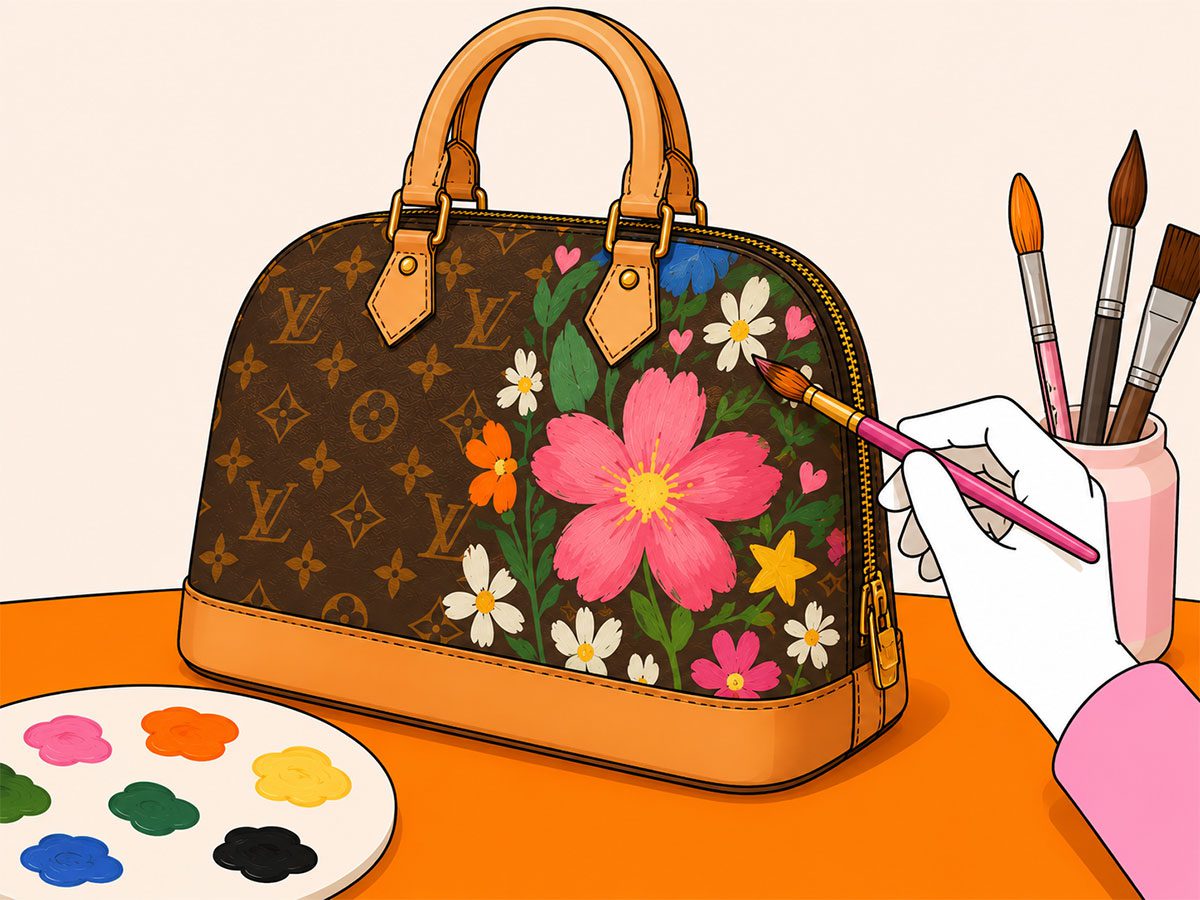
So she submitted photos to an online authentication service that confirmed her intuition. The bag was a fake. She decided to keep the bag and, as seen on Instagram, paint it with original designs.
“It’s not real,” she says, “so I felt okay drawing on it.” If anyone asks, she’ll tell them it’s fake, which she figures the painted-over canvas will make self-evident.
Is the Designer Dupe Era Here to Stay?
The cultural moment she’s navigating is one that Brown, the authenticator, sees every day from the other side of the transaction.
“There are whole communities online dedicated to buying replicas,” he says. “They share their factory sellers, show pictures of the real versus the one they got, and there are a lot of ‘ooh’ and ‘ahh’ in the comments. There is a lot of shamelessness around it.”
The Miami buyer has her own theory about where this lands. “I think it’s the pendulum effect,” she says. “We’re in the era of the fake, partly because of our economic situation and partly because people are moving toward making brand prestige less important,” she posits before stating that the swing back will come eventually.
Arvanitis is less certain the trajectory reverses. The trend and fashion cycle is moving faster than it ever has, she says: in the last five months alone, the Balenciaga City, certain Chloé styles and a handful of other bags have cycled back as “it” items. “Everyone is scrambling to get the new ‘it’ bag,” she says. “I think we’re just going to continue seeing this become a problem.”
The bags themselves, real or otherwise, are lasting longer than the moment that made them desirable. The question of what any of them are actually worth—in dollars, in status, in what they say about the person carrying them—is one the market is still trying to price.



