
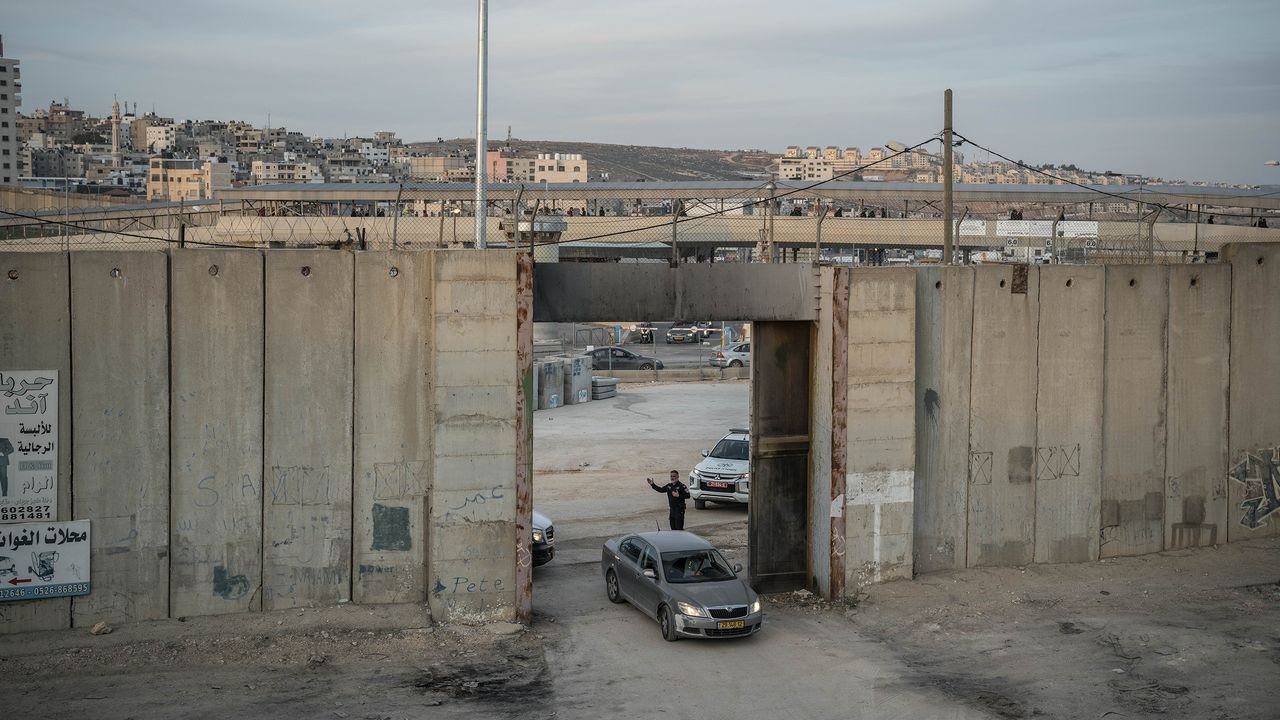
The framework that currently governs Palestinian workers in Israel dates to 1994, when Israeli and Palestinian officials agreed to the Paris Protocol of the Oslo Accords. The protocol established that the Israeli shekel would be the currency of the Palestinian economy, and that Israel would control borders, trade, tax transfers, and work permits. Walid Habbas, a researcher at the Palestinian Forum for Israeli Studies (MADAR), argued that Israeli policies made Palestinians dependent on Israel, and that work permits always functioned as a “mechanism of control.” Earnings from Israel made up nearly a quarter of the West Bank’s gross domestic product, generating income for households, local markets, and the government’s tax base.
Raead, a contractor from Tarqumiyah, erected high-rise buildings in Israel for twelve years. “We built Tel Aviv,” he told me proudly. His house has polished stone floors and a central courtyard; photographs of his father, the owner of a major construction company, were displayed in every room. Families like his used to lend support to relatives and neighbors; they paid when others couldn’t. Now, he told me, he was two hundred thousand dollars in debt. Palestinians are liquidating their possessions, he said—cars, furniture, jewelry, even land meant to be passed down to children. “When people are desperate, they sell,” he told me.
Some Palestinians have decided that they can no longer wait for new opportunities. Ashraf, who studied media at Hebron University and then found construction work in Israel, ran out of money after about eight months of unemployment. He kept hearing about men who were entering Israel without permits, for cash work in construction or agriculture. He began to weigh the possibility of getting hurt while sneaking across the border against the certainty of going hungry at home. He showed me a video of a man who was shot near the border wall, his lower leg soaked in blood. But another video showed Palestinians successfully using ropes to climb over the wall and disappear into Israel.
Ashraf runs a popular TikTok account that focusses on the lives of workers. In one video, he greets viewers from the fiftieth floor of a construction site in Tel Aviv. “Good morning to all the workers,” he says. In our conversation, he criticized the Israeli work ban as a form of collective punishment. He is particularly troubled by the Hebrew term Shabach, a portmanteau for “illegal resident” that has connotations of criminality. “I’m not coming to hurt anyone,” he told me. “I’m coming to work.”
I started my reporting in late 2025, shortly after Israel and Hamas agreed to a ceasefire in Gaza. By then, more than seventy thousand Palestinians had been killed, and where I live, in the Netherlands, the war in Gaza was widely discussed as a genocide. The workers I met in the West Bank, in contrast, did not seem eager to talk about the political situation. They seldom brought up the subject of Gaza, expressed little interest in political factions, and focussed on practical concerns: work, income, survival. They expressed anger at Israel for the work ban and frustration with the Palestinian Authority for failing to mitigate it. Some blamed Hamas for destroying years of hard-won economic security.
Then there are the workers who used to cross into Israel from Gaza. After October 7th, thousands were rounded up, bused to Ramallah, and dispersed across West Bank cities. In Ariha (Jericho), a low-lying, sun-struck town on the edge of the desert, four hundred and eighty Gazans have spent two years of limbo in a military base operated by the Palestinian Authority Security Forces. On my way there, I passed villas with pools, encampments where displaced persons lived, and government compounds. I paid a visit to Ariha’s governor, Hussein Hamayel, who said that the Palestinian Authority lacked the resources to help those affected by the work ban. He said that the West Bank was under a “financial siege.” Israel has withheld tax revenues that it collects on the P.A.’s behalf, a major source of the P.A.’s budget, and the government struggles to pay its own employees.



