
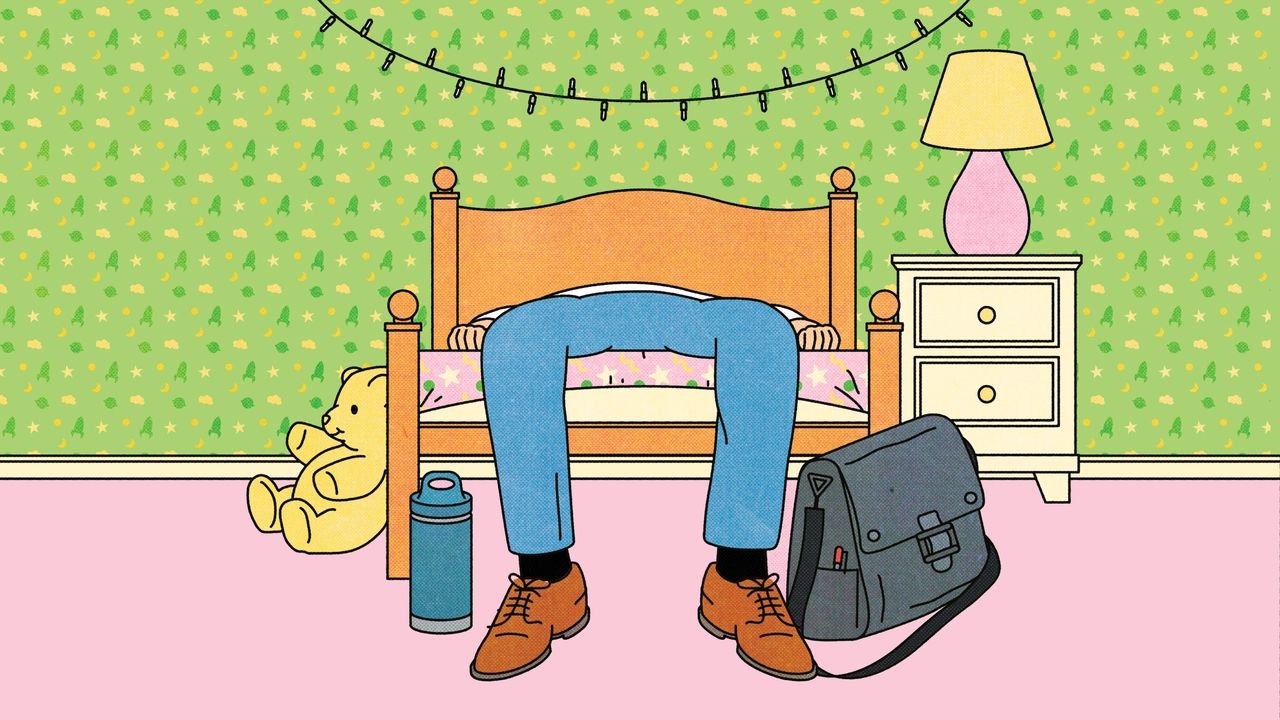
My point is, it’s difficult to come to any strong conclusions from these various reports. The SHED study shows a significant post-pandemic increase in “adults under age thirty” who live with their parents, but the census numbers don’t quite show the same spike, especially when it comes to twenty-five-to-thirty-four-year-olds, who, let’s be honest, should be the young people we’re most concerned about getting out of the house. (In 2019, 20.4 per cent of men and 13.1 per cent of women between the ages of twenty-five and thirty-four lived with a parent. In 2025, those numbers were 19.2 per cent and 13.6 per cent, respectively.) While there is a way to squint and make the numbers I’ve mentioned look like a narrative about arrested development, in reality, the only conclusion we can draw is that there has been a steady increase in young people living at home over the past twenty-five years, but it is likely not so drastic that we all have to start saving up for A.D.U.s to house our adult kids because the rent is too damn high or their college degrees are too worthless or because A.I. has taken everyone’s jobs.
So, what about the economy? Isn’t this shift just a product of high rents, low wages, and the unaffordable cost of living in the cities where young, enterprising people flock to start their careers? The data there is similarly hard to parse. Some expensive metropolitan areas, such as Los Angeles and Miami, have relatively high rates of young people living at home, but others, such as San Jose, Seattle, Austin, and Denver, do not. Instead, much of the longer-term shift toward staying at home likely comes from baked-in cultural and demographic trends. A Pew analysis of the census data found that there wasn’t necessarily a link between the price of rent and the percentage of young people who lived at home; other studies, from the Urban Institute and the Treasury Department, have shown some correlation between rising rents and more young adults staying at home, but their stated effect is ultimately mild when compared to racial and ethnic demographics. According to the Pew report, three of the country’s metro areas with the highest percentage of twenty-five-to-thirty-four-year-olds living at home were in California (Vallejo, Oxnard-Thousand Oaks-Ventura, and El Centro), while the fourth was Brownsville-Harlingen, in Texas. One characteristic these four places have in common is that they are highly diverse. Places with large Latino, Asian, and Black populations have markedly higher rates of intergenerational living than places that are mostly white. As the country has slowly become less white over the past sixty years, and as immigrants routinely have more kids and grandkids than native-born Americans, their preferred living arrangements seem to have had some effect on what others might see as the nation’s dilettante index.
The decline in leaving the nest is also often attributed to lower rates of marriage and cohabitation, an argument which, accurately enough, points out that young people used to leave the house because they fell in love, got married, and started their own family. Now that people start that whole process later in life, if at all, some of them are, understandably, just sticking around at their parents’ house until they find somebody.
Still, there doesn’t really seem to be some fresh crisis about young people never leaving home. Yes, people are getting married later in life, and that does lead to more young adults staying with their parents. Yes, there are more Asian and Latino families in America than there were in 1980. But we kind of knew that already, didn’t we?
I mention all this because so many comments about young adults seem to suffer from the same melodrama. When it comes to living at home after college, what seems to have happened, at least when it comes to the breathless media coverage, is that pundits saw a rising number and assumed the margin must stem from some sort of societal decline. In reality, most young people are likely doing O.K., even if some of them are still living at home. But it’s also likely that they’re not doing quite as well as they had hoped, especially when it comes to the cultural markers of financial independence and asset accumulation—these things, in America, revolve around buying a home. Or, in the case of an increasing number of people who graduate from college, they might be making a decent wage, but in a job that wasn’t exactly what they thought they’d be doing after graduation, like a barista or an S.A.T. tutor.



