
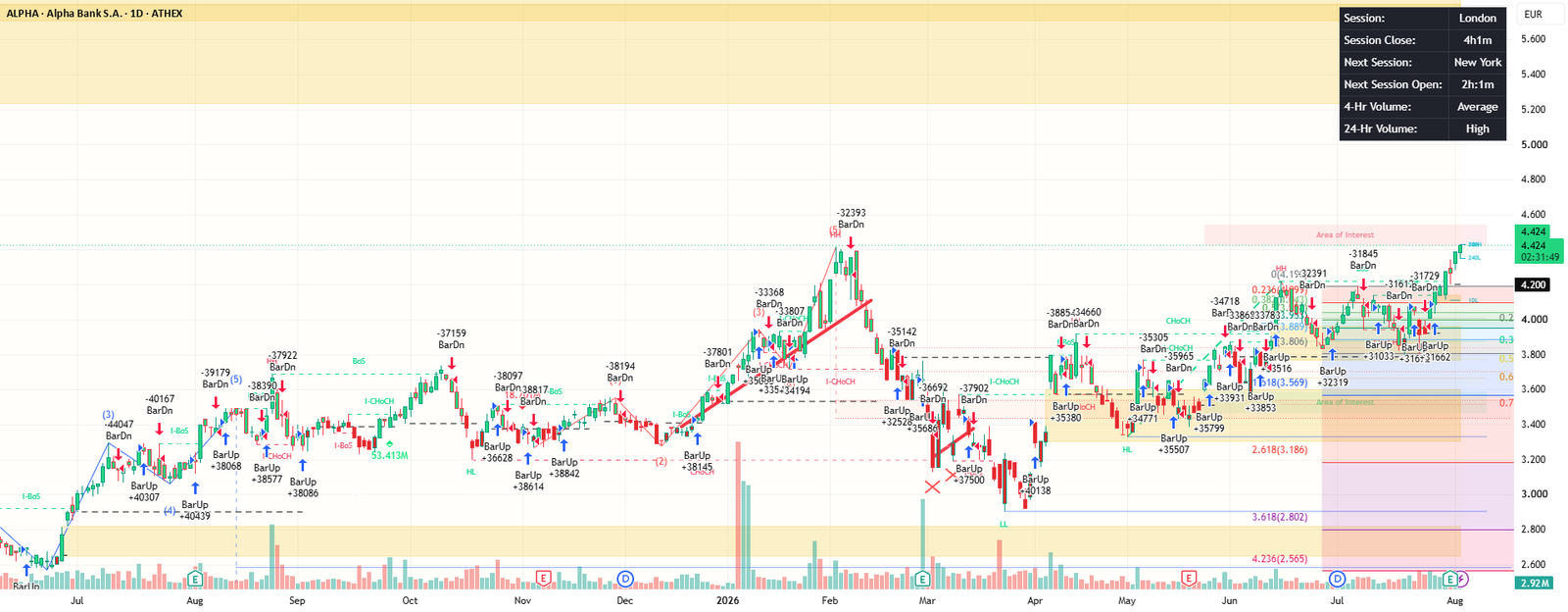
Working backwards from the performance columns, the stock opened the year around €3.58, sat near €4.07 a month ago and €4.17 a week ago. The entire weekly move therefore came after the 31 July results, which tells you the market is repricing on new information rather than drifting. The €4.17–4.20 zone was the pre-results ceiling and has been broken on volume; on a conventional reading it converts to first support. Below that, €4.07 is the base of the last month and its loss would invalidate the setup. Above, the first meaningful marker is €4.49 — the level at which Alpha trades level with Eurobank in absolute terms, which matters psychologically in a market where retail investors anchor on nominal price. The Alpha/Piraeus ratio has fallen roughly 16% since January, from 0.527 to 0.443, and the past week is the first genuine recovery in that ratio all year.
The reason the technical picture matters is that the valuation gap behind it has not closed. Tangible net asset value came in at €7.8bn at the half year, which puts the stock at roughly 1.28x P/TBV. Eurobank Equities had it at 1.17x in June against approximately 1.5x for the other three systemics, and even after the rally the discount remains double-digit. What makes that hard to defend is the return profile: Alpha posted a 15.5% return on tangible equity in the second quarter against 15.6% for National Bank. Essentially identical profitability, materially different multiple. On earnings the picture is the same — with guidance revised up to €0.41 EPS from €0.40, the stock trades on about 10.8x 2026 earnings for a 9.5% earnings yield. Closing the gap to 1.40x implies €4.84; closing it to the peer 1.5x implies €5.18, or roughly 17% upside.
The results themselves were not a marginal beat. Adjusted profits came in at €275m, 17% above consensus, while reported net profit exceeded forecasts by around 30% — the largest surprise in the sector. Half-year net profit reached €497.2m. Fee income rose 34% year on year, or 24% on a comparable basis, with AXIA advising on more than €10bn of transactions in six months. Loans grew 4% in the quarter and 12% year on year, the strongest credit expansion of the four, which is difficult to reconcile with a narrative of structural underperformance. Cost/income ran at 38%, cost of risk at 39bps, NPEs at 3.6% and CET1 at 14.3%. Management booked a €273m distribution provision for the half and intends to pay an interim dividend of roughly €124m in Q4, alongside a buyback programme of up to 205m shares — close to 9% of the share count — launched on 31 July.
Then there is the index event. Greece enters FTSE Russell’s developed market indices at the September 2026 review, with STOXX applying the change to its main European indices on the same date and MSCI following in May 2027. The banking sector is regarded as the primary recipient of the associated flows given its heavy weighting in international indices. Passive money buys on capitalisation and free float, not on local sentiment, so Alpha’s smaller size means less absolute passive demand than its peers. But for the active developed-market managers who arrive afterwards, the comparison set changes entirely — a Greek bank earning 15.5% on tangible equity at 1.28x book stops being measured against three domestic peers and starts being measured against southern European banking, where the discount is wider still. The UniCredit partnership moving into implementation and the persistent M&A optionality sit on top of that and appear nowhere in the multiple.
None of which makes the discount a gift. Alpha runs the thinnest capital buffer of the four at 14.3% CET1 against National’s 17.3%, asset quality remains the weak link with NPEs at 3.6% versus 2.4%, and the 2.16% net interest margin is structurally below Eurobank’s 2.48%. The quarter also contained a €39.6m PRODEA dividend inside the fee line, which is not recurring. And JP Morgan’s target price of €4.40 sits fractionally below the current market — consensus has not yet caught up to the second-quarter print, but nor is it treating it as a break in trend. The argument is not that Alpha deserves Eurobank’s multiple. It is that the RoTE gap to peers has narrowed from six points in 2024 to under three today while the valuation has not travelled the same distance, and the tape of the last four weeks suggests the market has finally started to notice.



