
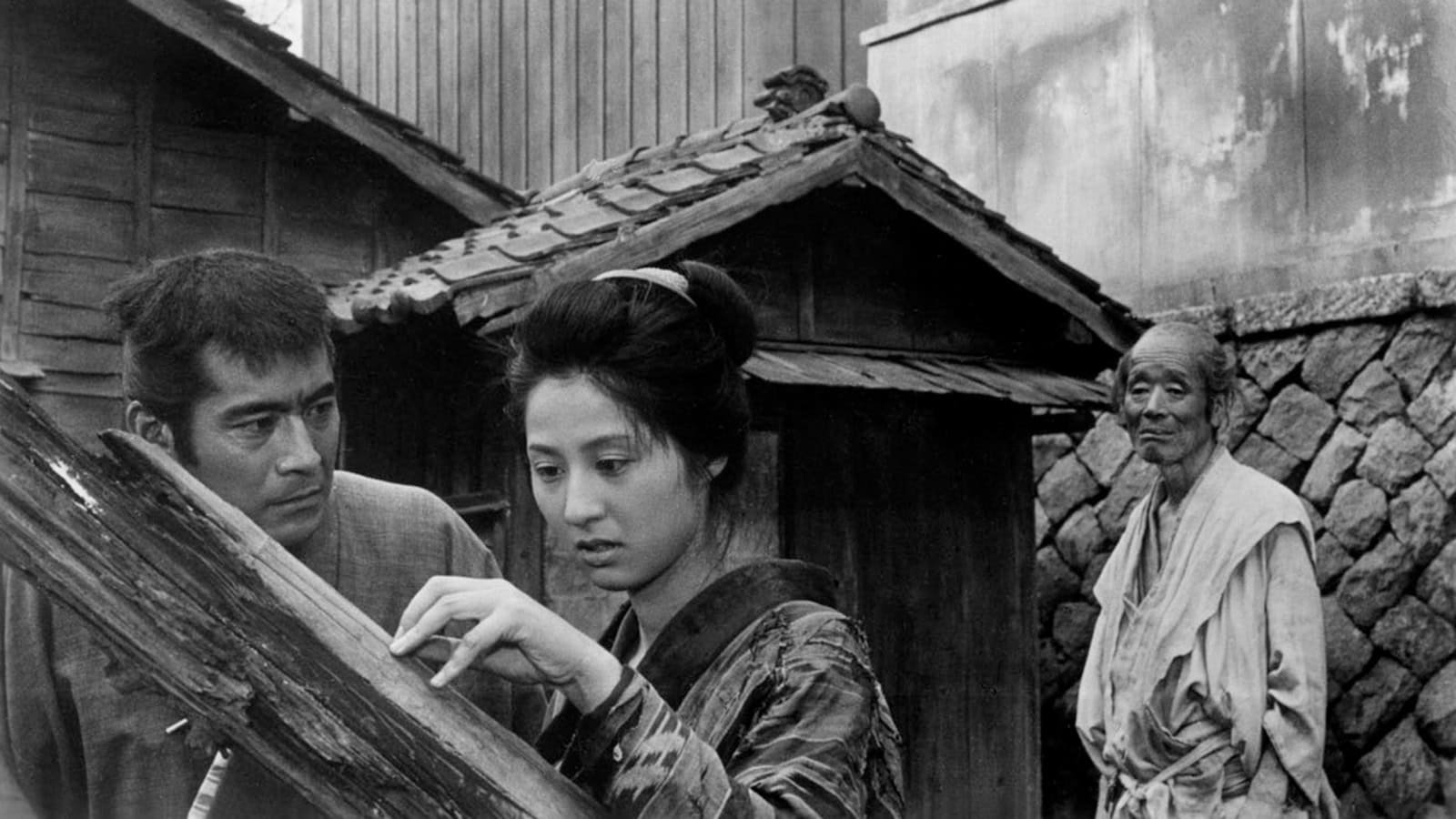
“The Lower Depths” is another, alongside “The Idiot” (1951), adaptation of Russian work by Akira Kurosawa, although this one is a bit less pessimistic. Based on a 1902 play by Maxim Gorky, the film was awarded a few times, including for Best Art Direction at the Mainichi Film Concours, and was ranked number 36 on the list of the greatest Japanese pictures of all time by the magazine Kinema Junpo in 2009.
Written by the director and Hideo Oguni, the story takes place in a grimy tenement where a landlord (Ganjiro Nakamura) and his wife (Isuzu Yamada) rent out small rooms to poor souls trying to survive. Among them are a thief (Toshiro Mifune) who is involved with the landlord’s wife but is more interested in her sister (Kyoko Kagawa), a gambler (Koji Mitsui), a samurai (Minoru Chiaki), and a former actor (Kamatari Fujiwara). One day, a pilgrim named Kahei (Bokuzen Hidari) arrives and causes quite a stir in their whole social structure.
When the original play was first shown, it was criticized for being too dark and lacking a clear moral message, but later became known as an important work of Russian social realism. Similarly, the movie adaptation was initially met with scepticism, but later gained recognition. Kurosawa moved the story from Russia to Japan during the Edo period, which emerged from the chaos of the previous one, called the Sengoku period, when military conflicts took place regularly. Even though the setting is bleak, the film includes a good amount of humour, verging on nihilism and absurdism, as some characters accept their situation and joke about it, showing how to cope with hardship.
Keeping a theatrical feeling, the cinematography by Ichio Yamazaki is well-planned and static, helping the audience focus on the story rather than visuals. Most of the film takes place inside cramped living quarters, which adds to the sense of confinement, many might feel in times of uncertainty.
The whole cast delivers rather expressive performances that highlight wit and vitality of the human spirit, as the characters spend their time talking, arguing, but also supporting each other. Despite the static setting, the story is relatively dynamic thanks to the large number of diverse individuals. Especially memorable are the performances of Toshiro Mifune, Isuzu Yamada, and Koji Mitsui, all of which were rewarded for their effort.
Although the narrative is set in the past, it reflected the reality of many people in the 1950s Japan, who had experienced serious suffering during the Great Depression, the Pacific War, as well as the Allied occupation of Japan. Hence, there is a certain parallel between the Edo-Sengoku relation as tackled in the film – in reality, after years of military rule and aggressive politics, Japan was disarmed, its form of government changed to a democracy, while its economy and education system was reorganized. All of this helped Japan become a global economic power.
Sad and gloomy, but also unexpectedly funny, “The Lower Depths” shows the harshness of life along with moments of personal resilience, underlining Kurosawa’s ability to aptly analyse society and present human nature. After 124 minutes, the audience might leave with a thought, that if reality is cruel, at least one can laugh about it, which might make existence less terrible.



