
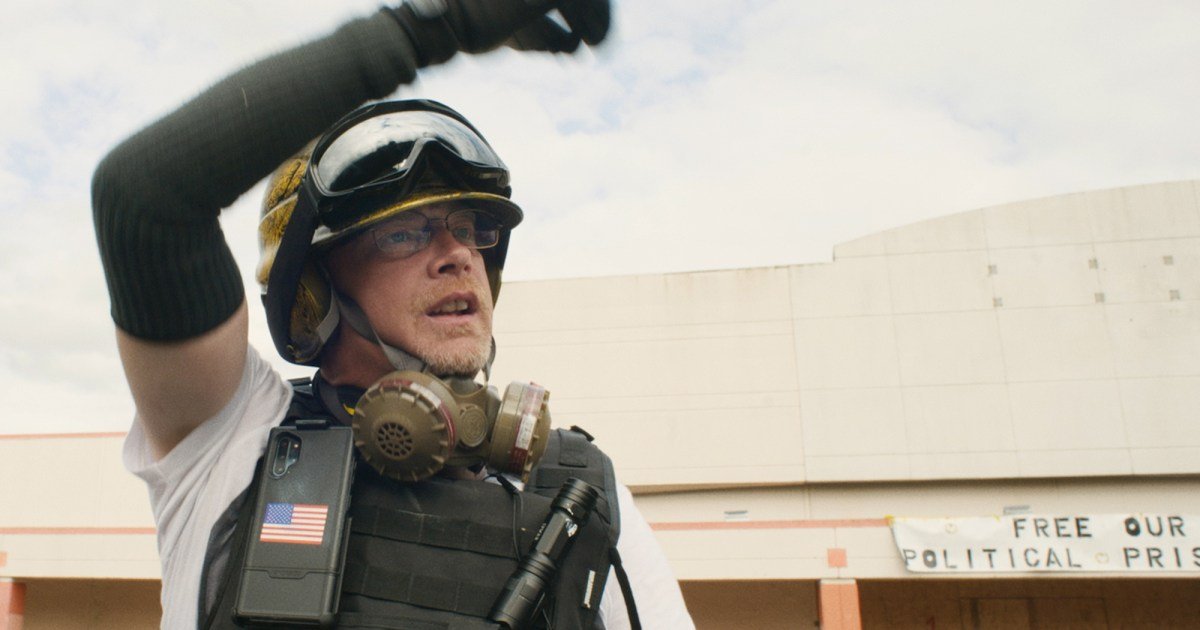
Still from “Homegrown”Courtesy of Michael Premo
Michael Premo was gasping for air. It was January 6, 2021, and Premo and his partner, fellow filmmaker Rachel Falcone, were crushed against a wall in the Lower West Terrace tunnel at the US Capitol. Between the gas mask and the body armor compressing his torso, Premo was struggling to breathe.
Then Premo made eye contact with a man he recognized from past rallies, who used his body to wedge Premo and Falcone free. When they were safely outside, Premo’s first thought was to find a Proud Boy named Chris Quaglin, whom they’d been following but had lost in the melee. They had to decide whether to leave or continue to film.
“Now it’s dawned on us, the sort of gravity of this historical moment that we are bearing witness to, and at that point it’s like a war photographer,” Premo says. “I’m just following the story wherever it goes.”
The moment was the climax of a story Premo had been working on for three years. His documentary, Homegrown, follows three members of the far-right nationalist Proud Boys—Quaglin, Thad Cisneros, and Randy Ireland—before and after the 2020 election, which they believe was stolen from Donald Trump. The film, which recently won a 2026 duPont-Columbia Award and is currently streaming on GATHR, traces Cisneros’ attempts at bridge building with Black Lives Matter, Ireland’s steady role as an organizer and Proud Boys ideological anchor, and Quaglin’s radicalization. It is a verité film, showing the ordinary texture of the men’s daily lives alongside the violence, with no narration or talking heads to tell viewers how to feel about either. And it feels less like documentation of a historic event and more like access into a current reality—one that many people would rather dismiss as extreme.
I watched the film as part of Project All, an initiative of the equity-focused research institute PolicyLink that argues the country’s way forward means bridging ideological gaps. The invitation to the viewing stated: “Americans still hold a deep love for their country and for one another—an untapped source of energy that can be mobilized to chart a new course above the fray of polarization.”
For viewers eager to condemn the Proud Boys, Homegrown replaces moral distance with something more uncomfortable: the idea that these men are not extraordinary.
It seemed an odd choice to use a film about the Proud Boys as an opening to connection. But Homegrown raised some questions for me, including: How did Premo, a Black man, manage to embed himself within an organization that, while describing itself as non-racist “Western chauvinists,” has been repeatedly linked to white supremacy? And then there’s his portrayal of the men in the film. For viewers eager to condemn the Proud Boys, Homegrown replaces moral distance with something more uncomfortable: the idea that these men are not extraordinary. Premo’s refusal to editorialize or explain his subjects means viewers see men who are in many ways familiar, who love their kids, who push back against racism in their own ranks, and who genuinely believe they’re on the right side of history—just as many viewers might believe themselves to be.

Premo, 44, says he’s always been driven to understand people across differences. Growing up in Albany, New York, the son of civil servants who worked for the state, he recalls as a child reading The Big Book of Peace, which included a drawing of an Israeli and a Palestinian. “I think the headline was something like, ‘Which is the Palestinian and which is the Israeli?’ and my younger self was trying to discern the difference,” he says. “And the point is there is no difference. They’re just people.”
When he was older, Premo went to college in Boston. He told me about an incident in which someone smeared urine and feces on his dorm door and wrote: “Michael Premo is a bitch N—.” While Premo says the school administration was sympathetic, they ultimately did little to resolve the issue and framed it as the person “acting out.”
“I told them that I wanted to make a film about people fighting for America and I wanted to understand what they were fighting for, and why.”
So in the aftermath of the 2016 election, Premo was surprised by how many people were shocked at Trump’s victory. He made Homegrown, in part, as an explanation. “To me he seemed to epitomize everything that America is but pretends it’s not,” he says. “I feel like Donald Trump was saying all of the quiet things out loud.”
He approached the men in the documentary from a place of wanting to understand. “I told them that I wanted to make a film about people fighting for America and I wanted to understand what they were fighting for, and why,” he says.
Before Premo started filming, he assumed that the far-right groups he met with would be predominantly white and was nervous about how he would be treated. But that didn’t turn out to be the case with the Proud Boys.
Founded in 2016, the group became known for street violence and confrontations with left-wing protesters. In 2020, Proud Boys tore down Black Lives Matter banners from two historic Black churches in Washington, DC; their leader, Enrique Tarrio, later pleaded guilty to burning one of them.
What Premo found was that the Proud Boys were multiracial, and, once he had earned the trust of Ireland and Cisneros, who were the leaders of their respective Proud Boy chapters, he was accepted. When some members did make racist remarks, Premo says Ireland defended him.
Still, Premo found the constant macho rhetoric and violence he witnessed while filming mentally and emotionally exhausting. He went to rallies dressed in protective gear, prepared for a riot. Even if there weren’t skirmishes between the Proud Boys and other groups, there were men talking about what they wanted to do to antifa or others.
While he included the violence in his film, Premo is clear that it is not meant to make these men exceptions, but to situate them within a broader pattern.
“One of my critiques of American history and polite, middle-class white liberal society is this idea that violence is only an aberration of the norm. It’s only something that is carried out by the fringe or the extremes of society, when fundamentally, the American project is a project built by violence,” he says.

In Homegrown, the result is an intimate if uncomfortable look that complicates existing narratives about the Proud Boys—and violence in America. Cisneros, Quaglin, and Ireland see themselves as fighting on behalf of disenfranchised men like themselves—middle and working-class people who have been ignored by a government that benefits the wealthy—and for a return to the ideals upon which they believe this country was built.
Quaglin, a 39-year-old electrician from New Jersey, becomes the film’s center of gravity. He and his wife—a Chinese immigrant who he says “100 percent is for Trump”—are preparing for the birth of their first child while his activism ramps up. We watch as he gets “punched in” to Ireland’s chapter after a rally—an initiation that involves reciting a pledge and getting decked by five Proud Boys. The film tracks Quaglin’s parallel storylines until they collide on January 6.
Premo chose to center Quaglin because his story was emblematic of many people Premo met while filming—men who had not been politically active before Trump’s 2016 election, but who then saw him as a solution. “Chris seemed to embody that individual who had these series of grievances, was trying to achieve something, though he wasn’t sure what he was trying to achieve,” Premo says. “It was really Trump that made him sort of hop up and go.”
Quaglin welcomed Premo and Falcone into his personal life. On the first day that they went to his house in New Brunswick to film, he woke up early to slow-cook pork on the grill for them. The night of January 6, Premo says that Quaglin left their hotel and returned with alcohol to celebrate. He’d remembered from some past conversation that Falcone liked Balvenie scotch and bought her a bottle.
It suggests something more uncomfortable: that the difference is often not one of belief, but of expression—who says what out loud, and who knows not to.
When I first watched Homegrown, I didn’t make it all the way through. The unfiltered look at Quaglin, in particular, was unsettling—not because of the violence or his racist comments, but because of the sense of normalcy with which they are presented. The opening scene shows Quaglin putting together a radiator cover in a nursery, in preparation for the birth of his son. Later, he outfits his truck to splatter paint over the Black Lives Matter sign on New York’s Fifth Avenue, carrying it out with methodical calmness. He is the only one of the men featured in the film who was at the Capitol on January 6, planning to go armed with knives and firearms for what he says will be a “CIVIL WAR.”
I found the ease with which Quaglin committed these acts astounding. The interspersion of political violence and domesticity doesn’t allow viewers to compartmentalize what’s on screen as fringe behavior, safely outside the bounds of ordinary American life. It suggests something more uncomfortable: that the difference is often not one of belief, but of expression—who says what out loud, and who knows not to.
As a Black woman, I know the quiet racism of liberal spaces, and the pretense that it is only perpetuated by those, like the Proud Boys, who are seen as extreme. The brilliance of Homegrown is that it forces viewers to confront that.
Ireland was the first of the Proud Boys in the film that Premo met, when they talked in a bar after a Trump rally in New York City. Ireland, 51, said that Premo shared that he was working on a film: “It was very much in general terms,” says Ireland. “That started a kind of friendship, I suppose.”
Ireland says Homegrown is a distortion of the Proud Boys because it focuses so heavily on Quaglin. “Chris is an extreme individual,” Ireland says. “I would say that Michael himself is more the standard.”
Cisneros, 49, challenges viewers’ preconceptions of who the Proud Boys are—and how they view the world. Before he agreed to participate in the film, Cisneros had his Proud Boys chapter in Salt Lake City watch Premo’s film Water Warriors, about Indigenous and white community members fighting to protect their water from a natural gas company. The “common man fighting the system” aspect of Water Warriors was something that resonated, Cisneros said.
One of the more surprising moments in the film is Cisneros’ partnership with Black Lives Matter activist Jacarri Kelley. Cisneros, who is Latino, says the Proud Boys and Black Lives Matter had shared goals in fighting for equality, because both groups were responding to a political system that had failed many working-class people. Kelley and Cisneros appeared together at rallies and public events. “The only way that we’re going to fix that,” Cisneros says in the film, “is if we recognize that we’re all sitting on the same plane and we’re all crashing into the same damn mountain.”
Cisneros was grateful that Premo was there to bear witness. “I’m honestly glad that I let Mike in in that way,” he says.
While some in his chapter were supportive of his decision, Cisneros says that within the nationwide Proud Boys Telegram chat, there was pushback. In the end, the partnership with BLM led to Cisneros being forced out of the Proud Boys.
His life spiraled out of control after January 6. He lost the Proud Boys, his dog, his relationship, and his freedom—he was recently released having served two years in prison in Texas for aggravated assault. Premo filmed some of Cisneros’ losses, including his father in hospice, but out of respect chose not to include them. Cisneros was grateful that Premo was there to bear witness. “I’m honestly glad that I let Mike in in that way,” says Cisneros, who has not yet seen Homegrown.
Meanwhile, Quaglin was incarcerated for his role on January 6 and was released in January 2025, after being pardoned by Trump. His wife divorced him, and Homegrown ends with a note that he had not held his son since his arrest in April 2021. Premo says Quaglin—who declined to speak to me for this story—blames him for the divorce.

While the film focuses on the Proud Boys, Premo also followed other groups he describes as explicit white supremacists. He filmed what one framed as a border protection exercise, in which they patrolled in southern Arizona, some dressed in Nazi uniforms. One man told Premo he was an abomination who should be exterminated. Premo felt it was wiser not to respond and just let the man speak. “That just tested every sort of emotional thread I had,” Premo says.
Premo couldn’t watch the footage he shot on January 6 for more than a year.
He hasn’t yet processed the toll that working on the film has taken. He couldn’t watch the footage he shot on January 6 for more than a year. When the editors asked for his input during their first pass, Premo refused and asked them to just send the clips they thought they might use. Even then, he was reluctant to watch.
Premo tried therapy to cope with the mental and emotional exhaustion. “One therapist told me that in stressful situations I should take my shoes off and connect with the ground, and that didn’t seem to be applicable in my scenario,” he says. What worked was “bubble baths and cognac.” He also built in time, while filming, for hikes or to be in nature.
Premo and Falcone applied to film festivals in anticipation of the 2024 election cycle. While the film premiered at the Venice Film Festival that August, they encountered resistance from festival organizers in the United States. Some programmers saw little urgency, Premo says, doubting Trump could be re-elected. Others felt the film was platforming a hate group.
That shifted after Trump won. Homegrown now has been screened at more than 50 film festivals and won the duPont-Columbia in January. Along with its streaming agreement, it’s also available through an educational distribution agreement with New Day Films.
In making the film, Premo says he found that what people were fighting for came down to something more fundamental than politics: “I discovered,” he says, “that people are looking for belonging, meaning, and purpose.”



