
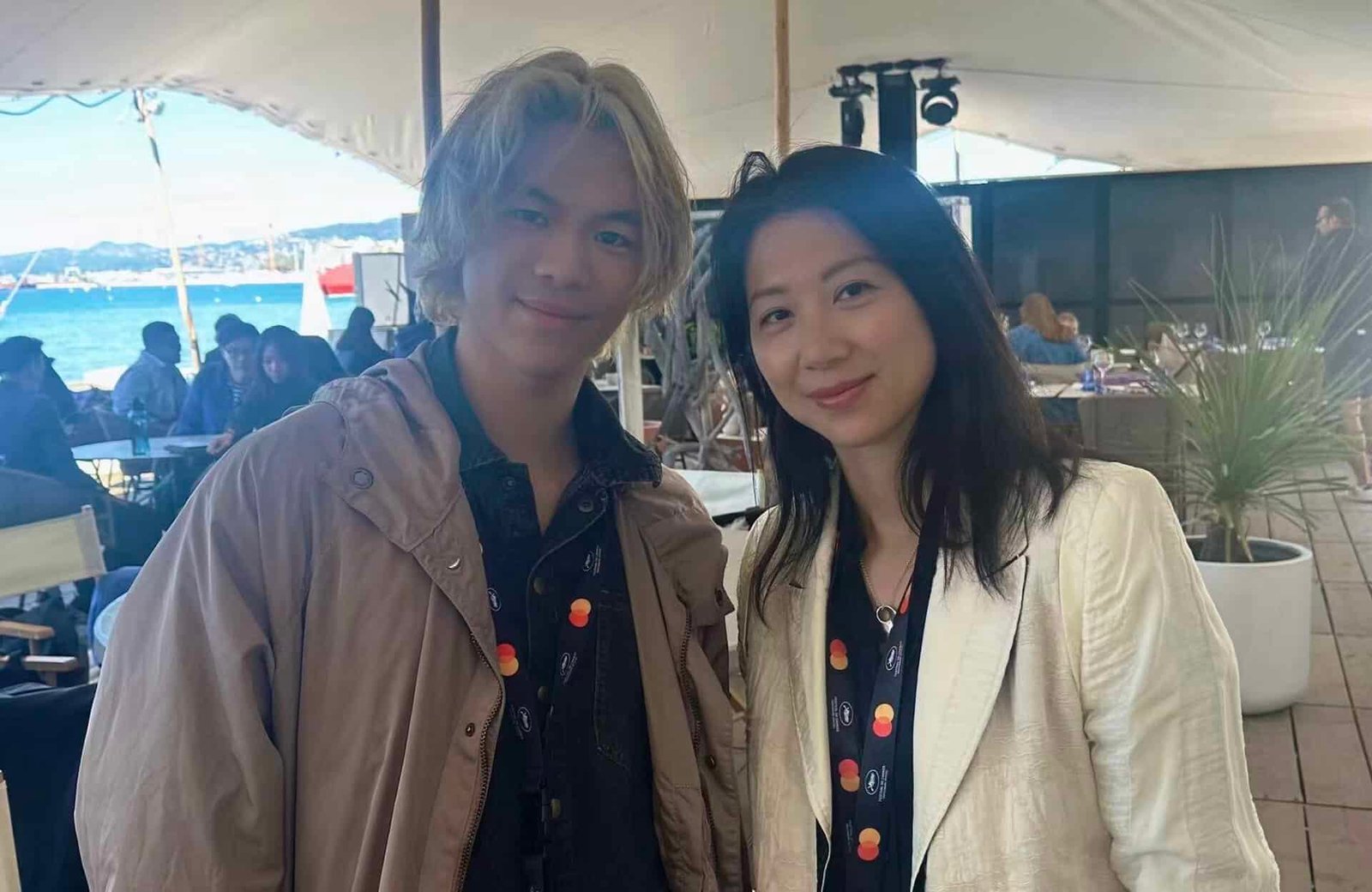
Following the success of her short film “Lili Alone”, which won the Leitz Cine Discovery Prize at La Semaine de la Critique in 2021, Chinese director Zou Jing presented her feature debut “A Girl Unknown” at Cannes this year.
A Girl Unknown Screened at Cannes
The film follows a young woman who grows up under three different names, each shaped by the families that raise her across shifting social and historical landscapes in southern China. Through her movement between three households, the film traces changing family structures, regional identities, and linguistic experiences from the 1990s onward.
Young actress Cao Ruofan plays the girl in childhood as “Lin Juan”, embodying an innocent and lively spirit, while Li Gengxi portrays the older versions of the character under the names “Wang Juan” and “Wu Lian”, navigating fractured family relationships and the emotional turbulence of adolescence.
In her early years, Zou worked in television documentaries and commercial advertising before gradually developing her storytelling practice through screenwriting workshops. She spent three years developing the script of “A Girl Unknown”, which was the first Chinese-language project to win the Cannes Critics’ Week Next Step Award.
Ultimately, the film received three awards, including the Fondation GAN Distribution Prize, the FIPRESCI International Critics Prize, and the Audience Award from Le Rail d’Or, which firmly establishes Zou as one of the most promising new Chinese filmmakers today.
The film spans three different families, each reflecting different family structures and generational dynamics across various periods of Chinese society. How did you connect personal destiny with broader historical and social changes through this family narrative?
At the beginning, I honestly wasn’t thinking on such a grand scale. To a large degree, the film started from my personal experience. I grew up in the mountains of southern China, so the village in the opening sequence comes directly from my own memories. It is a very beautiful and poetic landscape in the south. When we were writing about the first family, many of the details were actually projections of my memories. I wasn’t initially trying to design family structures — if there are any — factories, or even urbanisation as abstract concepts. Everything began from lived experience.
The second family also started from the character herself. I was very drawn to the complexity of the girl’s second mother, who is completely different from the first one. She is well-educated, elegant, with refined taste and dignity. Even after experiencing deep trauma, she still insists on living with grace.
In many ways, all three families began with one question: “What kind of person do I want to portray?” The second mother was the character I admired most, and from there I gradually built the world around her. I would be very curious about what kind of city she would live in and what sort of environment would shape her life.
At the same time, I also did extensive social research. The kind of event depicted in the film happened more frequently in southern China than in the northeast or northwest — some studies identify certain provinces more clearly. Although the film is not a documentary, I always wanted the emotional and social reality to feel truthful. That’s why we ultimately chose these particular locations.
I also wanted the girl to speak different dialects as she moved between different environments. She begins by speaking Hakka and later has to adapt to a completely new linguistic and social environment. The reason she gets bullied at school is probably due to the linguistic disparity. Back in the 1980s and 1990s, people still spoke dialects regularly — unlike today, when schools mostly use Mandarin. So language shifts themselves could create very deep psychological impacts.
The third family is from Hunan, and that was also based on realism. Guangdong and Hunan are geographically close, and indeed, many Hunanese people live and work in Guangdong. If something like this really happened, it had to feel believable. For example, I would never have a child suddenly transferred from a very distant province to Guangdong, because that simply wouldn’t feel logically grounded in reality.
Audiences may not consciously notice these details while watching, like why the girl first speaks Hakka and later Hunan dialect, but for me, these geographical and social logics had to remain convincing. Take the factory setting as an example. It’s true that during the 1990s and early 2000s, many young girls dropped out of school to work in factories because labour demand was enormous at the time.
A great deal of social research sits behind these character experiences. But I never intended to emphasise “historical transformation” itself. What I always wanted to foreground was the girl’s personal emotional experience rather than history as an abstract force.
The Chinese title of the film is “A Nameless Girl”, but in reality she isn’t nameless at all. Actually, she has three different names. Moving between families, she seems unable to establish a stable sense of identity. What does “a name” represent in the film for you?
I think names are extremely important to her. For people like us, who grew up in relatively stable environments, names may not carry the same weight. Nowadays, many people even have English names; they function almost like labels. But for someone who constantly moves between different families and doesn’t even know where she truly comes from, a name becomes identity itself.
I once saw a discussion online asking, “What does it feel like to be abandoned by your biological parents?” Someone described the immense shock of being renamed after entering a second family. That kind of emotional impact is difficult for people without similar experiences to truly understand. We may empathise, but it’s very hard to completely place ourselves in their position.
How did you try to visually communicate that feeling surrounding identity and names?
I think it operates more on a psychological level. A name represents her relationship to the family that gives it to her. When she becomes “Wang Juan,” she has entered the second family. Later, in the third family, she changes to “Wu Lian,” the name written on her birth certificate. But these names don’t carry the same emotional weight. In fact, it depends on whether she has truly formed a connection with the family attached to the name.
Can it be interpreted as her never truly finding a name that belongs to her?
I don’t see it that literally. For me, it feels more like a beginning. Even if she hasn’t fully found the answer yet, she has at least found her own position in the world.
From “Lili Alone” to “A Girl Unknown”, you seem consistently drawn to women on the margins of society. What attracts you to these kinds of female coming-of-age experiences?
I think what interests me is people living within difficult situations — not necessarily women. The girl in “Lili Alone” makes choices within hardship, and the same is true in “A Girl Unknown”. It just so happens that I chose female perspectives for both stories.
Actually, the refusal to surrender in a predicament is what interests me most. Recently, I watched the Korean film “The World of Love”, and one thing in particular resonated strongly with me: why must traumatised women always be positioned as victims?
I think “A Girl Unknown” contains something similar. Although the stories are completely different, both share a kind of stubborn refusal to give in. Especially the scene where Li Gengxi dances — I love that scene very much. The smile on her face represents her entire attitude toward life.
The film involved extensive collaboration with French partners. Could you share your experience of international co-production?
I think emotions have no national borders. At first, I assumed this was a very specifically Chinese story, but later I realised the French team connected with it deeply as well. We completed much of the post-production in France, including colour grading, music composition, and sound design. The French collaborators were incredibly talented and gave us enormous trust and support.
At the Cannes premiere, I also felt that French audiences had almost no difficulty understanding the emotional core of the story. I think that ultimately comes from people loving the story itself.
How was your collaboration with the actress Li Gengxi? Did she bring you any surprises?
So much. She’s someone who shines very brightly — not just as an actress, but also as an individual. There was a natural understanding between us without words.
What quality about her attracted you the most?
Gengxi herself also has a complicated personal background. She’s very strong-willed, unyielding, and resilient. She has that same refusal to surrender that I’m appealed to. Over the course of working together, we gradually became very close friends.



