
Jack Novak and Jeremiah Sandler pulled up to the day’s worksite, a Grosse Pointe home sharing its backyard with a 100-foot, pearl-toned sycamore.
“This tree was so big,” Sandler recalled.
“It was picturesque,” said Novak.
Their job on that Michigan winter day in 2019 was to destroy it, following through on a removal sold by one of their colleagues at a midsize tree care company who, they said, had told the homeowner the sycamore was hollow and had to come out.
“I think that was our first, ‘What the fuck, man?!’”
Novak and Sandler circled the base of the tree, looking for any signs of distress. It seemed fine to them, so they figured they’d run into rot or hollows when they started cutting. They were both in their mid-twenties then. Novak was the better climber—he’d worked as a nature guide and interned with the US Forest Service. Sandler’s gift was troubleshooting. He’d studied tree biology in college and was mentored by Michelle Mitchell, then-president of the International Society of Arboriculture. They had the experience and know-how to execute this removal safely, and they started in strategically with their chainsaws at the top.
But something was off. Every slice revealed healthy, muscle-pink wood.
“Jack and I made all those cuts, and this tree was solid,” said Sandler. “I think that was our first, ‘What the fuck, man?!’”
As long as humans have told stories about trees, the sycamore has exuded main character energy. Ancient Egyptians revered sycamores as a bridge between the worlds of the dead and the living. The Cherokee credited a lightning-struck sycamore with the gift of fire in their creation story. And in the Gospel of Luke, a tax collector named Zaccheaus climbed a sycamore-fig tree to get a good look at Jesus, an encounter that changed his life.
Somehow, centuries later, this Michigan sycamore became a catalyst for transition once again. Gut-sick about the removal, Novak and Sandler left their jobs to create their own consulting business and launch a public education campaign about “tree care” practices in North America. Using Instagram posts, YouTube videos, and a self-published book, the now thirty-something arborists are calling out the shadier side of their industry. Their handle matches their ethos: “Tree First.”
We’re scared of trees in America. As household bills pile up, there’s a tendency to side-eye each mature tree as a potential time-bomb. Will it crush the roof of a car, or crash into your kitchen? Will it fall on a neighbor’s house and get you sued? How much should you spend to prevent that from happening? Is it better in the long run to just call a company to remove the tree preemptively? There’s a nearly endless list of options you can Google. In Pittsburgh, you could call Axeman or Lop It and Drop It. It’s Gotta Go will do the job in Iowa City, Blades of Glory in Kansas City. Many states have choppers ready…there’s Chop Nashville, Cincinnati Chops, Chop & Chip, or Chop n’ Drop. Cut My Tree 123 is available, or you can recruit Chainsaw Cheri, Tree Assault, The Tree Army, or Saw and Order.
Most promise to mobilize fast. If you own a home, you’ve likely received a text message or two from some tree-cutter in your area (We’re in your neighborhood…) or even knocks on your door by locals with climbing gear and a chainsaw, towing a chipper. The bill for a full removal is almost always in the thousands. But what price for peace of mind?
It’s a sales pitch. Let’s begin there.
Accurately assessing the risk of living with mature trees requires a breath, a subtle shift from hyper-vigilance and panic-mind to a longer view. It’s true that many things can topple a tree—severe wind and hail, invasive beetles, a sloppy waterline dig that hacked a root system. Big trees are standing up to multiple threats in our hotter, stormier, drought-prone, matchstick climate. But as scientists have begged us to consider in study after study, the survivors towering overhead in cities and suburbs help us remain standing too. It’s mature trees that sequester the most carbon, lessen the impacts of flooding, bolster biodiversity and soil quality, lower the temperature of neighborhoods during heatwaves, and qualitatively improve our mental health, even reducing mortality rates.
“People are suspicious of our industry, especially in North America, and rightfully so.”
There’s no reliable data on the number of urban trees removed each year, unnecessarily or otherwise. But this year, researchers at Portland State University reported that of the 33 US cities they surveyed, 72 percent were losing trees. And, they stressed, the ubiquitous campaigns to plant baby saplings are not a cure-all: “…while these efforts to expand green space are laudable, little is known about the alternative approaches to preserve (as opposed to expanding) existing tree canopy and green spaces.” Yes, older trees carry risk and need tending, but they tend to us as well. What if we learned how to reduce the risk?
As Sandler and Novak were developing their own small tree care company, they searched online for arborists who shared their aversion to knee-jerk removals. They found a pocket of professionals who talked a lot about “veteran tree care”— supporting a tree as it matured, aged, and even died on site. Neville Fay, a British arborist and educator who founded the Ancient Tree Forum, was an enormous influence, especially a book he co-authored: Trees—A Lifespan Approach. (Fay passed away last August.) And they found a friend of Fay’s in North America, the Canadian arborist Philip van Wassenaer, who, much like Novak, had started out as a hotshot climber but soon sickened at the idea of cutting down these high-rise marvels he’d seen from the top.
Decades before, van Wassenaer had started his own consulting company, Urban Forest Innovations, that specialized in tree risk assessment. He was one of the first arborists in North America to use sonic tomography (measuring the speed of sound waves through a trunk) to diagnose decay, instead of drilling in to investigate or thumping the trunk and guessing. He also ran his company in a way that was counter-cultural in the tree care industry at the time: Instead of offering free consultations and then billing for services, he charged for the consultation; that changed the financial incentives so he didn’t depend on removals to make his living. His business model wasn’t antithetical to a tree’s longevity.
Sandler and Novak were told by their friends in Detroit that this model would never work in Michigan. But they tried it anyway, equipping their new business by filling a used cargo van with diagnostic and pruning tools instead of taking out loans for big trucks, cranes, and chippers. Seven years and more than two thousand customers later, they are booked and busy, referred by friends and neighbors searching for some safe way to keep their trees.
“It’s proof of concept, really,” said Novak. “People are suspicious of our industry, especially in North America, and rightfully so. Our industry is very exploitative of fear just to make money.”

We’ve had single-operator chainsaws since the early 1950s. But arborist Christopher Roddick, who spent three decades caring for show-stopper trees at Brooklyn Botanic Garden before moving to Connecticut in 2023, was always wary of them. He’d seen too many friends get hurt when the blade slipped, and too many trees wounded by nasty cuts. On a bright morning last November, Roddick let me visit his woodsy backyard in Litchfield County to watch his first experiment with a far smaller carving tool, a new attachment to an angle grinder (usually seen polishing or sanding) that looked rather like a lumberjack-size immersion blender, long and pointy with a wildly spinning head. It was called the Hollowhog Piglet, and only a handful made it into the United States before President Donald Trump’s tariffs bumped the price up 12.5 percent. Roddick got his $500 bank transfer to Australia right before the hike.
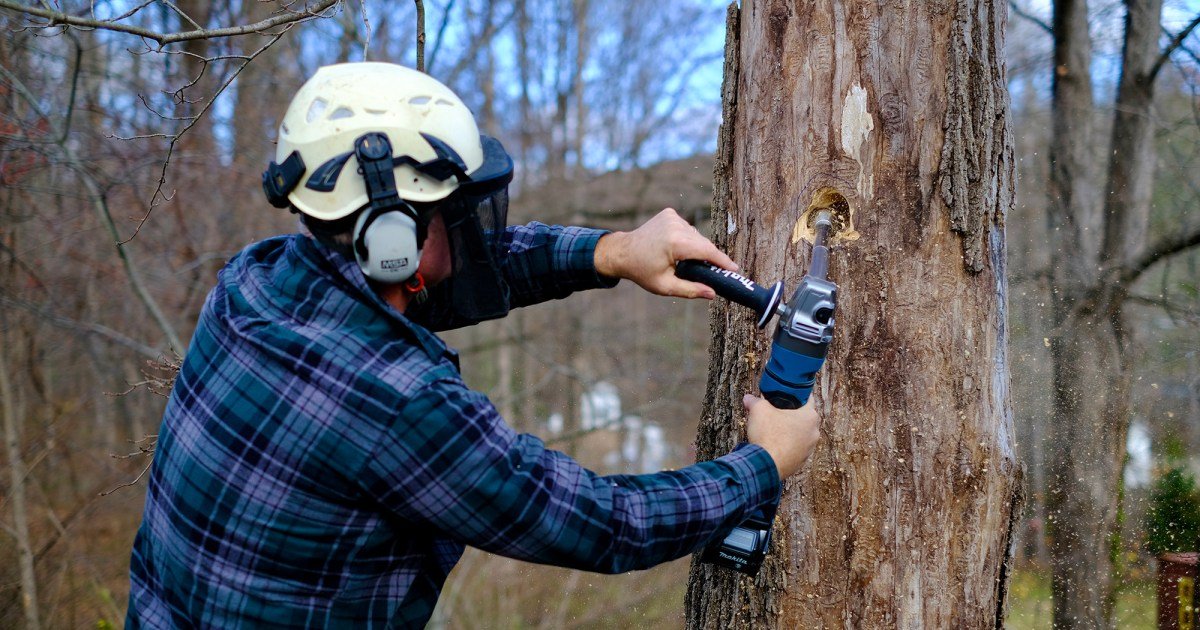
Developed by Australian conservationist Matt Stephens, who broke his right hand the second he revved his first prototype, the Hollowhog has one job: Bore a small hole in tree trunks and then carve a hideaway cavity within. The space offers a nesting spot for songbirds, if they so choose, or bigger critters. While trees often hollow out on their own over time, this speeds up the process and gives people another reason to allow a tree to stay put: habitat creation in a place where habitats more often get destroyed. A few American arborists, including Roddick, had attempted hollow-carving with a chainsaw in the past, but it requires “plunge cuts” right in front of your face, a grisly maneuver.
Roddick set up a perch for me on an eight-foot Japanese pruning ladder. Then he pulled a hardhat over his spiky gray hair and scrambled up one of those old New England stacked-stone walls a few feet away, gripping the battery-powered Piglet in his right hand. Once he steadied himself on a big boulder at the top, we both turned to face the single-story carcass of an ash tree, victim to a dazzling, deadly beetle called the Emerald Ash Borer. Roddick had been out earlier with a blue Sharpie to mark his target spot near the top. He made an “OK” circle with his thumb and forefinger to show me the circumference of the critter-entrance he was going for—he’d been researching specs.
“I want a hole for, like, chickadees or nuthatches,” he said. “About an inch and three-eighths or so.”
Roddick lowered a drop-drown facemask and then squeezed the trigger switch, unleashing a high-pitched dervish whir. The Hollowhog Piglet’s head spun off the trunk’s surface at first, which freaked me out, but Roddick held steady until it got a good bite and started to bore. Splinters flew in all directions as Roddick found his carving angles, and I felt myself exhale behind my camera, intrigued by what he was attempting here, which was nothing less than life after death.
“You have to think of trees as generating systems,” Roddick says at workshops he teaches up and down the East Coast. He means that not only can they turn sunlight into food (the sugars of photosynthesis) and transform carbon dioxide into oxygen, their bodies also nourish all the lifeforms around them (wildlife, bacteria, and fungi essential to healthy soil, us). And they do this at every stage of their development—post-death included, if given the chance. Roddick has been on a personal crusade to educate Americans about that option.
“We look at maturity as a hazard. Those trees get cut down all the time, all the time. It’s heartbreaking.” he told me. “Deadwood and decay are natural processes. Arborists will say, ‘You have decay on your tree,’ not like, ‘It’s great you have decay! Let’s do some reduction.’ That’s the battle I’ve been fighting for the past 25 years or so.”
“It’s all political.”
The battle went public back in 2018, when a member of Roddick’s arboriculture team, Alec Baxt, was fired from Brooklyn Botanic Garden while campaigning on Facebook to keep the reduced (only 10 feet tall, but still-living) base of a century-old London plane tree on site. It had been nicknamed the “treehouse tree” because kids liked to play inside its hollow trunk, a natural fort. Roddick also believed the tree should stay, but the garden’s managers ordered the removal anyway, citing safety and aesthetic concerns. Roddick responded to the controversy in a Facebook post of his own: “the message the executive class is sending is clear: working women and men should blindly obey orders with no questions asked, even when they are experts in their field.”
The Brooklyn Botanic Garden has always disputed these criticisms, telling The New York Times in 2018 that “staff on all levels, as well as outside horticultural scientists, landscape architects and engineers with relevant expertise and knowledge” were involved in the decision-making process that led to the tree’s removal.
Regardless, Roddick told me that if I was going to understand tree care, especially the care of mature trees, I’d have to understand one thing: “It’s all political.”
Those politics play out in the industry’s “best practices” around removals. They play out in state and municipal laws regulating who can take out trees and when. They play out in judicial systems, as litigious homeowners in the US and Canada sue each other over tree disputes. And, increasingly, they play out in the insurance industry.
Most states do not require a license to operate as a “tree care” professional. As dangerous as this type of work can be (it ranks in the top five most deadly US professions most years), it’s perfectly legal to simply buy a saw and hang a shingle in states including Texas, Pennsylvania, and Ohio. Attorneys General in Tennessee, Wisconsin, and North Carolina have put out consumer alerts about “predatory cutting” operations with high-pressure sales tactics, especially before or after storms. “Contractors that happen to be in your neighborhood might be going door to door to find easy targets,” wrote then-AG Josh Stein right after Hurricane Helene battered North Carolina in 2024. There’s been a recent proliferation of gig-economy-style tree care businesses, according to Tim Beatley, a professor at the University of Virginia’s Center for Forest Urbanism.
“It’s almost like schools of sharks are swimming through everybody’s neighborhoods,” said Beatley. “I’m getting these texts now, like, ‘I’m in your neighborhood cutting your neighbor’s tree, would you like me to remove anything on yours?’”
Neither of the two largest residential tree care companies in North America, Davey Tree and Bartlett Tree Experts, send those kinds of texts. They respond to customer inquiries by setting up appointments to consult with potential clients first, and the majority of those consultants are “ISA Certified” arborists. That’s a useful filter to know about: It means the person who’s looking at your tree has been trained and tested by the International Society of Arboriculture. It’s likely they are evaluating the riskiness of trees based on ISA protocol, which records a tree’s “likelihood of failure,” judged by recent growth rate, amount of decay, and/or structural damage. Weighing that against a list of nearby “targets” (swing set, parked car, porch, etc.), the arborist rates the consequences of failure (like dropped limbs or a collapse) from “Negligible” to “Severe.” From there, they might recommend all kinds of services: soil treatments, pruning, fertilization plans, or a removal. It’s a judgement call every time. The thing is, and this is important for homeowners to understand, mature tree removals are the big-ticket item on that service list, and the sales-arborist who’s come to evaluate is working on commission. I asked both Davey Tree and Bartlett if that incentivizes unnecessary removals.
“I mean, I would hope not. That’s not how you continue relationships with clients,” said Geoff Cowan, Vice President of Residential Services for Davey Tree, which has more than 12,000 employees operating in 47 states and Canada. “Our number one goal is always to prune trees, fertilize trees, spray trees for insect and disease control, only remove if we have to.”
Tom Smiley, a longtime research leader at Bartlett (with 3,700 employees operating in 42 states, Canada, and overseas) said selling removals works against the company’s business goals of visiting clients on an annual basis and caring for trees long-term.
“Trees die, trees become hazardous. Occasionally, they do have to go, but often we don’t even do that work,” he said. “The tree removal companies are the ones with a lot of rolling hardware. They have cranes, they have log trucks, and in general, that’s not us.” The company’s YouTube content generally reflects that view, this video of a big-crane removal set to a pulsating Remember the Name soundtrack notwithstanding.

If you’ve noticed more big equipment rolling into cities and suburbs lately, it’s because the tree care industry is undergoing a massive tool-up—next-gen lifts, cranes, remote-control saws, drones, chippers, and haulers. “The EC415-FG gives you an impressive 89 feet of vertical reach when paired with the Gierkink GMT 035 TTC Grapple Saw,” is how Altec, one of the largest equipment companies, describes one combo. “This powerful saw can cut through logs up to 16 inches thick, grip openings up to 33 inches wide, and handle lifts of up to 3,300 pounds.” Altec calls this a way to “maximize efficiency,” but members of the Tree Care Industry Association, a professional body whose stated mission is to offer “tools you can use to use every day to improve your safety, sustainability, and chances for success,” have been divided on the adoption of such equipment. They’ve been debating the pros and cons in TCIA’s magazine, noting that the equipment may be safer for humans, but that “lower quality of pruning cuts” is not so hot for trees. (Meanwhile, equipment companies place ads in TCIA magazine and bring big-hardware demos to the trade show floor at TCIA’s annual conferences.) The equipment is expensive, some combos can run you $400-600K, and that means small and midsize companies wishing to embrace the latest tech often take out mortgage-sized loans. When a company is shouldering financing like that, is it more likely to be pushing its most lucrative offering, $5-10K mature-tree removals?
“I think that’s a very legitimate question, and I’ve heard folks in our own industry acknowledge it and start to express concern over this phenomenon some call ‘feeding the beast,’” said Peter Gerstenberger, TCIA’s senior vice president of industry expertise. The TCIA has courses in financial literacy for early-entries to the tree care businesses, and Gerstenberger said one alternative to buying the big hardware is for arborists to contract with crane operators, pulling them in only when a job requires it. He told me a story about some trees he felt needed to come out at his own home in New Hampshire. He called three different arborists to consult and bid on the job—they had no idea who he was, which he liked.
“The first person came out and they said, ‘Yes, I’d like to do all your trees with my brand new crane. I need to park my crane in your driveway.’
‘OK, no problem.’
‘I’m going to need to remove this hickory on the left-hand side of your driveway in order to do all these trees on the right-hand side of your driveway.’
And I said, ‘Why would you remove that hickory? I really like that tree.’
And they said, ‘Well, it’s in the way of the swing of my crane.’”
Gerstenberger went with a different pro, and the hickory stands today. Moral of that story, he said, was for homeowners to get more than one opinion, even if they have to pay for the consultation, and trust their own judgment, just as they would when choosing a health care practitioner.
“Wait a minute, you can’t just take out a healthy tree because your insurance company says so.”
Another class of companies eyeing mature trees as a potential revenue source are “aerial intelligence” providers like Esri and Nearmap, which contract with insurance underwriters to document and report any tree standing near a home, especially if branches overhang a roof. Back in 2024, Kay Evanovich, the municipal arborist for the City of Decatur, Georgia, began receiving panicked messages from city residents about the result of such reports.
“I started getting homeowners freaking out from their insurance company saying they were going to be dropped if they didn’t take out their beloved tree,” said Evanovich. “I was like, ‘Wait a minute, you can’t just take out a healthy tree because your insurance company says so.’”
It wasn’t just Decatur. Jason Gordon, a professor of community forestry at the University of Georgia, has been studying these types of insurance actions and has seen it happen across the US. He says local insurance agents or arborists might understand when a mature tree is stable, but the underwriters relying on aerial images are too remote to accurately assess.
“They’re in LA and London and New York and everywhere else, managing these portfolios that are a half a world away,” Gordon told me. “It comes down to different ways that these two industries account for risk. Arborists are very site-specific. The insurance industry looks at risk in a very economic way.”
“I can readily conclude that destruction of the tree is not trivial.”
One solution that’s prevented unnecessary mature tree removals so far, he said, is an ISA-certified arborist writing the insurance company directly to vouch for a tree, forwarding a current risk assessment or noting if a city code makes it illegal to remove a healthy mature tree. Evanovich drafted that kind of letter for Decatur residents, and it was effective enough that the Georgia Arborist Association posted a template for other arborists to try.
Every mature tree still standing has endured a force more deadly than insurance threats, industry practices, invasive insects, or climate-juiced storms. The apex predator of even the healthiest trees in North America is development. It’s us, humans making decisions for necessity, pleasure, or profit that preempt the existence of the tall species who began their lives before our generation came along and could have outlasted us, too.
Sometimes it’s as simple as a house expansion. In 2019, a family in Toronto sued their next-door neighbors over a 60-year-old maple straddling both properties. The plaintiffs had already obtained building permits for a renovation that would expand the back of their home—that maple was the only obstacle. But the neighbors refused to allow the removal, and, to defend their beloved maple, they called in Philip van Wassenaer, the same consulting arborist who inspired the Tree First guys in Detroit. Justice E.M. Morgan heard the case at Ontario Superior Court and wrote a lengthy decision, obviously quite moved by the testimony:
Philip van Wassenaer has submitted a report that establishes that the maple tree is healthy and that it provides a range of environmental, economic, and social benefits to the Respondents (as well as to the Applicants) in the form of a shade canopy, improved air quality, aesthetics, habitat for birds and small animals, and stormwater reduction. The tree also provides value, since there would be a significant cost to replacing it. There is nothing in the Applicants’ record to counter these observations. I can readily conclude that destruction of the tree is not trivial.
Setting a precedent for “border trees” on private properties across Canada, he ruled for the maple.
More recently, the removal of “hundreds of healthy, nonhazardous trees” became a flashpoint in Trump’s quest to build a championship golf course in Washington, DC. “I am not the Lorax,” Judge Ana C. Reyes declared. “I do not speak for the trees.” But, she wrote in October, the court does speak “for the rule of law.” And, at least for the time being, she ordered the presidential tree-cutting to stop.
In a 2020 study titled “Private Tree Removal, Public Loss,” Australian researchers investigating the most effective ways to protect the world’s mature trees found that local governments had a lot of leverage, even on private property. Within Chicago’s city limits, for instance, 60 percent of the urban tree canopy is on privately owned land, so local tree codes can really matter. Still, most researchers looking at the issue emphasize that it takes more than just a law.
“Even with strong code provisions, enforcement is often the Achilles heel,” said professor Beatley at UVA, who recently published a guide to navigate the code-world titled Policy Toolkit: Protecting Mature Urban Trees on Private Lands.
Seattle is an interesting example. Over the last three years, city officials have publicly celebrated new tree ordinances (code 25.11, if you want to geek out). The city council praised themselves for protecting “a total of 175,000 trees across the City; the previous code only protected approximately 17,700 trees,” and last year, outgoing Mayor Bruce Harrell signed an executive order with seven “Actions to Increase Tree Preservation on Private Property.” It all sounded comprehensive: Laws required arborists to sign an official registry, trees were given “tiers” of protected status (with “heritage trees” in Tier One), and many removals could only happen after applications, city approvals, and public notices.
“We do have a lot of tree regulations, but they were written with loopholes,” said Sandy Shettler, who co-founded a watchdog group called Tree Action Seattle in 2023, right after the tree code was passed and trees kept coming down anyway.
“We’re still removing about 250 per month within the city limits,” she told me in October. “If you’re a developer, you can remove any tree, even a heritage tree, if you submit a statement. So basically, developers can remove any tree, and that’s our problem.”
Shettler’s group has reached out directly to developers, writing letters requesting protection for mature cedars, walnuts, cypresses, and other giants dwelling in the path of upcoming projects. The group doles out public praise or protest, depending on a developer’s response, finding that it’s effective to get as specific as possible, running campaigns tree by tree. The losses tally up on their campaign page, and they’ve gathered for “Celebration of Life” memorials days before targeted trees are felled, hoping for last-minute reprieves. This autumn, they had a win, two side-by-side oaks that survived new housing construction in the Ballard neighborhood of northwest Seattle. A fat driveway now runs between the twin oaks, but Shettler was hopeful their root systems will still have enough space to adapt.
“We haven’t had a Saving Celebration before, so this will be a first,” she said.

Late on a rainy May afternoon in 2023, Amando Flores was packing up his tools for the day. A seasoned gardener, he’d tended Gramercy Park—the notoriously gated, locked, and posh two acres of greenspace in lower midtown Manhattan—for more than 30 years. He had no precedent, though, for the eerie, otherworldly cry that reached him inside the garden’s small shed.
“I suddenly heard like a scream, and then I peeked through the window and I said, ‘Gee, like half of the tree is gone,’” said Flores.
The oldest tree in the park, a half-hollow English Elm from the 1840s nicknamed “The Old Lady” and known for a unique bark pattern that swirls like van Gogh’s Starry Night, had dropped a massive branch…right across a manicured footpath. The accumulation of time and decay had weakened her southern limbs to the point that even a gentle spring rain on new leaves was too much to bear. No one was hurt, but Flores immediately pulled out his cell and made calls, knowing an incident like this could have big, even litigious, ripple effects. Gramercy, which is privately owned, is like a fishbowl with hundreds of eyes looking in at all times, and trees have been condemned for far less.
Erik Anderson, an arborist at Bartlett, was one of the calls. Anderson is the latest in a succession of arborists to steward the elm—previous generations had pruned and fertilized it, tried to shield it from Dutch Elm Disease, even filled part of the main stem with concrete hoping to replicate sturdy heartwood (a common practice in the last century, now considered more harm than help). Anderson came to do a risk assessment on the elm a few days later and found it had essentially righted itself structurally, as aging trees often do, reducing torque. What remained could carry on, jagged as it looked.
“We know we’re never going to get back to how that canopy was, nor are we trying,” said Anderson as we circled the elm three years later. But, he added, that wasn’t unique to the tree. “I’m not dressing up in my parachute pants going to the clubs.”
Anderson told me it was all too rare for an arborist to be given leeway, over time, to carefully support an ancient tree in America, much less in the middle of New York City. Rare that a community is willing to manage risk and embrace the later-life aesthetic. It’s not the kind of tree a kindergartener would draw as “the ideal.” And yet, she is sculptural, standing half the size of the other elms in the park, sporting a giant black crevice that looks like the entrance to a cave. The Old Lady hosts birds, bats, and squirrels who speed and chase each other through her hollows. Parts of her lost southern limb rest decaying in a small fern garden a few yards away, a perfectly formulated fertilizer for the park’s microclimate. But her northern limbs still stretch up and leaf out every season. Even now, she’s putting on a foliage show for the eighth generation of humans to peek through Gramercy Park’s black iron gate. You’ll see her there in the center, husky, haunting, bright, and wild and as only an ancient can be.
Correction: Jack Novak‘s name was misspelled in an earlier version of this article.



