
It was about 1:30 on a September morning when Lazaros-Antonios Chatzilazarou received a LinkedIn message. He was up late playing video games, an indulgence that he allows himself as he works toward a PhD in game theory while juggling a job at the Big Four accounting firm EY and a teaching post at the London School of Economics. Hitting pause on the game, Chatzilazarou opened LinkedIn and read the message.
It was from a recruiter working for Mercor, an AI training company founded three years ago and based in San Francisco. Mercor was looking for game-theory experts, the message said. Was he interested?
Chatzilazarou figured it was worth scoping out. So he replied yes, closed the game, and took Mercor’s online skills assessment a few days later. A week after, he was training AI systems from the major labs that Mercor works with, a side hustle that has him developing prompts to test how AI models apply game theory, then grading their responses. No single week is the same, but he says that the amount of work from Mercor can be the equivalent of a full-time job—and while he’s coy about how much exactly he earns, Chatzilazarou says it’s “a very competitive salary, and I’m very happy about it.”
Chatzilazarou is part of a new and fast-growing white-collar gig workforce doing jobs that barely existed three years ago: using academic and industry expertise to probe the most advanced AI models, find where they fail, and teach them to perform better. In doing so, some fear these workers may end up making themselves obsolete.
As frontier labs race to build models with domain expertise, startups like Mercor have become essential middlemen, supplying the specialized talent they need. Scale AI, the main incumbent in this space, runs Outlier, a contractor network whose website invites prospective workers to “become the expert that AI learns from.” Turing, another AI services company, has listings for video content creators to produce short “walk-and-talk” clips in public places, speaking naturally about parks, landmarks, and cultural spots. The aim, according to the listing, is to train AI systems to better understand and describe the world—but it could just as easily describe the work of a travel YouTuber. Ethos, a London startup, raised $22.75 million from Andreessen Horowitz in May to build an expert network with voice-based onboarding, in which prospective experts are interviewed and assessed by AI. Its own framing is that the AI labs are “pointing a giant capital gun at every economically valuable occupation in the world.”
Wirestock, which spent years helping photographers license stock images, pivoted its business into an AI data supplier in 2023 and raised $23 million in May from a roster including Sheryl Sandberg’s venture capital fund. It now claims more than 700,000 creators and pitches itself as a way for artists to monetize their craft rather than watch it be scraped for free. Those roles can involve carrying out photo editing or design tasks that allow the AI systems to see what’s changed and how. AI training is even coming into your kitchen: A startup called Shift is offering New Yorkers free home cleaning, provided they’re willing to allow the cleaners to wear mounted cameras to create training data for embodied AI systems.
Academic curiosity and a desire to be involved in a world-changing technology is what drew Chatzilazarou to the job—a perspective echoed by the half dozen other professionals I spoke with who are doing similar training work. (The money doesn’t hurt either.) As Chatzilazarou puts it, if Christopher Nolan offered to show you how he shot Interstellar, you would say yes, even if you had never set foot in a movie theater.
What those being recruited—doctors, lawyers, bankers, research mathematicians—seem to think about less is the future impact on them. Their jobs are the ones AI is most often said to threaten. The International Monetary Fund has said that generative AI will touch some 40% of roles worldwide (and as many as 60% of roles in developed countries), including those in white-collar industries. From that perspective, experts training AI is a little like turkeys voting for Thanksgiving. Every problem they hand the model and every blind spot they help it close makes the machine a little more capable of doing without them—and the expertise that took a career to acquire becomes a little easier to hire by the hour, or eventually not to hire at all.
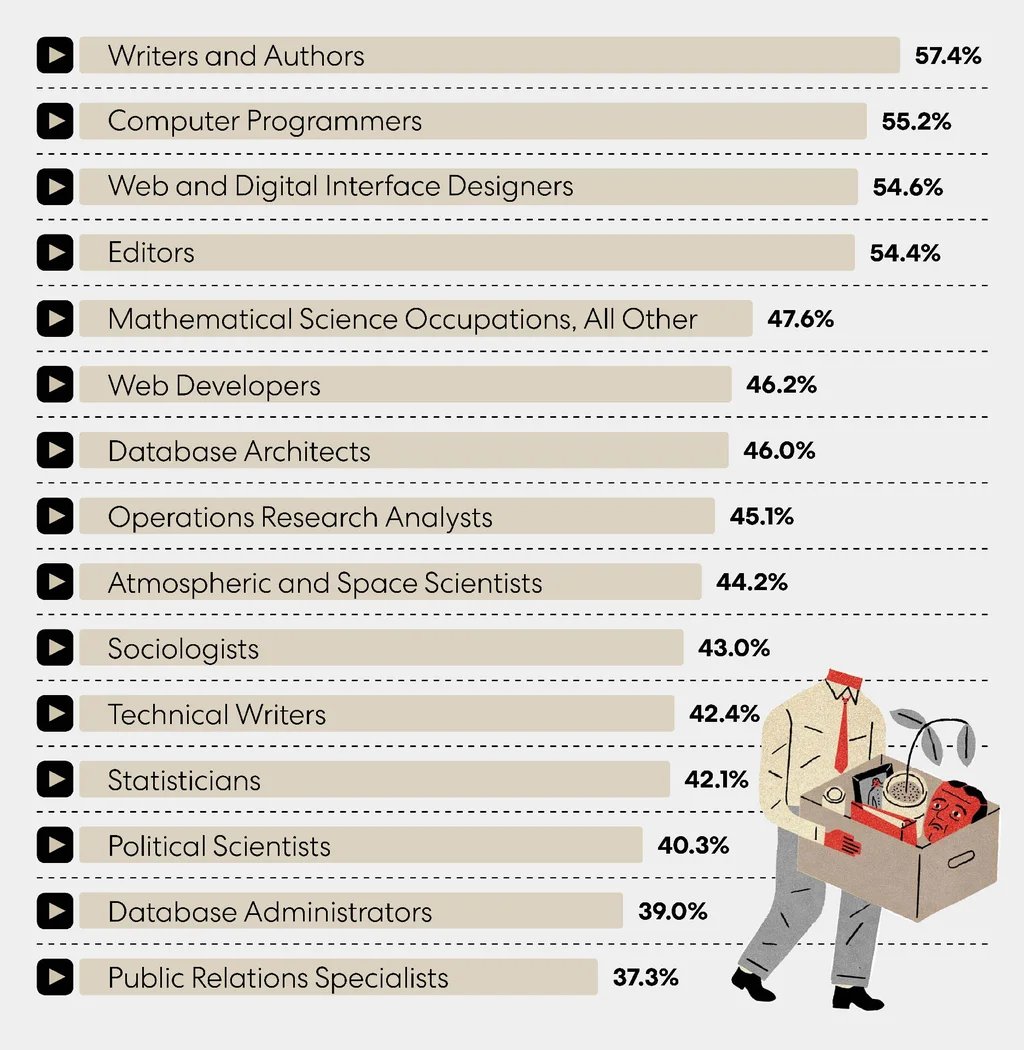
Risky Business
White-collar occupations with the highest estimated percentage of job loss due to AI in the next 2 to 5 years
In October 2025, three former high school debate partners became the world’s youngest self-made billionaires, beating Mark Zuckerberg to their first billion by about a year. Brendan Foody, Adarsh Hiremath, and Surya Midha—all 22 at the time and all college dropouts—built Mercor, an AI training company valued at $10 billion, on a single bet: that the labs would pay big for human expertise.
They were right. The company now pays out as much as $5 million a day to the experts on its books, says Foody, the Mercor CEO. The average pay is around $125 an hour—roughly the same as a physician and almost twice as much as the average executive, according to data from the U.S. Bureau of Labor Statistics. More than 100,000 people are on Mercor’s books, Foody says, including software engineers, scientists, architects, cinematographers, and more. Even that supply of world experts isn’t enough for the AI labs Mercor works with. Demand, Foody says, runs at three or four times what the company can supply.
AI training wasn’t always like this. Historically, the industry has relied on millions of underpaid, contracted workers in less economically developed countries in Africa and Asia. Outsourcing companies tasked them with drawing boxes around stop signs, tagging photographs of cats and dogs to train systems how to distinguish between them, and—at the worst level—watching and describing gory videos of unimaginable horror to train AI models to not reproduce them or to reject requests to interact with them.
The work during that era was essentially “this is an elbow, this is an elbow, this is an elbow,” says Lauren Vogel, a PhD in forensic psychology who works as a data operations and project management specialist at the AI training firm Surge AI. It was commoditized and low paid—less “training” and more “AI data labeling.”
Edwin Chen, who founded Surge AI in 2020 and bootstrapped it to more than $1 billion in revenue without taking venture capital, bristles at the term “data labeling.” His vision from the start, he says, was that “we should be using the full power of the human brain to train AI”—but a specific kind of AI that might one day help cure cancer or publish breakthrough mathematics rather than draw rectangles. Surge, which is reportedly valued at between $15 billion and $25 billion, counts OpenAI, Google, Anthropic, and Meta among its customers. Chen prefers to think of its network of “hundreds of thousands” of gig workers, who are paid what the company describes as a competitive wage, as expert teachers who challenge how a pupil thinks—in this case the AI.
Luca Sessini, an Italian lawyer who works as a contractor through Mercor, has watched the emergence of these new AI training companies, first as someone training the models, then as a central figure in the bubbling ecosystem around it. He runs a subreddit for people looking to get into AI training and his own advice platform, Aitrainingjobs.it. “There was a significant lack of available information about companies, project opportunities, and pay rates,” he says. (Sessini says the pay for the legal work he does starts at around $80 an hour.)
AI gig workers tend to fall into three loose camps. There are those who feel a higher purpose: A doctor who’s spent two decades in emergency rooms might want models to dispense better medical advice, knowing that patients increasingly turn to ChatGPT before walking into the ER. There are also professionals who can feel AI reshaping their fields and want to understand it from the inside—before it reshapes them. Some see a chance to diversify their income with knowledge they already possess. Most people, Sessini says, are motivated by a mix of all three.
Stefanos Aretakis, a tenured general relativity researcher at the University of Toronto who has a black hole phenomenon named after him, is pragmatic about his work training AI models on math challenges for Surge AI. AI is here to stay, and contributing to its development is “a duty, not something that I do for fun,” he says. Part of his brief is to invent Mathematical Olympiad-style and research-level problems the models can’t yet solve, then teach them how to do so.
Arshom Foroutan, a physician who started with Mercor about a year ago, just as he finished his residency, likes how the training role tasks him with problem-solving in a way that his day job doesn’t, as well as the pay. That works out to roughly what he would earn as a doctor, potentially doubling his income if he were to work full time at it, which he doesn’t currently. His task is to build clinical scenarios knotty enough to make the model fail, then correct it. Medicine, he points out, is full of nuance and competing variables that textbook cases don’t have. And that’s precisely where the machines, which have been trained on those textbooks, stumble.
Neither is particularly worried that their short-term monetary gain, obtained through a few hours of work here and there around their main jobs, may lead to a long-term loss of employment. Foroutan sees AI opening up the amount of care he can give rather than closing his profession down. The point of teaching, Aretakis says, “is that my students become better than me.” If an AI model becomes a better mathematician than he is, the whole of society inherits a brilliant tutor.
Mercor’s Foody agrees, saying the fear that automation destroys jobs is just the modern-day version of the early-19th-century Luddites. “The Luddites were not right in their assumptions,” he says, “because there is no shortage of things that we could do as an economy.” On a five-to-10-year horizon, Foody insists, “there’s just going to be more jobs than there are today.”
Is the trade of human expertise for AI competency worth it? This issue isn’t just potential job loss; it’s that an entire economy is being built to lean on a technology that, by design, looks backward. Carissa Véliz, an associate professor of philosophy at the University of Oxford’s Institute for Ethics in AI, worries that training AI to get better encourages us to accept “the good enough rather than being ambitious and valuing the best possible product.” We end up swapping excellence for productivity in fields where truth, and even beauty, matters. A technology built on prediction, she warns, tends to rehash the past, narrowing human agency and, with it, the room for genuine innovation.
Meanwhile, for all the talk of higher purpose, the work isn’t fulfilling—or even reliably paid—for everyone. For generalist contractors who answer open calls rather than being recruited for a specialty, the deal is shakier. On Reddit’s remote-work forums, as well as communities run by the likes of the Italian lawyer Sessini, posts claiming “AI training jobs are a scam” are numerous. Many complaints follow similar patterns, where posters share war stories about lengthy unpaid “assessments” that look suspiciously like free labor, interviews that lead nowhere, or accounts on the platforms being deactivated before thousands of dollars in earnings can be paid out. On the consumer review platform Trustpilot, one worker for an AI training company describes being banned for unsubstantiated accusations of fraud with $3,000 worth of work still unpaid.
Even workers at the top of their fields wonder how long they can stay ahead of the thing they’re teaching. Bogdan Grechuk, a mathematician at the University of Leicester who trains AI systems for Surge and was also approached by Epoch AI, a competitor, has watched the ground shift beneath him thanks to AI. He’ll design a problem he is convinced no model will crack for another two years, feed it to the latest version of ChatGPT, and watch it return an answer in half an hour. Experts like him are, he reckons, paid to stand at the edge of what the machines can do—and the edge keeps moving toward them.
There will likely be far more people standing at that edge in the years to come. Foody expects Mercor’s roster of contractors to increase from hundreds of thousands into the hundreds of millions. “If I had to play things forward 10 years,” he says, “most jobs in the economy will be very significantly training agents in one form or another.” In that future world, experts will be valuable until the day they can no longer ask a question their pupil can’t answer.
Some experts, at least, are sanguine about that prospect. We’ve been through similar upheavals before, says Aretakis, the black hole researcher. Previous huge technological changes still left plenty of people working 12-hour days and taking two weeks’ vacation a year, barely seeing their kids. If these tools can undo some of that by outsourcing grunt work that frees up more time for workers, being out-thought by his own pupil is a price he is glad to pay. Even a tiny contribution to that future, he says, would leave him “extremely happy to do it.” The result, he hopes, is a world in which “humanity will become more human.”
It’s a hopeful thought. But whether the experts end up enriched or expendable, and whether the rest of us find our working lives lightened or hollowed out, one thing is already settled. The founders selling other people’s expertise to the labs—Foody and his peers—will be sitting comfortably long after the edge has moved past everyone they hired.



