
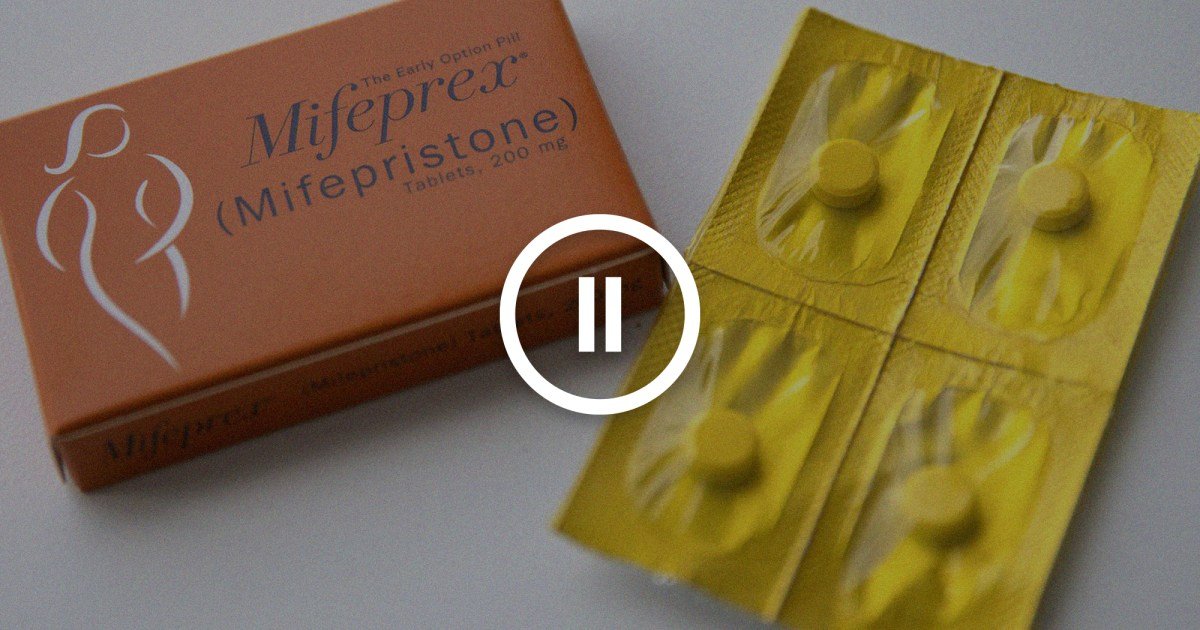
Mother Jones illustration; Erin Hooley/Chicago Tribune/Tribune News Service/Getty
The Supreme Court has rejected a federal appeals court’s attempt to end telemedicine and mail-order abortions, hitting pause on a fast-moving case that threatened to decimate access to abortion pills nationwide.
The one-paragraph SCOTUS order, issued late Thursday afternoon, means that for the foreseeable future, the abortion pill mifepristone can continue to be prescribed via telehealth and sent through the mail, even to patients living in states where abortion is banned.
“The number one message that we want to get across is that telehealth care is still available across the country,” said Lizzy Hinkley, legal director of the Abortion Coalition for Telemedicine.
Abortion patients, providers, and advocates have been in turmoil since May 1, when the far-right Fifth Circuit Court of Appeals issued an order suspending FDA rules that allowed online dispensing of mifepristone. That order was stayed by Justice Samuel Alito for 10 days while the Supreme Court struggled to decide how to proceed in a potentially monumental—and politically explosive—case.
Since the 2022 Dobbs decision overturning Roe v. Wade, more than a dozen Republican-dominated legislatures have enacted laws that severely restrict or ban abortion within their borders. But over the past four years, the number of abortions has risen nationwide, including in states where abortion is almost entirely illegal.
Abortion foes blame Obama- and Biden-era FDA rule changes expanding access to mifepristone, one of two drugs used in the standard abortion-pill regimen, including a 2023 rule that eliminated a requirement for in-person dispensing. Now, almost two-thirds of abortions in the US happen with abortion pills, and nearly 30 percent occur by telemedicine.
Louisiana sued the FDA last fall, arguing that the 2023 rule change was arbitrary, capricious, and “avowedly political”—not based on sound science, the suit claimed, but on Democrats’ determination to negate the Supreme Court’s intent in Dobbs to return abortion policy to the states.
The FDA argued that the lawsuit would disrupt its own, ongoing review of mifepristone’s safety, announced last fall. Mifepristone’s manufacturers, Danco Laboratories and GenBioPro Inc., warned of the potentially dire consequences of allowing states to upend drug regulations put in place years or even decades ago.
On Thursday, Alito—the arch-conservative who authored the Dobbs decision—was one of two justices who wrote in favor of letting the Fifth Circuit’s order go into effect. That would have cut off the supply of mail-order mifepristone to states like Louisiana, where telehealth providers are sending nearly 1,000 packages of abortion pills every month.
“Even this conservative Supreme Court is not willing to endorse anti-abortion extremists’ latest desperate attempt to deprive women of needed healthcare.”
Alito blasted his fellow justices’ decision to pause the Fifth Circuit order as “unreasoned” and “remarkable.” He also ranted about blue-state shield laws, which provide the legal protections that make it possible for telehealth providers to care for patients in states where abortion is restricted or banned. Such laws, he said, are “a scheme” to thwart states like Louisiana, which has some of the toughest anti-abortion restrictions in the country.
In his dissent, Justice Clarence Thomas brought up the Comstock Act, a Victorian-era federal criminal statute that conservatives argue remains the law of the land. If enforced, it would amount to a national abortion ban.
Comstock “bans using ‘the mails’ to ship any ‘drug . . . for producing abortion,’” Thomas wrote, and suggested that Danco and GenBioPro are engaged in a “criminal enterprise.” He said the drug companies—which appealed the Fifth Circuit ruling to SCOTUS—”cannot be irreparably harmed by [an] order that makes it more difficult for them to commit crimes.”
Abortion advocates expressed relief that the other justices—including several who have repeatedly ruled against abortion rights—did not let the Fifth Circuit ruling take effect. “Even this conservative Supreme Court is not willing to endorse anti-abortion extremists’ latest desperate attempt to deprive women of needed healthcare,” Hinkley said. She called the case “a deliberate effort to disrupt access to telemedicine abortion across the country and cause undue confusion among patients and providers.”
“The ban on mifepristone through telemedicine was never about safety,” said Dr. Angel Foster, a telemedicine provider and co-founder of The Massachusetts Medication Abortion Access Project, or The MAP. “It was about controlling people’s bodies and lives.”
But the reprieve is only temporary, she added. “Lawmakers have made it clear they are desperate to block access to medication abortion by any means necessary.”



