
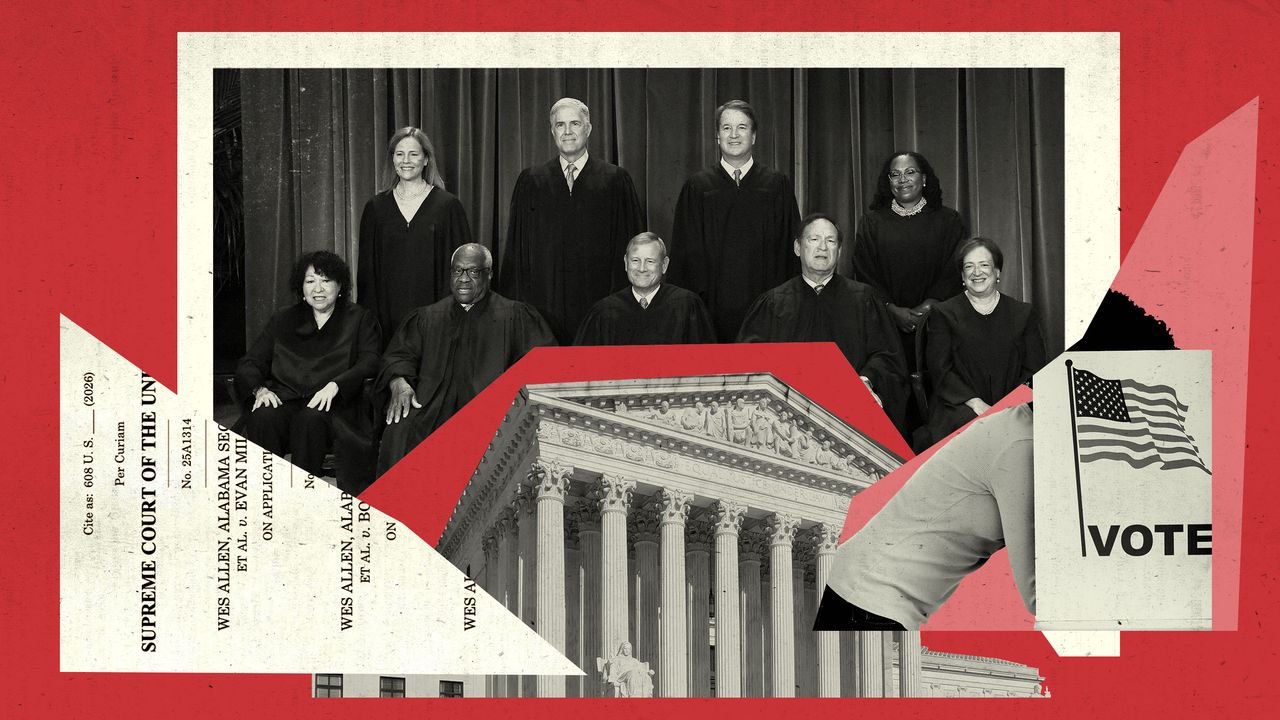
When the Supreme Court issued its ruling in Louisiana v. Callais, in late April, gutting what remained of the Voting Rights Act of 1965, it insisted, unconvincingly, that it was merely offering an “update,” clarifying the precise standards for determining violations of the law. Last week, the Court issued an unsigned order in a long-running case involving congressional redistricting in Alabama that exposed that obvious fiction. The four-page order, issued on the Court’s emergency, or shadow, docket, makes clear that Section 2 of the Voting Rights Act—which is supposed to protect against voting procedures, such as drawing skewed district lines, that have the intent or effect of discriminating against racial minorities—is a dead letter. There remains no feasible route, under the Voting Rights Act or the Constitution, to challenging district lines that prevent Black voters from electing candidates of their choice.
For years, Alabama had balked at obeying a series of orders, including from the Supreme Court itself, to insure that its Black voters have a voice in how they are governed. The conservative Justices rewarded this strategy, rebuking not Alabama but the lower court for not being deferential enough to a state that had repeatedly demonstrated its determination to delay and obstruct. And, despite repeated lectures about the danger of changing voting rules too close to an election, the Court in effect invited state legislatures to do precisely that. It has produced a system impenetrably rigged against the voters that the law was supposed to protect.
More than a quarter of Alabama’s residents are Black, but, with the Court’s intervention, just one of the state’s seven congressional districts is likely to be held next year by a Black representative. This outcome will be no accident. The lower court—some disputes under the Voting Rights Act are heard by a three-judge panel—repeatedly found that, in redrawing congressional districts in the aftermath of the 2020 census, Alabama lawmakers intentionally discriminated against Black voters. In the lingo of redistricting, they “packed” one majority-minority district with Black voters and “cracked” the rest among three other districts. To fix the problem, the court instructed Alabama to create a second majority-minority district. This conclusion was no ideologically driven result: the three judges include two appointed by President Donald Trump during his first term, and a Bill Clinton nominee.
The case made its first emergency trip to the Supreme Court in February, 2022, when the Justices, splitting 5–4 (Chief Justice John Roberts joined the three liberals), overturned the lower court’s order and granted Alabama’s request that elections proceed that year under the discriminatory map. Justice Brett Kavanaugh, noting that absentee voting in Alabama’s primaries would begin in just seven weeks, invoked what is known as the Purcell principle, after a voting-rights case from 2006, that federal courts should not intercede to block a state’s election laws in the period close to an election. “The District Court’s order would require heroic efforts by those state and local authorities in the next few weeks—and even heroic efforts likely would not be enough to avoid chaos and confusion,” Kavanaugh wrote then.
After the election, the Supreme Court, to the surprise of many observers, decided that the lower court was correct after all—the voting had been conducted under a map that most likely violated Section 2, and Alabama needed to redraw its districts accordingly. (In this round, Kavanaugh largely joined Roberts and the Court’s three liberals.) But the state did not give up so easily. In 2023, Alabama’s legislature approved another map with a single majority-minority district, drawing a sharp rebuke from the lower court, which pronounced itself “deeply troubled that the State enacted a map that the State readily admits does not provide the remedy we said federal law requires.” The court appointed its own experts to draw new districts in time for the 2024 election, which resulted in the election of two Black representatives. In 2025, as Alabama continued to contest the case, the lower court ruled for the third time that Alabama had violated Section 2—“not a close call,” it noted. The court also went further, finding that Alabama had violated the Constitution. “Try as we might, we cannot understand the 2023 Plan as anything other than an intentional effort to dilute Black Alabamians’ voting strength and evade the unambiguous requirements of court orders standing in the way,” the court said. “This amounted to intentional racial discrimination in violation of the Fourteenth Amendment’s Equal Protection guarantee.”



