
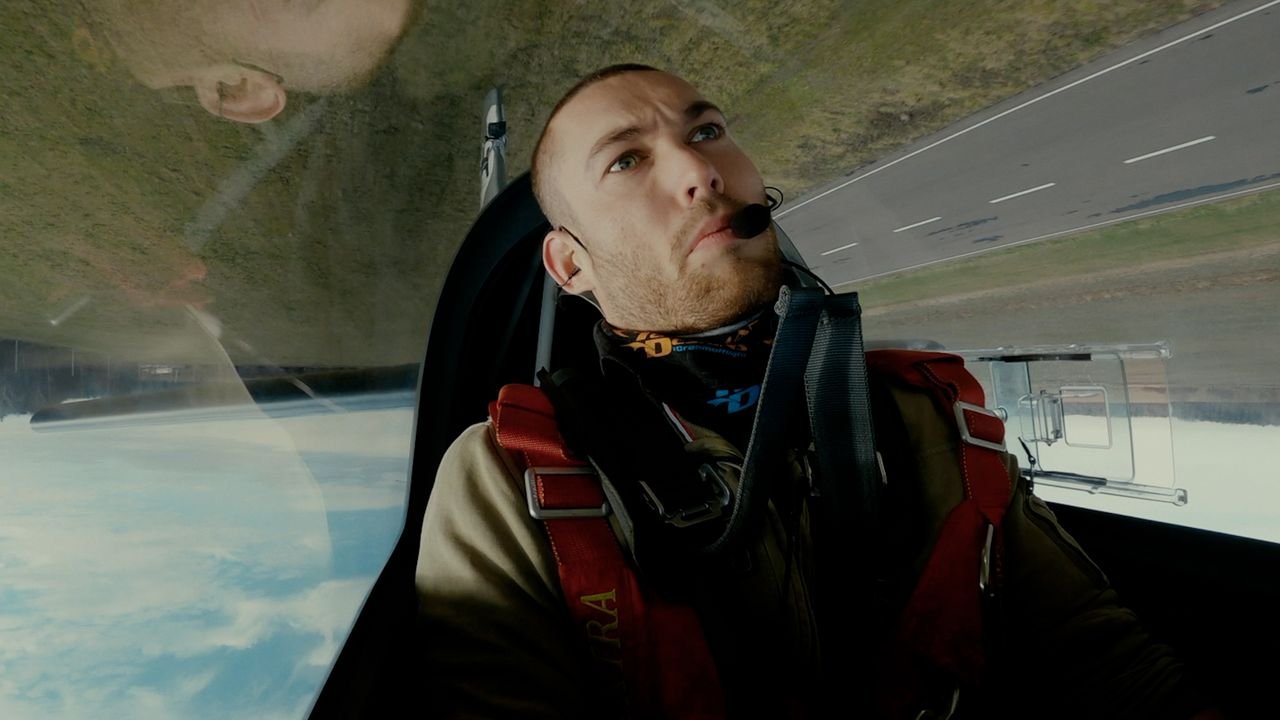
After Russia invaded Ukraine, Slipkan told Air Force recruiters that he could fly a fighter jet, but they said that he was too old. He became an infantry soldier in the Territorial Defense Forces instead. For three months, he served outside Mykolaiv, near the Black Sea, and completed a pair of ten-day rotations. To his frustration, he didn’t fight in any battles.
In August, 2022, Slipkan borrowed a Yak-52—an aerobatics plane—and, along with a door gunner, began searching for Russian reconnaissance drones. They took periodic flights for nine months but hit no targets, in part because it was so hard to locate the drones at night. When he met Fatkullin, the two realized that they shared an ambition to hunt Shaheds, and decided to team up. Slipkan told Fatkullin that a businessman he knew from his Africa days had lent him an Antonov-28 that had been used for skydiving before the war. Slipkan admired Fatkullin’s piloting skills, telling me that, just as some swimmers feel most comfortable in the water, “Timur feels better in the sky.”
The admiration was mutual. Fatkullin loved hearing Slipkan’s tales about his Soviet missions in fighter jets. And Fatkullin was deeply moved when he learned that Slipkan had suffered personally in the war. In September, 2022, his son was killed on the front line, in circumstances that he still finds almost impossible to discuss. Slipkan told me recently, “Everything that I’m not able to give to my son anymore, I give to Timur and the guys.”
For a year, the two men petitioned Ukrainian military authorities to let them form a unit for shooting down Shaheds. Meanwhile, the incidence of drone attacks on Ukraine was increasing. But, in Fatkullin’s telling, nobody in a senior defense role wanted responsibility for the unit. Eventually, in June, 2025, the necessary paperwork was signed, after Fatkullin and Slipkan agreed to be liable if they caused an accident or downed a drone over a populated area. Technically, the group would be a volunteer unit of Ukraine’s Territorial Defense Forces, but under the operative control of the Air Force. Officially, the unit was called the Air Defense Group. Privately, Ukrainians called it Aerotim.
One of the first people Fatkullin contacted was Serhii Gusak, the motorbike daredevil. Gusak, a pacifist, had spent the war true to his principles. For the first year, he had delivered humanitarian aid in Kyiv and eastern Ukraine on behalf of charities. He also soldered parts for a firm making interceptor drones that the Ukrainians used to target Russia’s reconnaissance aircraft. But he wanted to find a more active way to defend his country. He considered training as a medical-evacuation worker for injured fighters.
Fatkullin’s call came as a relief. Joining the unit would let Gusak protect Ukrainians without getting blood on his hands. (Fatkullin told me that his friend “doesn’t want to kill Russians,” adding, “I don’t have this problem.”) Fatkullin proposed that Gusak become his door gunner, shooting drones with a minigun. The work was perilous, because the door gunner would be more exposed to shrapnel than the rest of the crew, but Gusak accepted the role. He received two days of training from a former military officer on how to work and maintain the weapon.



