
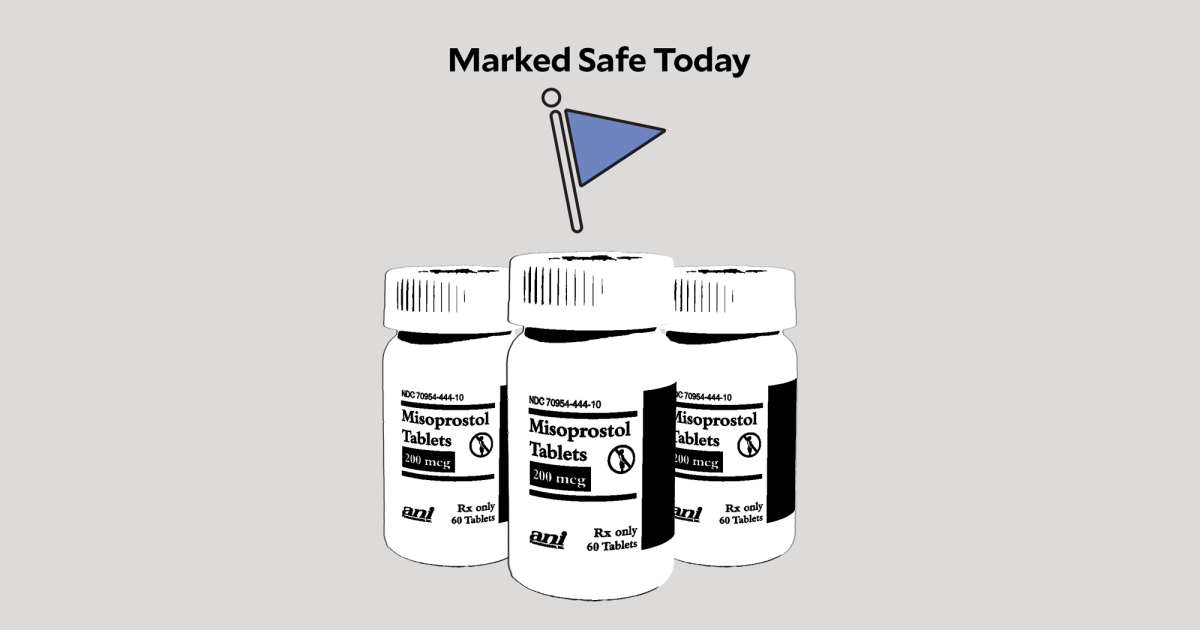
Mother Jones illustration
Medication abortion is back at the US Supreme Court—which is exactly where abortion opponents want it. Last week, in a late Friday afternoon move guaranteed to stoke maximum confusion and panic, the Fifth Circuit Court of Appeals blocked a Food and Drug Administration rule allowing telemedicine prescription of mifepristone, one of two drugs that make up the gold-standard abortion-pill regimen. On Monday morning, Supreme Court Justice Samuel Alito put that ruling on pause until May 11.
But even as abortion advocates expressed relief that telemedicine abortions can continue for a few more days, the order by Alito—the same ultraconservative who wrote the Dobbs decision overturning Roe v. Wade in 2022—was at best a reprieve. At some point soon, the court’s right-wing supermajority could drastically curtail or cut off access by mail to an extremely safe and effective drug that has been used by hundreds of thousands of women a year since Dobbs, including in states where abortion is banned. Almost two-thirds of abortions in the US now happen with pills, and nearly 30 percent occur by telemedicine.
Abortion activists have been watching the attacks on mifepristone for a long time, and they have a backup: misoprostol, the second drug in the gold-standard regimen. Developed in the 1970s to protect the stomach lining against ulcers, misoprostol also causes muscles in some parts of the body to contract. “In the uterus,” says Caitlin Gerdts, vice president for research at Ibis Reproductive Health, a nonprofit hub for abortion research around the globe, “what that means is cramping and then expulsion of what’s inside.” While misoprostol works exceedingly well in combination with mifepristone, it is also a highly effective abortion drug on its own. And abortion isn’t the half of it: “Misoprostol has a remarkable range of uses in the reproductive context,” Gerdts says, including induction of labor, miscarriage management, and treatment of postpartum hemorrhage.
Misosprostol is easier to obtain than mifepristone—in many countries, it’s available over the counter—making it the go-to method of terminating pregnancies in parts of the world where abortion is highly restricted and resources are scarce. If mifepristone is curtailed in the US, misoprostol-only abortions will likely become much more common here as well. Foreseeing that possibility, abortion opponents in Louisiana passed a law in 2024 reclassifying both drugs as dangerous controlled substances. Other states have considered something similar.
Meanwhile, abortion advocates are scrambling to switch to a misoprostol-only regimen if necessary, educating patients about what to expect (the side effects may be harsher), and spreading the word about medical hotlines, legal resources, and support networks so that women don’t put themselves at unnecessary risk. Educating medical providers unfamiliar with the drug is also critical. “Despite the fact that very good evidence exists for misoprostol’s effectiveness,” Gerdts says, “it’s really hard for clinicians to know what to believe or how to interpret it.”
Amid an increasingly hostile research environment, Ibis has launched US clinical trials comparing the two-drug regimen with misoprostol alone—the first such head-to-head study in the world. To learn more about the study and what may lie ahead for the misoprostol-only regime, I reached out to Gerdts, an epidemiologist by training, at her office in Oakland, California. Our conversation has been edited for length and clarity.
How did misoprostol become widely used as an abortion pill? It started in Latin America in the 1980s.
The origin story of misoprostol as an abortifacient is one of community need and innovation and discovery. It starts with pregnant people in Brazil reading the warning label for Cytotec, the brand name of misoprostol, which was available as an ulcer drug in a lot of pharmacies in Latin America. The label suggested that this was a medication that might cause a miscarriage. At the time, and still to this day, abortion was highly restricted in Brazil and across much of the region. So people started using misoprostol to terminate their pregnancies. They would end up having something that looked very much like a miscarriage, with bleeding but far fewer infections.
Soon, feminist activists started hearing about this, and the use of misoprostol as an abortifacient spread quickly across Latin America. Meanwhile, researchers started to document what was happening in emergency rooms. They found a real shift from the kinds of life-threatening complications that were so common [from illegal abortions]—perforated uteruses, septic infections, horrible injuries from ingesting toxic substances.
Given the high rates of maternal mortality from unsafe abortion around the world, that must have gotten a lot of people’s attention.
When you look at data on maternal mortality and morbidity in the region from the 1980s through the late 1990s, the trends are dramatic. You see a precipitous decline in maternal mortality and in the severity of [maternal complications] that is likely attributable to the rise in use of misoprostol for abortion.
“The origin story of misoprostol as an abortifacient is one of community need and innovation and discovery.”
Western medicine and researchers started to realize that misoprostol was an interesting and exciting innovation that could be potentially used in clinical [obstetric] practice. And so different clinical trials started. People started testing different dosages, regimens, routes of administration, timing between doses, and so forth, trying to figure out what is the most effective protocol for the use of misoprostol as an abortifacient.
But it is critical to remember that the first evidence about misoprostol as an abortion medication was based on the experiences of pregnant people themselves, generated within communities and spread by feminist activists. Then, as medication abortion became a part of standard clinical practice, the medical establishment claimed control and began to delegitimize the practice of self-managed abortion.
At almost the same time that women in Latin America were figuring out this new use for an ulcer medication, researchers in France were developing a drug that was intended to be an abortifacient—mifepristone, then known as RU-486, which the FDA approved in 2000. How does mifepristone work? And how did it come to be used with misoprostol?
Mifepristone blocks the hormone progesterone, which is necessary for a pregnancy to continue. It halts the growth of the pregnancy, thins the uterine lining, and loosens the pregnancy, causing it to detach from the uterus. But then the pregnancy tissue still needs to get out. When mifepristone was tested on its own, it wasn’t particularly effective. Although some people do have abortions with mifepristone alone, it’s not something you can rely on.
What misoprostol does is it contracts and expels. It squeezes the uterus and pushes things out. Researchers discovered that the two drugs, in combination, are incredibly effective. But misoprostol is the workhorse. Misoprostol is the original abortifacient medication.
The FDA approved misoprostol in 1988 as an ulcer medication. Is misoprostol-only abortion legal under FDA regulations?
All of the uses for misoprostol that we talked about [in the reproductive health context] are off-label uses. This is not just a misoprostol thing. Across medicine, drugs get used off-label for many, many indications. It’s an incredibly costly process [to get FDA approval for a new indication], so off-label use of medications is extremely common and supported by evidence.
Misoprostol is on the World Health Organization’s list of essential medicines for a number of indications, including postpartum hemorrhage, miscarriage, and abortion. It’s totally fine for US clinicians to prescribe off-label use of misoprostol for abortion. And importantly, the FDA doesn’t regulate misoprostol for abortion in the way that it regulates mifepristone. Mifepristone falls under the FDA’s Risk Evaluation and Mitigation Strategy program, which places major restrictions on who can prescribe it and how it can be dispensed. Historically, there was an in-person dispensing requirement, which the Biden administration got rid of during the pandemic. That’s the rule change that allowed for telemedicine prescribing and is at the center of the case now at the Supreme Court. Under the FDA rules, providers who do prescribe mifepristone have to sign up on a list that is publicly available.
But misoprostol has none of those restrictions. It’s an ulcer medication. Anybody who can prescribe medications can prescribe misoprostol, except in Louisiana. The Society of Family Planning and the National Abortion Federation both have a sample protocol for misoprostol-only abortion to help clinicians prescribe.
But from a clinician’s perspective, in a very litigious society, there are lots of reasons to have concerns. I totally get that.
One of those concerns is research suggesting that the misoprostol-only abortion regimen is much less effective than the two-drug combo. But a lot of that bad rap seems to come from its origins as something that women figured out how to use on their own, without doctors and governments telling them it was OK.
The early research on misoprostol-only abortion was trial and error, because the drug was not created to be an abortifacient. The clinical trials were not aimed at that or at any of the other obstetric or gynecologic indications—this drug was for treating ulcers.
It was only after we realized the profound implications of this medication that there started to be trials for postpartum hemorrhage, for induction of labor, and for abortion. As researchers built that evidence base, you can see the effectiveness of the drug getting higher, not because there’s a change in the pharmacokinetics of misoprostol but because we were figuring out what was going to work and what the best protocol was going to be. For people through 12 weeks’ gestation, the currently recommended regimen is three to four 800-microgram doses taken three hours apart. It’s most effective if it is dissolved under the tongue or buccally—in the cavity between the cheek and the gum—or taken vaginally.
However, the early trials are still in the published literature. A systematic review in 2019 found that the misoprostol-only regimen was 78 percent effective—meaning women had complete abortions without procedural intervention—versus 95 to 98 percent effectiveness for mifepristone and misoprostol combined. But that analysis included extremely outdated regimens that we would never use now. In 2024, we did another review of the literature in the New England Journal of Medicine that only included studies that use the currently recommended regimen. Those newer studies show that the effectiveness of misoprostol alone for abortions is much closer to 90 percent—and in some studies, it’s 100 percent.
In another recent study, you partnered with “accompaniment groups”—networks of mostly women who help other women gain access to abortion meds, educate them about what to expect, and then support them while they take the pills and afterwards. These networks are highly organized and have become very common in some parts of the world. In the US, we call them community support networks or abortion doulas.
In the SAFE Study, we recruited more than 1,000 people who had called accompaniment groups in Argentina and Nigeria for help getting abortion pills, then compared their experiences of the two regimens. We found that self-managed abortion with accompaniment group support was no less effective than clinician-managed abortion. When the study was published, the main findings were, perhaps, less surprising to the [reproductive health] field than the fact that we had almost 100 percent effectiveness for misoprostol-only abortion. For the two-drug regimen, it was around 94 percent. Those numbers blew everyone’s minds except for our partners, who have been using misoprostol-only for decades and know that it is safe and incredibly effective. The SAFE study confirmed the need to take another look at misoprostol only, not just as a second-tier abortion medication regimen, but as an important tool in the abortion toolkit. It is the workhorse globally.
Misoprostol-only abortion also has a reputation as being no fun for patients, with symptoms like nausea, diarrhea, and serious cramping. What is the experience typically of people who have a miso-only abortion versus the two-drug combo?
The honest answer is that we don’t know, because we do not have head-to-head data. The fact is, medication abortion may not be a particularly pleasant process, no matter how you go through it. When you have a medication abortion with mifepristone, you also use misoprostol, so you can also experience nausea and vomiting and all of those symptoms.
I think the outdated data has helped reinforce this bias against misoprostol as being unpleasant. Clinicians start thinking, “Oh, misoprostol isn’t good. It’s so much harder [for patients], it’s a much worse experience.” One potential issue is that if you tell people who are having misoprostol-only abortions that they’re going to have a really painful, horrible, terrible experience, they may be unnecessarily concerned about what is going to happen, and may be more inclined to seek care that could potentially place them at increased risk for criminalization.
In the SAFE study, people reported really good abortion experiences with both regimens. Of course, they are supported by accompaniment groups who know and trust misoprostol and are counseling people on the full experience. So their understanding of what to expect is probably different from a clinician who’s never prescribed misoprostol before and has concerns.
How essential is that kind of help—maybe from a friend or an abortion doula—to having a safe, effective, good abortion using misoprostol only?
From a safety perspective, people do not, technically speaking, need to have someone with them as they go through this process. However, people have a range of emotional needs and logistical needs. People should have what they want and what they need. So for some people, doing it on their own with the internet and not having to tell anybody is exactly what they want. For other people, having somebody on the phone who they can reach out to at any point for reassurance is exactly what they want. Some people want to go into an office and have their doctor explain it to them. Some want to have a procedural abortion. All of those are valid options.
“The important thing is, you don’t need a doctor or a nurse to do this safely, but you do need accurate information about what to expect.”
What is so clearly demonstrated by all of the research on accompaniment networks and abortion access globally is that virtually none of these people have any clinical training whatsoever. They have training in the medication protocols, and they know how to counsel people about what to expect. The important thing is, you don’t need a doctor or a nurse to do this safely, but you do need accurate information about what to expect.
Now you and your colleagues are conducting a new clinical trial in the US, funded by private donors, that is aimed at answering a lot of the lingering questions.
The MORE Study is a multi-site clinical trial in the US to directly compare the effectiveness of the currently recommended misoprostol-only regimen to the combined mifepristone-misoprostol regimen. It is an incredible opportunity to study both regimens and document people’s experiences with bleeding, cramping, and nausea; their needs for care; different gestational stages—everything you can think of. We will have an immensely rich data set to be able to finally compare the two regimens head-to-head. We are actively recruiting participants across four to five brick-and-mortar sites. It’s an enormous undertaking. We’re really excited about it.
In this increasingly constrained legal environment, we need better information for prescribers and for people seeking abortions. We need people’s own words, data, and experiences to be able to finally say, here’s how the two regimens are different, here’s what to expect.
That’s something I’ve been hearing from more and more abortion advocates: It’s really important to keep patients out of the ER if they don’t actually need to be there, because that’s where they are most likely to be criminalized.
We need to document these experiences so that clinicians and counselors and doulas and support people can make sure that people who are having misoprostol-only abortions—and mifepristone-misoprostol abortions—have the best information that they possibly can.
Misoprostol is an incredibly important tool in our toolbox. Especially for folks in states where abortion is banned, it’s important that they understand the realm of normal, so that they do not seek medically unnecessary care—and if they need to seek care, they’re doing so in a way that is not putting them at legal risk.



