
Picture this: You’re at the gate, shoes pinching after a long walk through the terminal, and you know you packed your flats. They’re right there, somewhere in your carry-on. But getting to them means hoisting the bag onto a bench, unzipping the clamshell, and watching your carefully packed clothes threaten to spill out onto the airport floor. By the time you’ve wrestled the bag back together, your flight is boarding.
It’s a scenario that has played out in airports for decades—because for all the advances in materials and wheels and tracking technology, the fundamental architecture of the carry-on suitcase has barely changed. Open from the middle, split in half, dig around, repack, repeat.
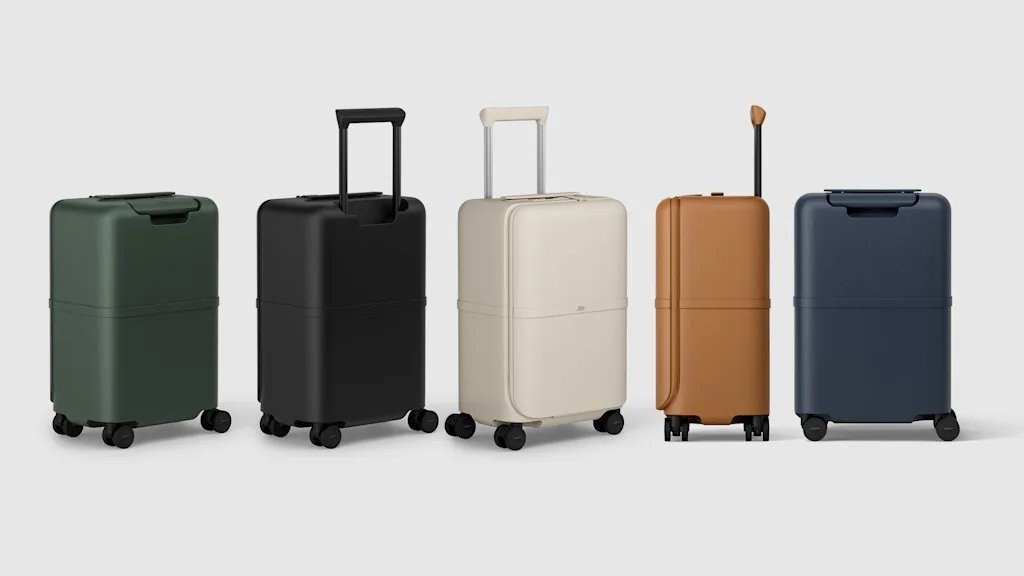
July, the 7-year-old Australian travel brand that has built a following by rethinking luggage design, is betting there’s a better way. On April 23, the company launches the Capsule Carry-On, a $395 bag built around a top-down packing system, with a lid that opens at the top rather than splitting the bag in half. It’s a bet that goes beyond product design: As competitors fold and struggle, July believes that real engineering breakthroughs—not just new colorways—are what keep a luggage brand alive.
It’s a design shift that sounds simple, but it wasn’t. It required solving a complex engineering problem. Standard carry-ons are made from polycarbonate sheets vacuum-formed into shape. The sheets must have a certain thickness, otherwise the plastic weakens. That’s a problem when your design calls for a deep base and a slim lid. July’s solution was to engineer a single-piece formed shell that has a consistent thickness throughout—a manufacturing feat that required close collaboration with its factory partners to pull off.

July’s design team is constantly gathering feedback from travelers as it develops products. The insight that drove this design came from conversations with Quantas flight attendants, who regularly need to swap shoes mid-shift but have nowhere to lay a suitcase down in the galley of an aircraft. July’s answer was to create the “QuickGrab” feature—a pocket that’s accessible when you open the lid of the Capsule, allowing you to quickly access items inside your bag.
“If you want to switch from heels to flats or grab a . . . jumper, you can just quickly grab it while standing up,” says July cofounder Athan Didaskalou.

The format also transforms the experience at your destination. With a clamshell suitcase, you need enough space to unzip it so you can access both compartments. They don’t fit on most hotel luggage racks. If you’re in a tiny New York hotel, there may not be enough space anywhere but the bed. “You know you’ve been rolling your suitcase across dirty streets, but you have no choice but to place it on your clean new bedsheets,” Didaskalou says.
With the Capsule design, you can simply put the bag down and open the lid. It takes up roughly half the footprint. Didaskalou also says it changes the kinds of items you can pack. You can lay a hat or a basketball inside the suitcase and simply close the top. With a clamshell, these items would be crushed by the middle divider. “It’s a small reconfiguration of space, but it opens up a range of possibilities,” he says.
Two more features round out the redesign. Travelers complained about suitcases rolling away on train platforms and inclined airport walkways, so July engineered “SilentMove”: lockable wheels controlled by a small switch at the handle base. And the bag ships with CaseSafe, July’s Transportation Security Administration-compliant lock with integrated tracking via Apple Find My and Google Find My Device.

Didaskalou says innovation has been core to July’s business model, and nowhere is that more valued than in the Asia Pacific markets where the brand does significant business. July is opening stores in Singapore and Kuala Lumpur this year. “As an Australian brand, our domestic market is small, roughly 25 million people, so we need to have a global outlook,” he says. “We’ve found that in the Asian market, they love these little engineering details.”
That focus on product has also become a survival strategy. Paravel, a sustainability-focused luggage startup, filed for bankruptcy earlier this year. Away, once valued at $1.4 billion, has gone through multiple rounds of layoffs. Both companies grew fast on VC capital, then struggled to turn a profit. July took a different path.
“In Australia, we don’t have as much access to capital, so we focus on the old-school business tactics of growth, profitability, and customer satisfaction,” Didaskalou says. “We can’t just change the color of the suitcase and hope it gets people excited.”



