
When two souls meet, they are destined to part; and when they part, they are destined to meet again. Kim Jin-yu explores the bittersweetness of the reunion through his latest independent feature, “Journey There”. The slice-of-life drama revolves around Moon Chun-hee (Kim Hye-ok), an elderly woman who moves out of her husband’s home to follow him into the afterlife. When his grand piano gets in the way of downsizing, her new neighbor, a German Korean adoptee and composer, Min-jun (Justin H. Min), happily picks it up. As they cross paths again and again, they realize – little by little – that the belonging they were searching for was right in front of them all along.
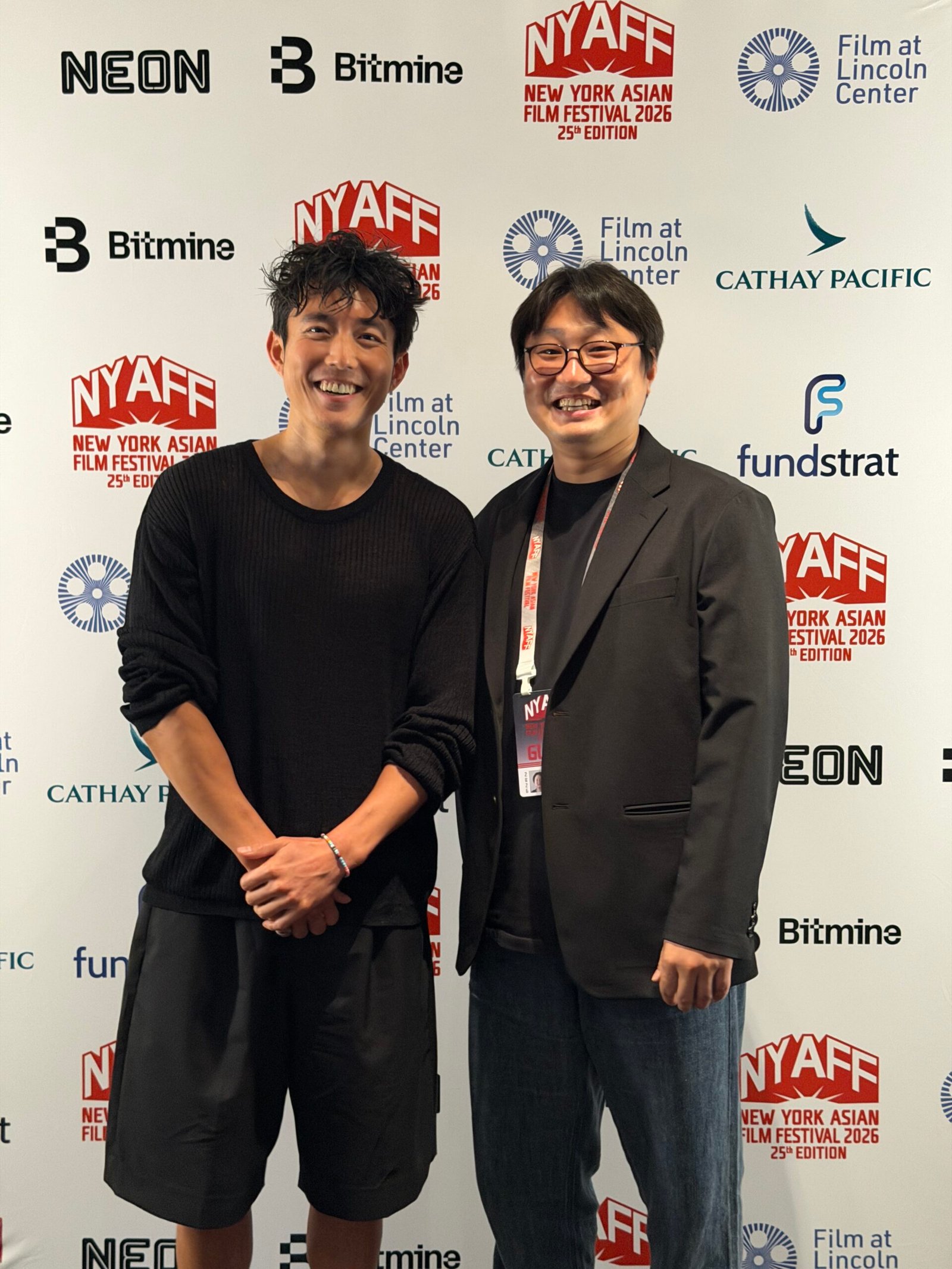
We had the opportunity to speak with director Kim Jin-yu and actor Justin H. Min at the New York Asian Film Festival this year, where the feature made its North American premiere. Over the course of the Zoom conversation, we covered filming in the U.S. versus Korea, their favorite foods on set (hint: it’s not what you think it might be), and of course, death.
This interview has been edited and redacted for clarity. Translation has been made possible through the New York Asian Film Festival.
How did you two meet?
Kim Jin-yu (KJY): I contacted his management in Korea and sent the script over to them. I heard from Justin that his mom really loved that he was working on this project more than anyone else.
Justin H. Min (JHM): It was my first big Korean project, so I ran it by my parents. They got to read the script and were like, “You have to do this. This is so good.” I loved it myself, so this was just confirmation. I got to meet our director as soon as I got to Korea during pre-production.
Justin, what about the script spoke to you?
JHM: So many things. I have so many friends of mine whose parents have passed. A couple of my grandparents have passed as well. When you get older, you start to think about death and mortality and the limited time we have here. This is a story that explores those things, in a beautifully hopeful way. The idea of found family is really beautiful as well. Sometimes the connections that we form in our lives end up being the most meaningful relationships that we have.
Kim Jin-yu, did you adjust the role for Justin at all?
KJY: No, there weren’t any particular adjustments I had to make for Justin. I wanted him to feel as free as he could to try things on set, acting-wise. I wanted him to feel comfortable working with the character.
How did directing work on the ground? Were you all speaking in Korean or English?
KJY: Since I am not fluent in English, I used limited words. When I look back, I wonder if it was really rude of me. Some phrases I would use for Justin were like, “Energy up!” or “Energy down.” I would try to communicate as much as I could with him in Korean.
JHM: I understand most Korean, so that was fine. But even in those moments where we didn’t understand each other fully, I think there was a deeper level of understanding outside of the language that helped us connect to the characters in the story. Since Min-jun is a fish out of water in Korea, he feels a little displaced. He doesn’t fully understand where he comes from and what his identity is. So, anytime those moments of dissonance came up on set, we leaned into them, because this is who his character was.
Justin, most of your career before this was in North America. Was it different for you to film in Korea versus the US?
JHM: It had been a dream of mine to work more in Korea, since I am such a huge fan of the Korean film industry. I grew up watching a lot of Korean films and dramas with my parents, so I had been hoping and praying to work with the Korean film market. Fortunately, my manager Martin was able to bring me the script, so it all happened.
In terms of making a movie, it’s very similar. Obviously there were some cultural differences, but other than that, it was just like making a movie here in the States.
I heard from other Korea diaspora directors and actors that, when they film in Korea, the food is always better.
KJY: Oh my god! (laughs)
JHM: Absolutely. A million times better.
KJY: (to Justin) Well, you only eat salads.
JHM: (to me) There is this narrative going around on the press tour, where both our lead actress and director say that I only ate salads while filming the movie. That’s not true at all. I love Korean food! I did have my share of salads, to be clear, because I love vegetables, but I ate other things. Since we filmed in Gangneung, I used to eat this hotteuk (Korean brown sugar pancakes) that were directly made from this woman’s kitchen.
What about you, Director?
KJY: Ah, when I was on set, I drank water the most. (laughs) I was feeling a little sensitive, since we were filming in my hometown.
JHM: It was a close, tight-knit community. Kim Jin-yu knows all the restaurant owners; his parents came and cooked as well. It was like a full-on family affair.
A very healthy set, over all! (all laugh)
Kim Jin-yu, how did you find the sets that you did for the film? It’s your hometown; but instead of the exterior, we see a lot of interiors of the apartments and this beautiful house.
KJY: So many of the places and locations in the film are familiar to me, because it is my hometown. The apartment building was actually the hardest to scout, because people were already living there. But I was able to actually scout and get permission to film there because I had drinks with the village chief. I also feel like I am able to do better storytelling in a place that I know well. I am very lucky to have been able to use these locations.
The beauty of these sets is how analog they feel, especially compared to how futuristic Seoul can be, nowadays.
KJY: This is a film that deals with death and mortality, and the ways in which we remember people and things that have passed on. And I think a good device to do that was to work with things that people have left behind – namely, the grand piano. These objects begin to take on their own meaning. I agree that this is not a film that looks to the future. Instead, this film asks us about how we want to live our present moment, and how we can receive objects and memories from the past to gain new meaning within ourselves.
It’s beautiful. So many adoption stories are about reunions, but this one is about the endings.
KJY: Society becomes better when people do not try to hold on tightly or try to possess something, but instead, when people are willing to give away something of their own. I do feel like objects are infused with a kind of wisdom and spirit passed on through generations.
JHM: Min-jun comes to Korea hoping to find his identity and his mother to fill this void in his heart about who he is and where he comes from. I think the beauty of the story is that, although he thought that his identity hinged on finding his mother, he is able to find himself through the connections he made instead. We think that there are major milestones that we need to hit, or people that we need to meet to feel a sense of fulfillment and identity. But actually, it’s about what’s happening inside.



