
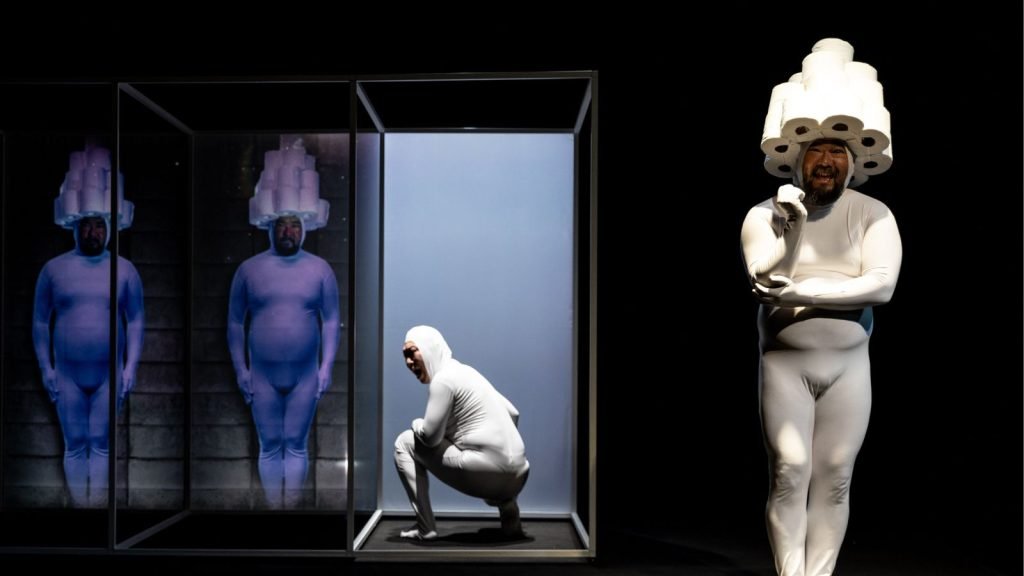
There is nothing cautious about Yu Murai’s “HAMLET | TOILET”, presented at the Craiova Shakespeare International Festival. Created by KPR/Kaimaku Pennant Race, the contemporary Japanese theatre company founded in Tokyo in 2006 by Murai, the production takes Shakespeare’s “Hamlet” and drags it into one of the most private, ridiculous, vulnerable, and revealing spaces of human existence: the toilet. The result is a work that is deliberately vulgar, visually extreme, physically exhausting, frequently hilarious, and unexpectedly thoughtful in the way it connects bodily functions with cowardice, sanity, revenge, grief, and the inability to move forward.
HAMLET | TOILET is playing at the Craiova International Shakespeare Fesival
The production premiered at Japan Society in New York in 2024 and received strong critical responses. “American Theatre” wrote that “the absurd marriage of toilet trivia and Shakespeare made powerful theatrical sense”, while other outlets praised Murai’s bold use of the toilet as a space where people confront themselves. KPR has built its identity on exactly this kind of theatrical collision, drawing from kabuki, noh, anime, manga, pop culture, and contemporary performance in order to reimagine canonical works through a distinctly Japanese sensibility. After attracting international attention with “ROMEO and TOILET” in New York in 2009, and later touring “1969: A Space Odyssey? Oddity!” to festivals in Tunisia, Romania, Thailand, and South Korea, the company now brings “HAMLET | TOILET” to Craiova as another example of Shakespeare filtered through the body, the absurd, and the grotesque.
The basic premise is as simple as it is bizarre. Hamlet is reading “Hamlet” while shitting. From this image, Murai constructs an entire theatrical universe in which the question “to be or not to be” is pushed into the realm of digestion, excretion, blockage, release, and repetition. Instead of Elsinore as a court of political intrigue, the stage becomes a symbolic bathroom, a place where the protagonist is trapped between thought and action, between the desire to expel something and the inability to do so. The production does not offer a conventional synopsis of Shakespeare’s tragedy. Rather, it breaks “Hamlet” apart and reassembles it through narration in the toilet, graphic fart jokes, hip hop dance, repetition, and a constant stream of language that rarely allows the audience to rest.
This is not simply a gimmick, although the production certainly enjoys its own excessiveness. The humor is loud, physical, scatological, and intentionally over the top. Farts become theatrical punctuation. The tube scene pushes absurdity to an almost unbearable level. The repeated phrase “you don’t know unless you wipe and see” becomes both a toilet joke and a philosophical statement, suggesting that truth is not abstract, but something one discovers through contact with the body and its dirt. In this world, Shakespeare is not diminished by vulgarity. On the contrary, Murai seems to suggest that “Hamlet” was always about the body as much as the mind: a body that hesitates, decays, leaks, suffers, and refuses to obey rational control.
There is also a darker cultural context underneath the laughter. As Murai explained in the post-performance discussion, repetition in the production is connected to fear, pain, sorrow, and the repetitive patterns through which people survive. He linked this idea to the trauma of the Great East Japan Earthquake of March 11, 2011, the Fukushima disaster, misinformation, falsified documents, and a generation forced to continue living amid official lies. This background gives the repeated scenes and phrases a weight that goes beyond comedy. The performance repeats because trauma repeats. The body returns to the same position because society returns to the same unresolved wound.
The production’s toilet setting also becomes a space of confession. Private bodily acts are connected to radiation, illness, shame, family, and the hidden effects of contamination. In this sense, the toilet is not only funny or disgusting. It is one of the few places where people are alone with themselves, stripped of public performance. Murai’s use of scatological imagery therefore has a genuinely subversive edge. It brings Shakespeare down from the royal chamber and places him in the cubicle, where questions of life and death are not declaimed nobly, but pushed through pain, constipation, and embarrassment.
The acting is central to the production’s impact. Takuro Takasaki, G.K. Masayuki, and Atsuyuki Tanaka commit completely to a style that demands both verbal speed and physical endurance. The delivery of lines is almost nonstop, creating a sense of pressure that mirrors the protagonist’s inability to release himself from thought, memory, and bodily discomfort. The performers run, squat, sweat, dance, repeat movements, and submit to a theatrical structure that often appears almost sadomasochistic in its demands, particularly in the extended scenes where two of the actors successively, are sitting underneath a tube that pours stones at them for quite some time. Nevertheless, during the discussion, Murai rejected the idea that the company is “into sadomasochism”, explaining that the intensity is connected to the play’s focus on pain and sorrow. Even so, the physical strain is impossible to ignore, and it becomes part of the meaning of the piece.
Visually, “HAMLET | TOILET” is minimalisy. Natsuko Takebe’s set design uses toilet paper, pipe-like structures, and limited objects to form a symbolic space rather than a realistic bathroom. The absence of conventional props is compensated by sound and video, which become part of the stage language, along with the subtitles actually. Takashi Kawasaki’s video design and Tsutchie’s sound and music design help create a world where media culture, bodily functions, and Shakespearean tragedy constantly interrupt one another. Ryuichi Okino’s lighting supports the shifts between comedy, discomfort, ritual, and nightmare, while Akane Sato’s costumes, including white full body suits and toilet-paper-like hats, turn the performers into figures somewhere between clowns, patients, ghosts, and human waste.
Sound is particularly important. The production uses rap, hip hop rhythms, fart noises, musical repetition, and the sound of falling pebble-like objects to create a sensory attack. Shinnosuke Motoyama’s choreography reinforces this energy, especially in the hip hop sections, where the performers’ bodies become both comic instruments and suffering machines. The result is a performance that feels closer to a theatrical installation or bodily concert than to a conventional Shakespeare adaptation.
Not everything will work for every viewer. The excessiveness is the point, but it is also the challenge. Some sequences stretch their jokes until they become exhausting, and the constant scatological imagery and sound can easily alienate audiences expecting a more balanced relationship between “Hamlet” and the toilet concept. In the play we watched in Craiova, a number of people left before the ending. Yet this discomfort is also what makes the production memorable. Murai does not want to decorate Shakespeare with Japanese pop references. He wants to force the audience to sit inside a space where thinking, defecating, remembering, laughing, and suffering become inseparable.
“HAMLET | TOILET” is a genuinely radical interpretation of “Hamlet”, one that turns the tragedy upside down and then asks what can be seen from that undignified angle. It is crude, intelligent, excessive, physically demanding, and often hilarious, but beneath the graphic farts and toilet paper lies a serious meditation on trauma, repetition, paralysis, and the body’s stubborn refusal to be ignored. At the same time, it is undoubtedly a challenging work that definitely demands from its audience at least some knack for the particular type of humor and some appreciation for intense repetition. But in the end, a play that cannot be ignored in any way.



