
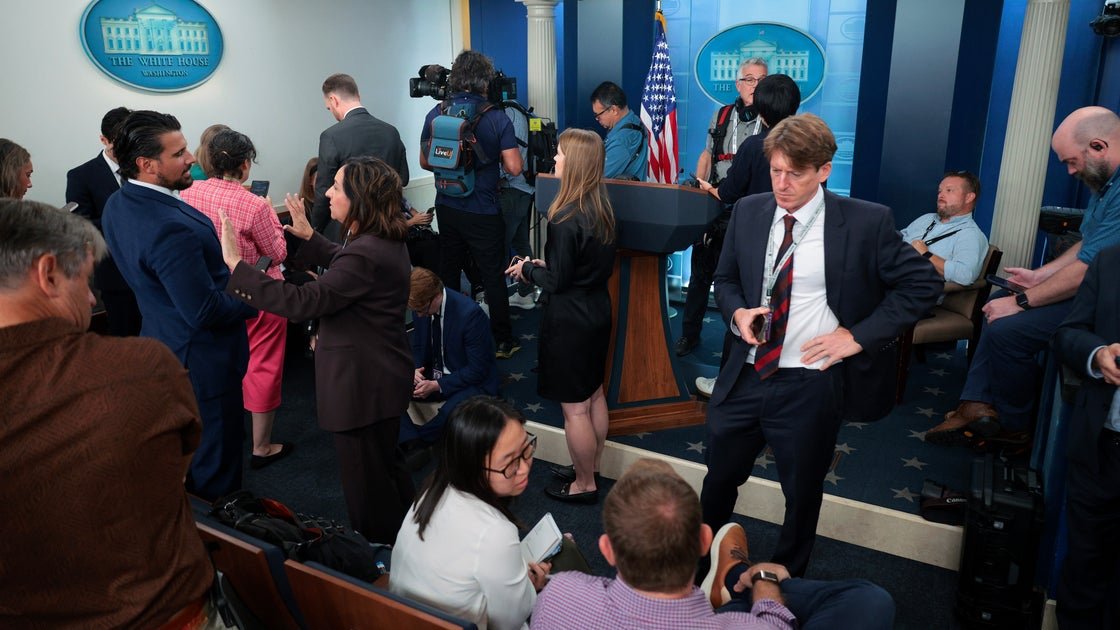
Nearly a month after the White House attempted to ban certain news outlets from covering the presidency, the Trump administration has a new approach: The Justice Department is now investigating ABC, CBS, CNN, NBC and Fox News, claiming they violated antitrust laws when they temporarily suspended coverage of President Donald Trump following the ban.
According to The New York Times, the five outlets were notified of the investigation on Oct. 9.
But experts are already calling out what seems to be a blatant effort at retaliation against the outlets, including Trump’s usually preferred Fox News, for their united stance against his ban.
“You don’t have to be a lawyer to know it’s retaliation,” Aaron Caplan, professor of law at Loyola Law School and expert in constitutional law, ethical lawyering and the First Amendment, told HuffPost.
DOJ investigators are reportedly seeking the outlets’ records related to White House television coverage and any communications about their coverage of Trump after he banned CNN, Politico and MS NOW from White House grounds on Sept. 18.
Trump’s ban prohibited those outlets, normally part of the standard “press pool” rotation of journalists who collaborate to ensure consistent and freely shared coverage of the presidency, from the White House — a sudden and deeply unusual move.
Though the White House claimed the ban was due to national security and issues of professionalism, Trump stated publicly that he didn’t like their coverage of him. The banned outlets sued on Sept. 21, alleging a First Amendment violation and retaliation.
Meanwhile, other outlets in the press pool — ABC, CBS, NBC and Fox News — collectively suspended their televised coverage of Trump. “The public has a vital interest in receiving accurate, independent information about its government. No administration should restrict a news organization because it objects to its reporting,” the networks said in a joint statement at the time.
Now, DOJ officials are reportedly investigating this as a violation of the Sherman Act, first passed in 1890, which is meant to prevent monopolies or agreements between companies that might unfairly restrict trade. The Justice Department said in a statement to The New York Times that they had organized a “group boycott” and that the Antitrust Division was investigating because boycotting “among commercial competitors can violate the Sherman Act.”
Spokespeople for the Justice Department and White House did not immediately return a request for comment on Monday.
“You don’t have to be a lawyer to know it’s retaliation.”
– Aaron Caplan, professor of law at Loyola Law School
Other outlets, including The New York Times, Washington Post and HuffPost, temporarily declined to publish photos taken as part of pool coverage while the ban was in effect. These outlets are not included in the DOJ investigation.
Bruce D. Brown, president of the Reporters Committee for Freedom of the Press, told HuffPost in a statement Monday that the antitrust investigation “appears to be a pretext” for seeking records from the networks about how they cover the president.
“The decisions news organizations make about coverage are protected by the First Amendment, and summoning antitrust authority, on top of the retaliatory actions the White House has already taken to bar certain outlets, is another and even more brazen attempt to try to intimidate journalists,” Brown said.
Legal experts agree that the Justice Department investigation reeks of retaliation.
“It’s so obvious that this is really just punishing the networks for making a decision about speech,” said Stuart Benjamin, a professor of law at Duke University who specializes in the First Amendment.
The Sherman Act, Benjamin said, is concerned with efforts to undercut competition in the marketplace — it’s not about agreements on industry standards or what merits attention.
“One of those harms to competition can be a boycott. You can imagine where a group of entities get together to engage in a boycott in order to hurt a competitor. If media companies did that, it would violate antitrust laws just like it would for any other company,” he said. “But the key is that they are going to hurt competition.”
That is not what is happening with the news outlets that challenged Trump. Benjamin gave an example: If a group of media companies agreed not to print the names of victims of sexual assault — something which is, in fact, standard practice — that wouldn’t violate antitrust laws because that agreement wouldn’t harm competitors or competition. Whether media outlets choose to cover something or not is their prerogative, he said.
“You have the right to speak, you have the right not to speak. You have the right as a reporter to cover something, and the right to refuse to cover something,” he said. “It’s just so obvious that they don’t like the speech-based decisions of these networks.”
“It strains credulity to think there’s harm to competitors,” Benjamin added. “Donald Trump is not a competitor of the networks.”
If anything, the television networks’ decision to remove themselves from pool coverage temporarily created an opportunity for their competitors — namely the outlets that Trump prefers, like One America News and NewsNation.
“I think it helps OAN and the others. It puts them on the same footing as the [five networks now under investigation] because none of them were getting that pool feed during that time. The irony is if shutting down the pool is an antitrust problem, then presumably creating the pool is an antitrust problem, and yet the White House set up the pool in the first place,” Benjamin said.
“It strains credulity to think there’s harm to competitors. Donald Trump is not a competitor of the networks.”
– Stuart Benjamin, professor of law at Duke University
For now, Trump’s Sept. 18 press ban against CNN, Politico and MS NOW has been halted under a temporary restraining order from U.S. District Judge Tim Kelly, a Trump appointee.
Kelly found the ban was likely unconstitutional. In the order, the judge noted that Trump had already publicly admitted that it was the outlets’ coverage he didn’t like. It was the “alleged lack of truthfulness and negativity,” Kelly wrote, that appeared to spur the decision to ban the outlets.
With the temporary restraining order in place, CNN, Politico and MS NOW have asked Kelly to give them a more permanent solution by issuing a preliminary injunction on Trump’s ban. Odds look good for the outlets: During a hearing last week, Kelly appeared highly skeptical about the government’s claims about national security or reporters’ professionalism. That ruling is expected by Tuesday.
As of Sept. 26, all networks but CNN — which remains blocked by the White House for certain coverage assignments, including coverage aboard Air Force One — had resumed coverage for the press pool. Last month, The New York Times reported that the networks were in talks with each other about how they might fill CNN’s spot in the pool if it continues to be denied access.
Caplan told HuffPost that if the news outlets ultimately decided to sue the Trump administration over the antitrust investigation, a retaliation claim could be “really easy to prove.”
“In this particular situation, the administration is saying ‘we are investigating you because of what you did or didn’t put in a news broadcast on these days.’ It’s super easy to prove the motivation for this government action is disapproval of the speech,” Caplan said.
The First Amendment’s free speech clause provides the opportunity for people to challenge any retaliation against their speech.
To prove retaliation, according to Congress, an individual must be able to demonstrate that first, they engaged in speech protected under the First Amendment; next, that the government took “an adverse action” against that individual; and finally, that the individual’s “protected expression motivated the official to take adverse action.”
But Caplan said that if the news outlets opted to sue the administration over the investigation later on, they might be able to argue that the probe itself injured them.
“Sometimes there are cases where an intrusive investigation involving demands for records, subpoenas or other testimony can rise to a level of a significant burden,” he said. “But it depends how far the administration wants to go.”



