
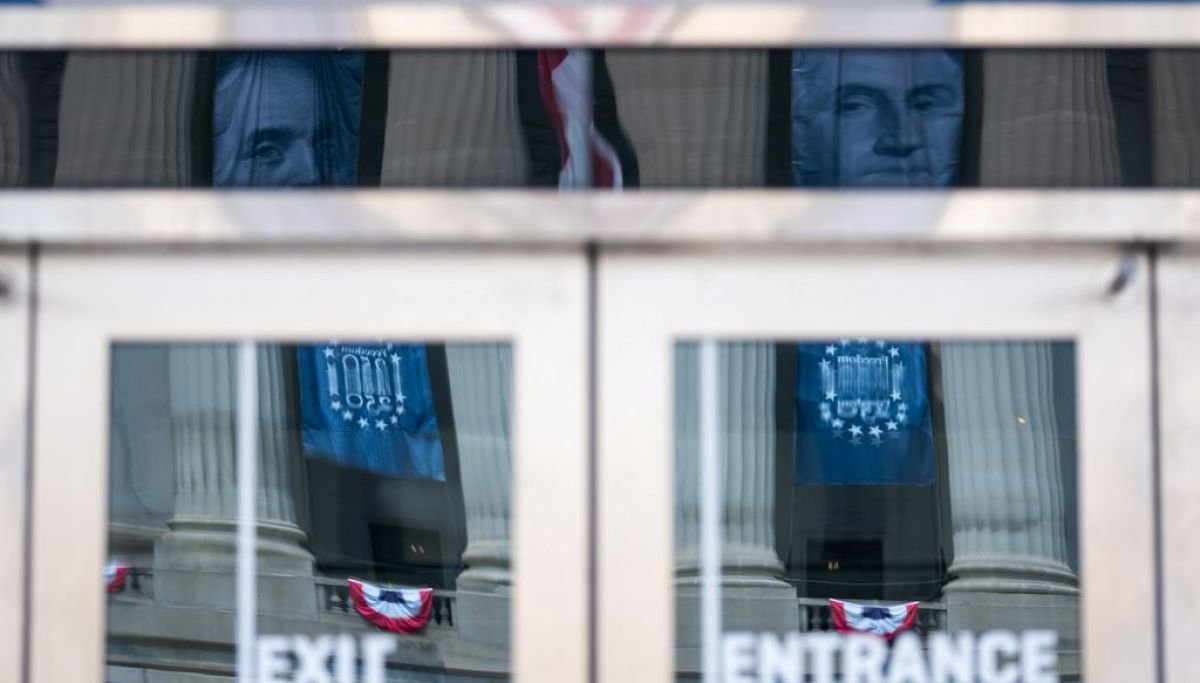
President Donald Trump recently signed an executive order directing temporary warning signs outside the Smithsonian‘s National Museum of American History, advising visitors that some exhibits may present a distorted account of America’s past. The order follows a White House report — released, pointedly, on July 4 — questioning whether the museum has drifted from its founding mission and encouraging visitors to consult additional historical resources as the nation marks its 250th anniversary.
Predictably — because it was a Trump executive order — Washington erupted. Critics called it censorship, authoritarianism, and another culture war stunt.
Here’s the irony. For more than a decade, many of America’s universities and cultural institutions insisted that history itself required warnings — that before encountering a challenging book, a lecture, a monument, or even difficult chapters of America’s past, citizens deserved trigger warnings, content advisories, and sensitivity notices. An entire vocabulary of caution took root across American public life.
I TOURED SMITHSONIAN’S NATIVE AMERICAN MUSEUM. WHAT I SAW WAS PURE ANTI-AMERICAN PROPAGANDA
Now a warning label has been directed at a museum, and suddenly the practice is portrayed as an assault on democracy.
One need not agree with Trump’s executive order to recognize the irony. You cannot spend years insisting that Americans need warnings before confronting history and then declare the very idea illegitimate the moment someone else holds the pen.
I do not write as an outsider. I serve as a trustee within the Smithsonian family, and I believe deeply in these institutions. Precisely because I value their mission, I think the questions raised by this moment deserve thoughtful engagement rather than reflexive dismissal.
The report behind the order makes serious allegations. It contends that America’s flagship history museum currently offers no major exhibit dedicated to the founding era — not Washington, not Jefferson, not the Continental Congress or the Revolution — even as the nation celebrates 250 years of independence. It quotes museum leadership describing history as a “prime tool of social justice,” speaking of connecting “scholarship to activism and advocacy,” and asking how to “problematize” the 250th anniversary of the Declaration of Independence. It notes that the words “American history” were removed from the museum’s own mission statement.
I will not litigate those claims here. Others will debate every exhibit and every quotation, and the museum deserves the opportunity to answer them fully.
But the questions the report raises are larger than any single exhibit. They go to a deeper question: Does America still possess a shared story capable of binding us together as one people?
Every enduring civilization tells a story worthy of being inherited. It tells the truth about its failures, but it also explains why the civilization itself remains worth preserving. The civilizations that endure know the difference between honest self-examination and permanent self-indictment.
America’s institutions of memory should hold that same balance — teaching slavery and the Civil War, segregation and civil rights, Japanese internment and constitutional liberty. We must confront our failures without losing sight of the larger truth: The United States remains history’s most successful experiment in ordered liberty, constitutional government, and human opportunity.
Over the past decade, that balance has eroded across much of American culture — in universities, publishing, curricula, and yes, in museums. The result is a peculiar kind of history, one that apologizes for every American failure in extraordinary detail but grows strangely reluctant to examine the American miracle itself.
Why did more people choose America than any nation in history? Why has this country produced unmatched innovation, philanthropy, constitutional self-government, and the broadest expansion of individual opportunity the modern world has ever seen? Why, after 250 years, do millions still dream not simply of visiting America — but of becoming Americans?
A national history worthy of a great nation must wrestle with those questions as honestly as it wrestles with our shortcomings.
Serving as a trustee of the Woodrow Wilson International Center for Scholars has reinforced my conviction that rigorous scholarship and civic purpose are not competing values. The Wilson Center exists to help America understand the world more clearly, compete more effectively, and lead more wisely. It does not ask scholars to choose between intellectual rigor and service to the nation.
It insists upon both.
That should be the aspiration of every institution within the Smithsonian family. Not propaganda. Not politics. Not grievance masquerading as scholarship. Excellence in the service of the nation.
The Smithsonian’s greatest asset has never been its collections. It has been the public’s trust. That trust is earned not by telling a comfortable story, but by telling the whole story well.
The president’s critics are right about one thing: executive orders cannot repair a culture. But this order was never really about repairing the culture.
It was about revealing it.
The Smithsonian did not create America’s fractured civic identity. It inherited it. But institutions entrusted with preserving our national memory cannot escape the responsibility to help repair it.
Here is the statesmanlike path forward, and it belongs to the Smithsonian itself. The 250th anniversary is not a threat to be managed or a narrative to be deconstructed. It is the greatest opportunity in a generation for our national museums to do what they were created to do: place before millions of visitors the inspiring, complicated, and ultimately triumphant story of the U.S. — told with honesty about our failures and confidence in our achievements.
An institution that seizes that opportunity will not need warning signs. Its credibility will speak for itself.
America’s 250th birthday should not be remembered as the year we argued over signage outside a museum. It should be remembered as the moment our institutions recommitted themselves to telling the whole American story — honestly, confidently, and with enough faith in this nation that the next generation will want to carry it forward.
Because nations are not ultimately held together by armies, economies, or governments.
AMERICA’S HISTORY MUSEUM FORGOT TO MENTION THE FOUNDING
They are held together by a shared story.
And no nation can lead the future if it can no longer agree on its own past.
Alan Rechtschaffen serves as a trustee of the Woodrow Wilson International Center for Scholars, a congressionally chartered institution within the Smithsonian. He writes here in his personal capacity. The views expressed are his own.



