
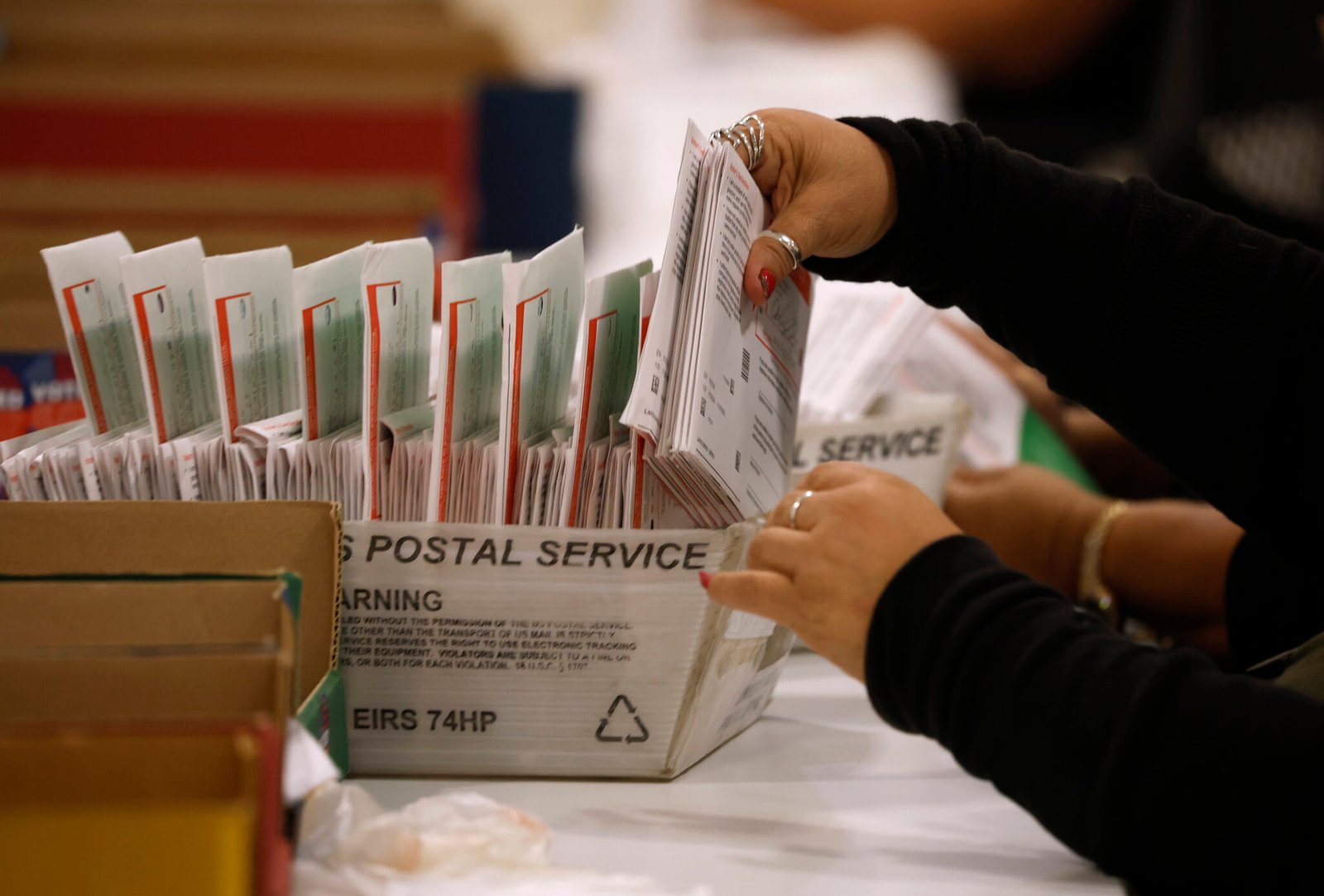
A federal judge blocked major portions of President Donald Trump’s executive order restricting voting by mail on Thursday, finding he had exceeded his constitutional authority.
The decision halts, at least until a nearly certain appeal is heard, efforts by the U.S. Postal Service to require states to submit the names of likely mail voters before it delivers ballots. It also stops the U.S. Department of Homeland Security from compiling lists of voting-age citizens in each state.
U.S. District Judge Indira Talwani, an appointee of President Barack Obama in Massachusetts, is the first judge to block the March 31 executive order. State and local election officials have raised concerns that its requirements would inject chaos into preparations for the November midterm elections.
Talwani ruled that Trump had asserted too much control over elections in several parts of the order as he directed federal officials to quickly take actions that he argues are needed to prevent noncitizen voting, which rarely occurs.
“The Constitution does not grant the President any specific powers over elections,” Talwani wrote.
Order overpowered states
The executive order directed Postmaster General David Steiner to put forward a rule requiring states, at least 90 days before a federal election, notify the Postal Service whether they intended to allow ballots to be sent through the mail. States would then have to submit to USPS a list of voters planning to vote by mail at least 60 days before the election.
Talwani wrote that the Postal Service lacks any authorization by Congress to put forward binding regulations on mail-in voting. The Constitution, she wrote, “reserves the power to determine voter eligibility to the States alone.”
The executive order also required the Department of Homeland Security, with help from the Social Security Administration, to compile a list of voting-age U.S. citizens living in each state and then provide that information to state officials at least 60 days before each federal election. The order does not tell states how to use the data.
The list of citizens would be drawn from naturalization and Social Security records, according to the order. It would also include data from SAVE, a powerful computer program maintained by Homeland Security that verifies citizenship by checking names against information in federal databases.
The executive order pointed to no relevant constitutional or legal authority supporting the compilation of the citizenship lists, Talwani wrote. Trump “lacks any authority to compile voter lists for each State,” she wrote.
A day before the decision, Steiner told a U.S. Senate committee that a proposed Postal Service rule to implement the executive order would lead to non-delivery of ballots in states that don’t provide lists of anticipated mail voters — a position condemned by Democrats.
“Today’s decision is a very significant victory for free and fair elections and a defeat for Donald Trump’s vile efforts to make it harder for people to vote,” Senate Minority Leader Chuck Schumer, a New York Democrat, said in a statement.
“Once again, the courts have reaffirmed that Trump’s efforts to subvert the election are patently unconstitutional.”
White House spokesperson Abigail Jackson said in a statement that the Trump administration remains confident the executive order will be implemented by the November election.
“The entire Trump Administration will continue lawfully enacting the agenda President Trump was elected to enact – which includes the safety and security of American elections,” Jackson said.
Latest setback
Trump has suffered a series of setbacks in recent days in his efforts to influence the administration of state-run elections.
A federal appeals court on Wednesday ruled that the Department of Justice wasn’t entitled to state voter rolls. Senators also continues to rebuff the president’s attempts to pressure them into passing the SAVE America Act, which would require voters to show documents proving their citizenship.
Talwani’s decision came in a lawsuit brought by Democratic state attorneys general. It is the second major district court ruling over the executive order, after a judge in Washington, D.C., declined to stop the order because the Trump administration hadn’t taken enough action to implement it.
Under Thursday’s decision, federal officials must notify their employees within a week that sweeping portions of the executive order are void.
And on Monday, a judge blocked the use of SAVE to search for noncitizen voters.



