
U.S.-Iranian negotiations have gone nowhere, with a two week cease-fire scheduled to expire on Wednesday and no agreement thus far to replace it. Both countries have blockades in place—Iran preventing most shipping out of the Persian Gulf via the Strait of Hormuz, blocking about 20 percent of global oil and gas supplies, and the United States preventing ships from entering or exiting Iranian ports—and have been issuing threats, appearing far apart.
The impasse shouldn’t be surprising. U.S. and Iranian leaders are approaching the war and negotiations very differently—which means their negotiating teams are operating in entirely different universes.
The Iranian team is pursuing Tehran’s vision of national interests and seeks real concessions to secure the regime and advance its geopolitical position. The U.S. team is pursuing Trumpian image management. They’re not looking for meaningful results but headlines and photo-ops they can use as the basis for a positive story to aid a beleaguered president, at least until their latest lies become obviously untenable and they seek new ones.
U.S. officials’ statements usually put Donald Trump at the center, spinning, exaggerating, and lying to create a narrative of a strong leader in control of events. Trying to defend Trump’s decision to ease sanctions on Iranian oil exports in an attempt to reduce energy prices that rose because of the president’s own war, U.S. Treasury Secretary Scott Bessent absurdly asserted that Trump was “jujitsuing the Iranians” by “using their own oil against them.”
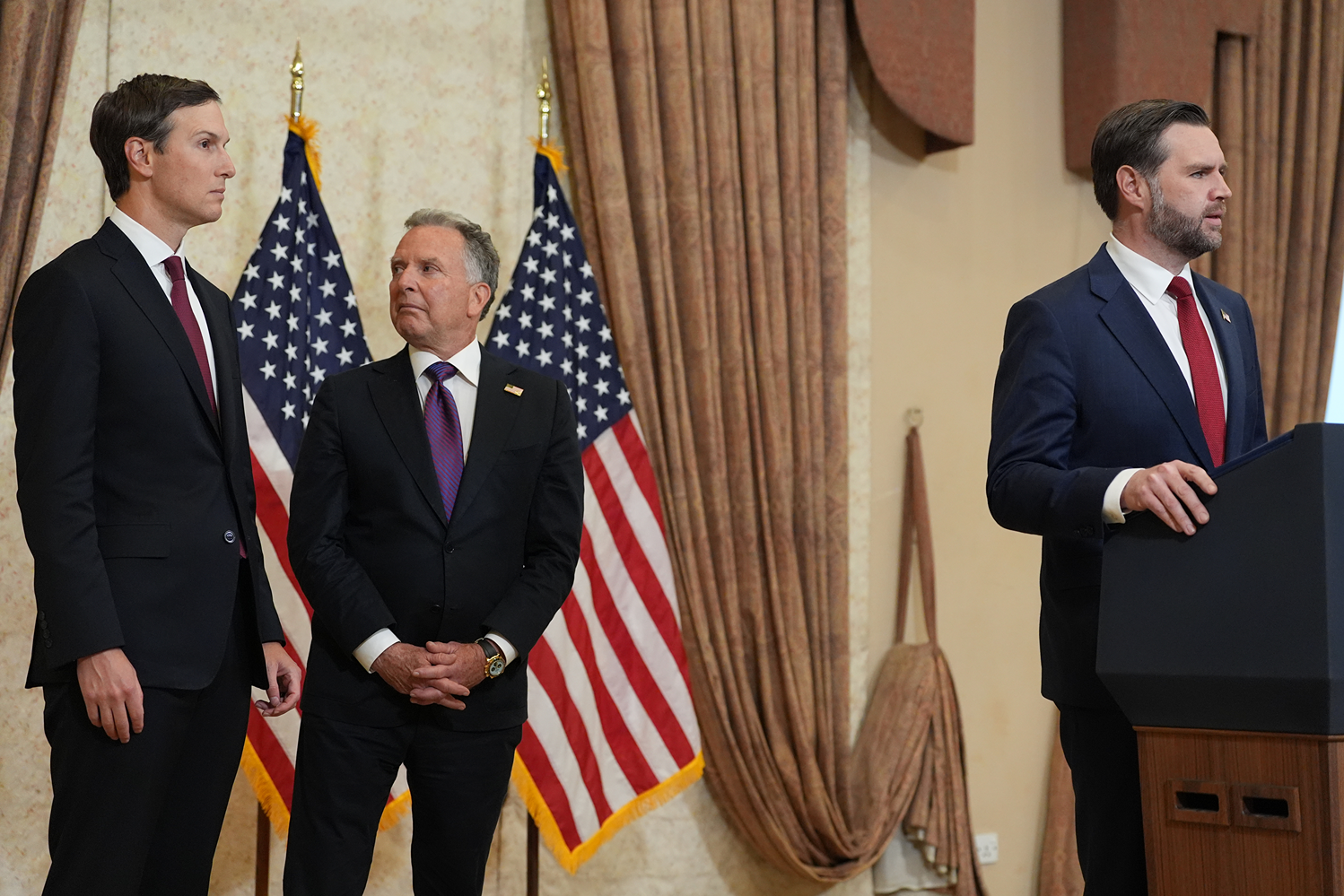
The U.S. negotiating team does not include Secretary of State Marco Rubio or career diplomats. It is led instead by Trump’s associate Steve Witkoff, a real estate investor, and Jared Kushner, the president’s son-in-law. That’s different from negotiations with Iran under Presidents George W. Bush, Barack Obama, and Joe Biden, which were led by diplomats and included nuclear scientists and experts.
U.S. statements typically didn’t mention the president by name, instead casting talks as among multiple countries. Iran’s current negotiating team features diplomats, politicians, and scientists, and statements typically refer to “the Islamic Republic” rather than cast the war as the leader’s personal glory.
The asymmetry gives Iran leverage. It marks U.S. leaders as more eager for a deal, with Iran more willing to endure the ongoing economic damage. Iran doesn’t want an agreement unless it’s highly detailed, technical, and implemented in stages to build trust and ensure compliance. The U.S. team, meanwhile, wants an agreement for the sake of saying they reached an agreement and finding a nonhumiliating way out of the conflict Trump started without a good strategy, international support, or a path to victory.
Iran also has good reason to not trust the United States, especially Trump. In 2018, in his first term, Trump reneged on the Joint Comprehensive Plan of Action—the 2015 nuclear deal that had taken years to negotiate—even though Iran was following it. In 2025, in his second term, Trump bombed Iranian nuclear sites and then lied that Iran’s nuclear program was “completely and totally obliterated.” Less than a year later, he went with the opposite lie, claiming that Iran was on the verge of acquiring multiple nuclear weapons, and alongside Israel launched a campaign of airstrikes and assassinations.
With this war, Trump has said many different things and frequently shifted the goalposts. He has called for regime change, unconditional surrender, handing over nuclear material and agreeing to zero enrichment, curbing Iran’s missile program, ending Iranian support for various regional groups, giving Israel formal diplomatic recognition, reopening the Strait of Hormuz, and more. Trump and other U.S. officials have repeatedly lied about the facts on the ground, the state of the Iranian government, and what Iran has or has not agreed to.
As a result, the United States has no credibility, making Iran wary that Washington would fail to follow through on war-ending promises and instead pocket gains and attack again later in pursuit of more.
Trump is an inveterate liar, but his record shows he knows that lies sell better when based on a grain of fact. This was clear when, in his first term, Trump illegally held up congressionally allocated military aid to Ukraine to extort the Ukrainians into announcing criminal investigations into Biden and his son Hunter Biden, leading to Trump’s first impeachment. He didn’t ask Ukraine to actually prosecute the Bidens, who had committed no crime, just to say that Ukraine was investigating, which Trump could use as the basis for insinuation and conspiracy theories ahead of the 2020 U.S. presidential election.
Along those lines, Trump doesn’t need Iran to actually make big concessions—he just needs headlines saying there’s a deal or even just progress toward one. That generates positive coverage and makes markets rise, which generates more positive headlines and gets investors worrying more about missing out on a rally than getting caught in a crash. The reality of U.S. national interests, such as nuclear nonproliferation and reducing Iranian support for anti-American militias, is evidently less important to him and his team than short-term narratives that could benefit the president. The problem for him is that those short-term narratives then contradict one another, creating an endless cycle of failure and response.
This approach was evident in the first round of talks. While bombing Iran, the United States sent a list of 15 demands via Pakistani mediators. Iran rejected them all, countering with their own list of 10 demands, including acknowledgement that Iran controls Hormuz and has a right to enrich uranium. Trump threatened massive war crimes against Iran, even genocide—saying that a “whole civilization will die tonight”—and then agreed to Iran’s 10 points as the basis for negotiations. That concession got Iran to the table, but Trump insisted that his threats had forced them to. Positive headlines and market rallies followed.
But then the Trump negotiating team tried a bait and switch, agreeing to none of the Iranian demands they had accepted in principle and issuing demands of their own, such as Iran forgoing all nuclear activity and the United States getting a cut of Hormuz toll revenue. Talks ended without a deal, and markets wobbled.
Then Trump got Israeli Prime Minister Benjamin Netanyahu to agree to a 10-day cease-fire in Lebanon—stopping Israel’s campaign there was another Iranian demand—and then claimed that Hormuz was totally open. Media outlets carried Trump’s proclamation and highlighted Iran saying the strait was open while omitting or downplaying the crucial detail that Iran meant open for passage in coordination with its Revolutionary Guard after paying a toll—i.e., in practice, mostly blocked. Oil prices fell, and stock markets rose, even though little on the ground had actually changed.
But Trump then lied that Iran had accepted all U.S. demands, including a joint project to remove all of Iran’s enriched uranium, though he kept the U.S. blockade in place. Iranian officials accused the United States of lying and said they would maintain their blockade until Washington backed down. Iran has been hesitant to engage in further talks, saying the U.S. approach does not “demonstrate seriousness in pursuing a diplomatic process.”
That could be posturing, trying to get another concession as a precondition to talks, or an indication the Iranians think delays will put more pressure on the Americans. Either way, U.S. representatives have traveled to Pakistan, perhaps hoping that Iran will agree to talk at the last minute and, if not, that the United States showing interest in negotiations will be enough.
The Trump administration appears to think that if it can string the process out long enough, and scare the Iranians with military threats while tempting them with economic benefits, Iran will eventually agree to a deal. The details don’t really matter. Trump will claim total victory, coverage will be positive, and markets will cheer the prospect of normal energy flows, which will generate more positive headlines and praise from wealthy donors. In the meantime, some people presumably in or connected to the White House can ride the market manipulation to make billions of dollars with insider trading. And any longer-term problems can be dealt with—or lied about—when they arise or shunted off to future presidents.
The problem is that this scheme needs the Iranians to play along. Even the American public can’t help but notice the closure of Hormuz, with tankers stuck in the Gulf and not arriving at scheduled destinations, creating unignorable shortages. The impact is most visible in canceled flights, a rapid rise in airline costs in Asia, and higher gas prices throughout the United States. While Trump might be able to sell the idea that Iran made big concessions even if it didn’t, such as on uranium enrichment, he can’t get many people to believe that the strait is open and energy supplies are flowing when they’re not. Even more than Trump needing Ukraine’s help to sell lies about Biden in 2020, he needs Iran to go along with the outlines of the story he wants to tell now.
But Iran wants longer-term security, not a temporary reprieve. The Iranian regime took a big hit from the United States and Israel and is still standing. That’s a point of pride, a demonstration of resilience. Despite Trump and Netanyahu’s hopes, the bombing did not make the Iranian government collapse or beg for mercy. Iran has acquired leverage by choking Hormuz and not unreasonably wants something real to loosen its grip.
The Iranians may have gotten wise to Trump’s short-term manipulations. Falling markets put the U.S. president under pressure, but any appearance of movement toward peace, even just a meeting, makes markets rebound. Therefore, to win significant concessions, Iran needs to stop the appearance of progress and give the global energy supply crunch time to really bite.
Unless something changes soon, the cease-fire deadline will pass without a deal, perhaps even without an agreement on a framework for future discussions, undermining Trump’s efforts to calm markets. That will force him to weakly extend the deadline unilaterally or follow through on threats he probably intended as a bluff, which would at minimum cause avoidable death and economic harm. Approaching negotiations seeking a durable peace—such as the deal that Trump ripped up without cause in 2018—would avoid all this; instead, Americans and Iranians are stuck inside Trump’s self-aggrandizing narrative of personal triumph.



