
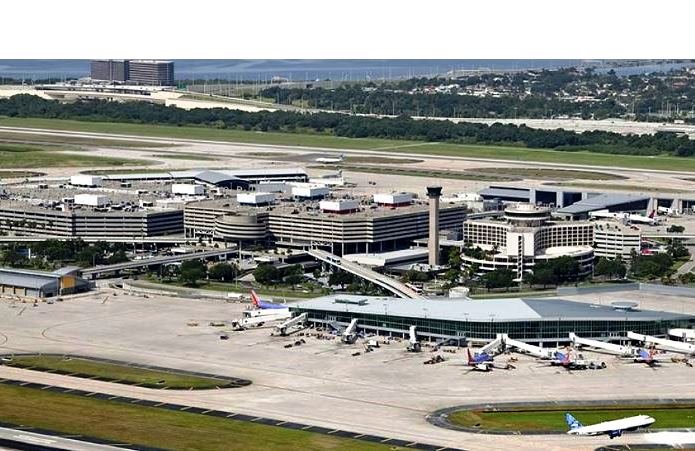
Officials with the union representing transportation security officers at more than 400 U.S. airports are criticizing the decision by the Trump administration and officials with Tampa International Airport to privatize security operations there next year.
The Transportation Security Administration (TSA) notified the American Federation of Government Employees (AFGE) Monday that the agency intends to launch a privatization called TSA Gold+ at airports in Tampa, Charleston, South Carolina, and Des Moines, Iowa, in 2027.
The AFGE says the new program would put private contractors in control not only of security screening but the screening technology itself — machines that detect guns, explosives, and other prohibited items. While TSA staff would provide oversight, they would no longer directly screen passengers or carry-on items at those airports.
“Make no mistake — this is a major departure and step backwards from the aviation screening security system that Congress created in the wake of the Sept. 11 terrorist attacks in 2001 and the deadly bombing of the Pan Am Flight 103 over Scottland in 1988,” AFGE President Everett Kelley said Tuesday in a written statement.
“Changes of this magnitude should not be made behind closed doors without the input of Congress, the flying public, the local airport authorities, and TSA employees themselves.”
In a statement to the Phoenix, officials with Tampa International Airport said they have opted into the TSA Gold+ program, adding that it “reflects the Airport’s strong commitment to modernization, innovation, and operational resilience in aviation security.”
“The change to privatization not only reduces disruption risks caused by lapses in federal appropriations or government shutdowns but also allows greater flexibility in exploring new screening checkpoint infrastructure and technology to enhance the customer experience,” said Beau Zimmer, the airport’s communications manager.
Project 2025
The AFGE represents 47,000 TSA officers at 400 airports across the country. Their concerns about the Trump administration’s privatization plan arise because such a plan was included in the Heritage Foundation’s Project 2025 document, the conservative policy wish list that surfaced ahead of the 2024 presidential election.
According to the liberal Center for Progressive Reform, the Trump administration had initiated or completed 53% of Project 2025’s domestic administrative policy agenda in the first 12 months following the president’s inauguration in January 2025.
“As part of an effort to shrink federal bureaucracies and bring private-sector know-how to government programs, TSA is ripe for reform,” the document says on page 158. “The US should look to the Canadian and European private models of providing aviation screening manpower to lower TSA costs while maintaining security.”
Project 2025 suggested the TSA could expand the existing Screening Partnership Program to all airports. Currently, 20 U.S. airports are part of that program, including in Sarasota, San Francisco, and Kansas City, according to a May NPR report.
All screening at U.S. airports was conducted by private screeners before the 9/11 attacks. Shortly after the attacks, the U.S. Senate passed the Aviation and Transportation Security Act 100-0 to create the TSA.
The AFGE says the Trump administration’s fiscal 2027 budget proposes to eliminate 8,400 transportation security officer (TSO) positions — roughly 14% of TSA’s screening workforce. About 4,500 of those positions would be replaced by private contractors through a mandatory expansion of the Screening Partnership Program to include all small and non-hub airports. That would expand the SPP from 20 airports to about 220 airports.
At a House Homeland Security Committee hearing held in May, most Democrats said that forced privatization at U.S. airports would be a mistake that would lead to worse outcomes for both travelers and TSA personnel. Workers at private companies would earn less than most TSA staff, they said, while losing their collective bargaining rights, according to a report from Government Executive.
Right of first refusal
“The administration’s actions should concern all Americans, and AFGE will continue to speak out against any proposal that threatens our members’ jobs and jeopardizes the safety of the flying public,” Kelley said.
According to officials who have been informed about the plan, TSOs have right of first refusal for jobs with a contractor, and no TSO will lose a job who wants to keep it.
A TSA spokesperson issued this statement to the Phoenix:
“TSA Gold+ presents a new way for TPA to deliver exceptional service to every traveler, while advancing security, efficiency, and the overall airport experience. Throughout this transition, we remain committed to operational stability and supporting our employees.”



