
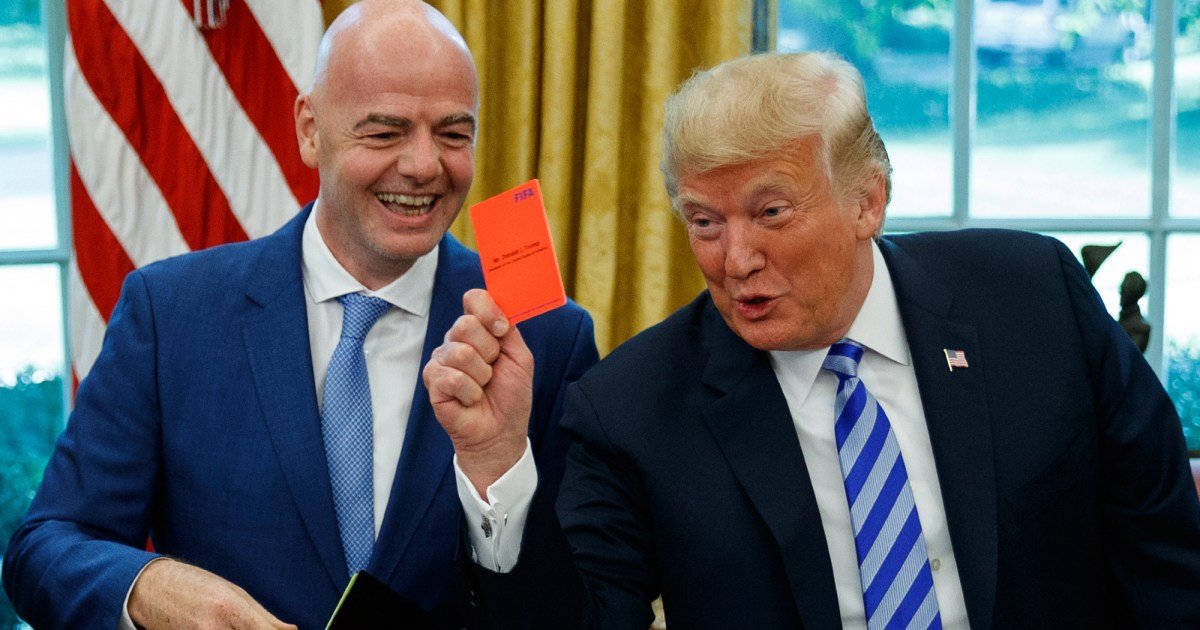
President Donald Trump holds up a red card with FIFA President Gianni Infantino in the Oval Office on Aug. 28, 2018.Evan Vucci/AP
As the US men’s national soccer team prepares to face off against Belgium on Monday night, the question isn’t whether their aggressive and quick play style can defeat an opponent that humiliated them 5-2 back in March—it’s what Donald Trump’s role in the decision to suspend star striker Folarin Balogun’s one-match ban means for the integrity of the World Cup.
FIFA, the international soccer governing body, on Sunday suspended the red card Balogun received in Wednesday’s match against Bosnia-Herzegovina, which would normally bar him from the next game as well. In case you haven’t followed the flurry of developments since, here’s a non-exhaustive list of events as of Monday afternoon:
First, FIFA suspended Balogun’s one-match ban by applying Article 27 of its disciplinary code, which allows it to cancel or delay a suspension without explanation. The governing body could have easily just stated that the match officials’ video review system was not applied correctly by showing slow-motion and still images to evaluate the severity of Balogun’s foul, which is typically against protocol—but it didn’t.
The other side was, unsurprisingly, outraged.
Reports came out the same day that President Trump called Gianni Infantino, the president of FIFA, just hours after the Wednesday match, asking him to review the suspension—the first of what were reportedly three such calls.
By Sunday, Trump was thanking FIFA in a Truth Social post for “reversing a great injustice” by suspending Balogun’s ban. On Monday morning, FIFA granted Belgium the right to appeal against its decision—and promptly dismissed Belgium’s challenge the same day, stating that since the soccer federation was “not a party to the proceedings,” it had “no standing to appeal the decision.”
UEFA, the soccer governing body in Europe, said that FIFA crossed “a red line” with the move. “When the certainty of rules is no longer guaranteed by its guardians, the integrity of the game is at stake and the credibility of a competition is undermined,” it added.
Belgium’s soccer federation released a statement, saying that “to safeguard the legitimate rights of all participating teams and to protect the fundamental principles of fair play in our sport,” it was “investigating all potential options” to push back against the move. Even the country’s foreign minister risked Trump’s ire, saying bluntly, “If a phone call really is what explains this incomprehensible decision, it would amount to undermining the most basic rules of soccer and sports.”
Belgium’s soccer federation said that it did not receive an explanation of the decision and would leave “all further actions open,” suggesting a potential dispute at the Council of Arbitration for Sport.
While this is not FIFA’s first in-game controversy—including allegations of match-fixing in favor of host Argentina in 1978—the debacle has already set an alarming precedent. France has now asked FIFA to rescind their talented player Michael Olise’s yellow card against Paraguay. England coach Thomas Tuchel joked that Trump could help overturn defender Jarell Quansah’s red card against Mexico.
As Christina Unkel, a former soccer referee and current sports executive, wrote on X on Sunday, FIFA’s refusal to state any reasons both raises a variety of questions and invites other countries to bring their political weight to bear to appeal calls by referees, although no other leader shares Trump’s close relationship with FIFA’s top official.
Regardless of how Belgium’s appeal and France’s request shake out, the White House’s role in the controversy will likely follow Folarin Balogun—who didn’t ask for the reversal—throughout the rest of his international career. Balogun was a good sport about the red card: He shook all the match officials’ hands after the match on Wednesday, and later told reporters that he accepted the referee’s initial decision.
“You can feel something unjust has happened to you, but it’s not an excuse to not do the right thing,” Balgun said. “Every game I try to shake the referee’s hand and this game was no different. It’s important to give the correct example to people watching.”
It’s an idea that FIFA should take into consideration.



