
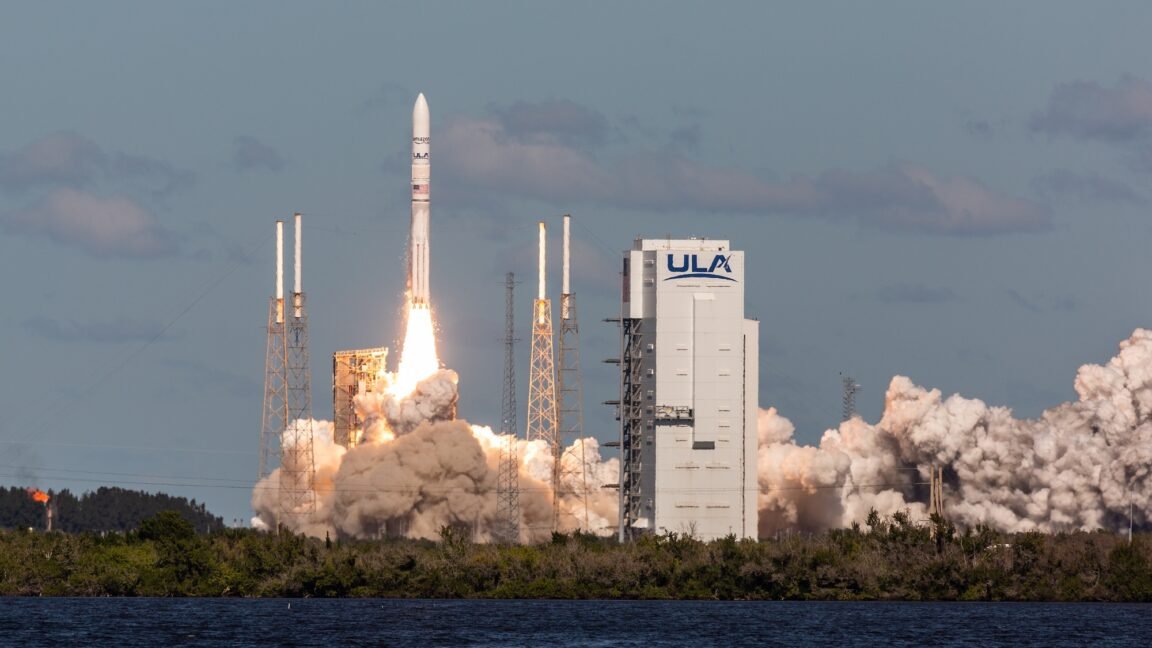
Amazon Leo’s launcher fleet. The Atlas V is no longer available.
Credit:
Amazon
Wider impacts
Sunday’s incident is bad news for ULA’s two primary customers: Amazon and the US Space Force. It’s also a potential setback for NASA’s Artemis program to return astronauts to the Moon.
First, Amazon. The loss of 40 Amazon Leo satellites onboard the Vulcan rocket is, by itself, a secondary concern next to the inevitable grounding of the company’s primary launch provider. Amazon has 37 more Vulcan launches reserved with ULA, each of which is slated to deliver 40 or more Amazon Leo satellites to orbit.
The Amazon Leo constellation today consists of 396 satellites, a fraction of the network’s planned total of 3,292 first-generation spacecraft. Amazon officials told Ars in October that the company has enough satellites to start initial commercial Internet service by the end of the year, but more launches are required to realize the network’s full capacity.
Amazon is setting up its service as the first head-to-head competitor in the consumer satellite broadband market with the Starlink network owned by Elon Musk and SpaceX. OneWeb and other companies also offer Internet connectivity from space, but their business models focus on beaming capacity to traditional telco providers, not directly to consumers.
Previous delays with the Vulcan rocket have kept Amazon satellites on the ground far longer than the company planned. Amazon recently announced it manufactured its 1,000th satellite, meaning more than half of its network nodes are sitting in storage. Finally, Amazon was looking forward to ramping up its launch cadence, with Sunday’s launch the first for Amazon Leo on ULA’s Vulcan rocket.
“There is risk with any launch, and that’s especially true for inaugural missions like LV-01,” Amazon said in a statement. “ULA has been a trusted partner for Amazon, and we believe they’ll learn from this mission and deliver on their long-term plans for Vulcan.”
Amazon made launch bookings with Europe’s Arianespace and Bezos’s Blue Origin at the same time it signed the contract for 38 Vulcan launches in 2022. Amazon reserved additional launches with Arianespace in September, bringing that company’s total contract to 24 launches for Amazon. Three have launched so far, and the fourth is set to take off later this month on an Ariane 6 rocket from French Guiana.



