
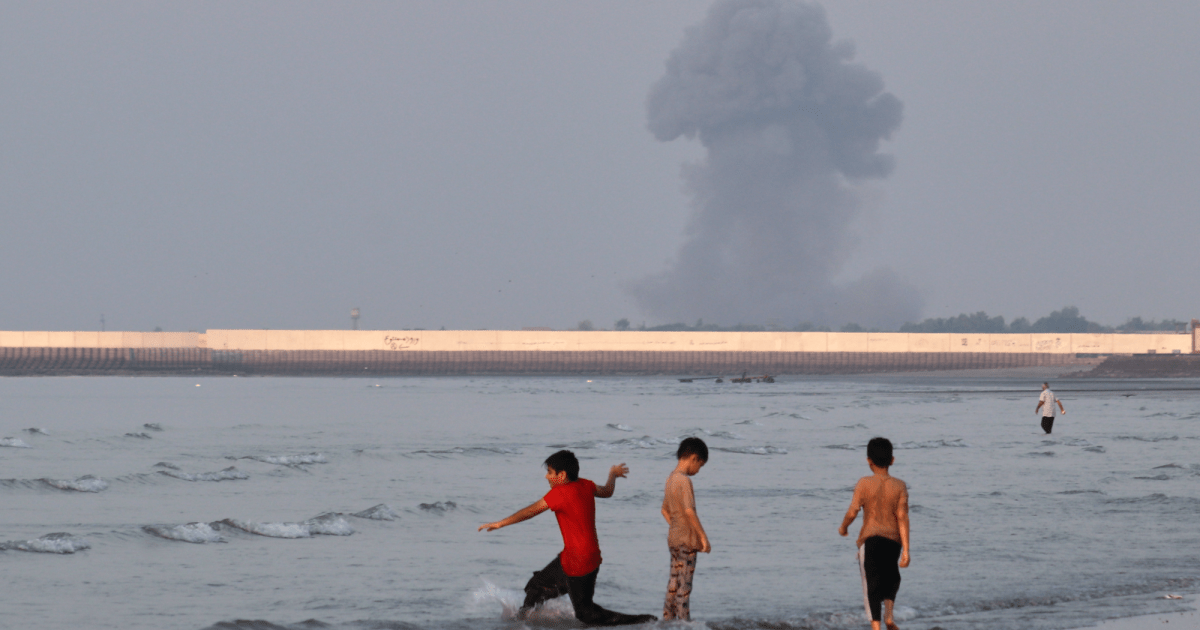
Three children stand in the shallow waters of the Strait of Hormuz, as a plume of smoke rises from an explosion off Bandar Abbas, Iran, on July 13, 2026.Razieh Poudat/ISNA/AP
As the US military announced an eighth consecutive night of strikes on Saturday against Iran’s military systems, it also reportedly hit the country’s water and energy facilities, food storage sites, and bridges.
Iran’s energy ministry told citizens to reduce their usage of electricity and air conditioning following the American strikes.
Iran has also struck American allies across the Gulf, including an attack at a military facility in Jordan on Friday that left two US service members dead and one missing. Officials in Kuwait said Iran hit a power and water desalination plant on Friday. The next day, the country’s government said Iran attacked the same plant again. Approximately 90 percent of Kuwait’s water supply comes from desalination plants.
The escalation in hostilities comes a month after the Trump administration and Iran’s leadership signed an interim ceasefire agreement that opened up negotiations to end the war. But that deal has fallen apart amid clashes over the Strait of Hormuz, a major shipping pathway where about one-fifth of global crude oil and natural gas passed through before the war began in February.
The strikes look likely to continue as Iranian officials said Saturday that the country was dropping its commitments to the interim deal. Air raid sirens were heard across Jordan on Sunday, the New York Times reported.
Meanwhile, American officials told the Times that the United States was sending more warplanes to the Middle East, a move that was in the works, along with hitting more Iranian infrastructure, even before the soldiers’ deaths in Jordan. (A third service member was killed in northern Iraq during the disposal of a downed Iranian attack drone, the Pentagon said Sunday.)
Erika Guevara Rosas, a senior director at Amnesty International, told the Guardian in April that although key infrastructure can qualify as a military target, facilities like power plants are essential for meeting the basic needs of civilians. Therefore, “attacking them would be disproportionate and thus unlawful under international humanitarian law, and could amount to a war crime.”
This post has been updated.



