
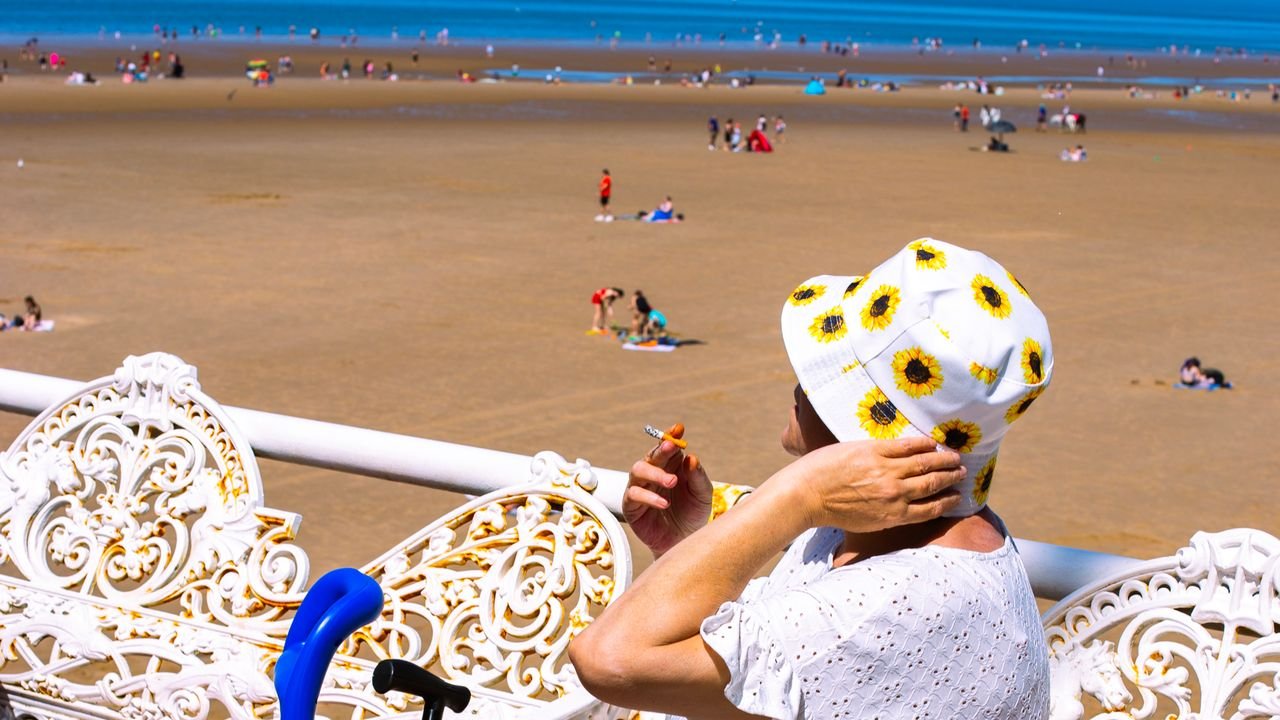
Today, the town’s Victorian grandeur is rotting and crumbling away, its cast-iron piers corroded by sea salt. The story goes that cheaper flights and package holidays from the nineteen-sixties onward sent most Brits to sunnier shores abroad. In response, the town shifted its marketing to late-night booze-ups and wedding parties (known, in British parlance, as stag dos and hen dos), and subsequently grew a reputation as a sandcastle Sodom. This downturn in the local economy was made worse by decades of austerity measures and brain drain. At this point, the town’s name has become synonymous with loss and decline in the U.K.
Recently, on a day of elusive Blackpudlian sunshine, I found a sightseer named Anthony waiting with his luggage at the train station. The sixty-five-year-old was headed home to Manchester after a long weekend by the sea. Anthony is a hulking, bald man with pale skin and even paler eyes, and he was dressed in an island-print tropical shirt. He visits Blackpool seven times a year, yet readily admitted to me, as he puffed a cigarette, that “it’s a bit of a shithole.” During his latest visit, Anthony had indulged in a time-honored Blackpool trifecta: drinking, karaoke, and pub-bound socializing. But he’s careful not to stray too far from his usual haunts. “When you start getting to the backstreets,” Anthony said, “you see how the place has really gone downhill.”
I spoke with another frequent visitor, Alison O’Neill, a sixty-year-old from Chadderton, near Manchester, who told me that she first started visiting Blackpool as a child. Now she goes up to four times annually, often staying at the same hotel, for nostalgia and convenience. “Well, I know what I’m getting when I go,” she said. Alistair Lindsay, forty-two, from North Somerset, travels for more specific reasons: he’s an acolyte of the Northern-soul movement of the nineteen-seventies, a subculture predominantly made up of geriatrics vigorously dancing to obscure American soul records, for which, Lindsay confirms, “Blackpool has become something of a mecca.” But the glint of disco balls can only distract for so long. “Only thirty yards down the road, you start to see boarded windows in these condemned buildings,” Lindsay told me. “You want to look at that seedy underbelly? You don’t have to look too far.”
On one of these downhill backstreets is the tautly named Higgitt’s Las Vegas Arcade Blackpool & £1 Burger Bar. Its limited floor space is divided between a raised kitchenette and a waiting area stuffed with gambling machines. When I arrived, the bald head of the owner, Chris Higgitt, surfaced through the grill’s plumes of smoke. In a different life, Higgitt would be a showman, a real Britain’s Barnum. He speaks of himself with a rehearsed authority. “I am the pound-burger man,” he said, adding, “I’m quite good in front of a camera—I’ve got the confidence.” Higgitt makes YouTube videos about his life in Blackpool, and told me that he was attempting to create an online soap opera about Blackpool, starring locals, to try to draw tourists in.



