
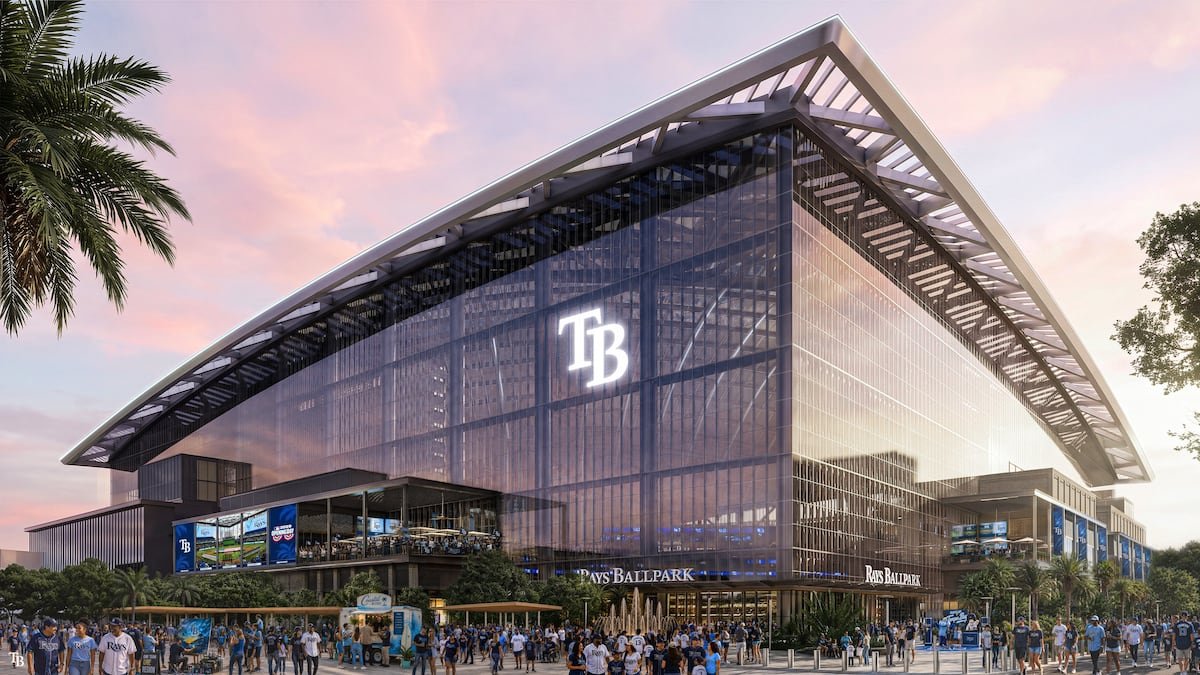
After nearly eight months of negotiations and about two decades’ worth of previous efforts, the Tampa Bay Rays stadium proposal is set to face definitive votes.
The Tampa City Council will vote Thursday, with the Hillsborough County Commission following Friday. At the center of debate will be the primary stadium agreement, which is well over 100 pages.
“We have been in continuous discussions with representatives of the Tampa Bay Rays and the City of Tampa, and the documents have now been finalized for your review and consideration,” County Attorney Julia Mandell wrote in an email delivering the document to commissioners Tuesday night. The agreement was first released publicly last Friday, but Mandell noted then it was subject to change.
That’s still true of several documents. Two others previously released — the team’s guarantee and non-relocation agreement — remain under discussion with Major League Baseball, she wrote. And the deal’s definitive community benefits agreement, as well as other pacts, will later require approval, too, she added.
But the primary document is perhaps the most consequential piece of paperwork, and it’s plenty to parse through.
So, what’s in the final stadium deal and what isn’t? Here’s a look at some of its most intriguing elements.
A decreased public contribution?
A $100 million ask from the city’s Community Redevelopment Agency is no longer part of the deal. The Rays are covering that difference with a loan. The plan is for the team to get its advance back with interest from property tax revenues generated from the team’s proposed mixed-use district of restaurants, residences and retail surrounding the stadium.
Proponents of this structure argue it is an improvement for the city because the loan will be paid off by the surrounding project’s own revenue. Detractors contend property tax dollars, even from the stadium district, are a public expense, nonetheless, and that paying interest to the team on that loan makes for an expensive proposition.
Development incentives instead of guarantees?
When the County Commission approved a draft agreement with the Rays in May, a county presentation noted the team’s “commitment to minimum valuation for private development” as an item left to clarify in definitive agreements. The completed deal does not include any such guarantee.
The team has long promised at least $8 billion — and at times up to $12 billion — will be privately invested in the surrounding development. But the completed agreement does not oblige them to meet that or any other minimum valuation, and the team has yet to detail a plan for the surrounding development.
Instead, the deal is built around incentives, with a structure that changes as the surrounding development’s taxable value does.
Where will the property tax money go first?
The money generated by the stadium’s surrounding development will first go toward paying off the loans from the city of Tampa and the Rays. It will then go toward paying the team’s “unreimbursed, engineer-certified costs” spent on public infrastructure or public project improvements. After that, the money will go to future public infrastructure repairs within the stadium district.
Is the Community Investment Tax in the deal?
The revamped city contribution no longer asks City Council members to approve the use of dollars from the Community Investment Tax, a county sales tax that pays for roads, public buildings and upgrades to existing stadiums. County commissioners said the sales tax would be off-limits to any new stadiums before it was renewed by voters in 2024. At the city level, numerous council members — enough to deliver a negative vote — had objected to use of the tax.
The tax, however, does remain an integral part of the county’s part of the proposal. Hillsborough’s Community Investment Tax contribution is at $360 million and slated to be paid in four installments of $90 million.
A Lithia Pinecrest stipulation
As part of a more subtle show of state support for the stadium proposal, the Florida Department of Transportation is contributing $100 million for improvements to Lithia Pinecrest, a gridlocked Hillsborough road slated to receive $210 million from the county’s sales tax.
If the state’s Department of Transportation fails to deliver any part of the $100 million, the agreement released Tuesday gives Hillsborough the ability to reduce its Community Investment Tax commitment to the stadium — set at $360 million — by the same amount.
Increased rent payment
Once set to be only a few dollars, the team’s rent payment is now listed at $4 million annually.
The Bucs currently pay $3.5 million in rent to play at Raymond James Stadium. If they renew their lease for its final five years, the football team will see its annual rent rise to $7 million annually.
Is the Community Benefits Agreement ready?
The Rays, according to the agreement, will enter into a separate Community Benefits Agreement with Hillsborough and Tampa with a split that sends 65% of the benefits to the county and 35% to the city. The total value of the community agreement, however, is not set, and will almost certainly not be set before definitive votes are cast.
On Tuesday evening, the team highlighted more than a dozen community-related points of emphasis it intends to focus the agreement around. How exactly they would be realized and what contractual obligations the team would have to fulfill remains to be determined.
Community Redevelopment Area changes
Council member Bill Carlson, who once vowed to vote against the stadium deal, has pitched several Redevelopment Agency-related changes that, he said, could decide his stance on a final deal. He wants to see three of the city’s existing redevelopment areas — Drew Park, downtown and East Tampa, where local property tax dollars are funneled back into the region to address blight — amended as part of the deal.
Those Redevelopment Area changes are included in the primary stadium agreement to an extent that would appear to satisfy Carlson’s request.
Drew Park Community Redevelopment Area ‘carveout’
Stadium proponents originally argued the ballpark and surrounding development in the Drew Park Community Redevelopment Area would aid a low-producing redevelopment area. There was concern, however, that adding the large project would keep money from flowing back to the Drew Park neighborhood.
Now, the Rays project will be carved out from the redevelopment area. Within the carveout, a tax-increment financing and Community Development District combination will use property tax revenue to pay off loans from the city and team, and maintain the stadium. The Drew Park Redevelopment Area will be untouched.
Maintaining the county-owned stadium
Similarly to how Hillsborough allocates money to maintain Raymond James Stadium, Benchmark International Arena and Steinbrenner Field, the deal stipulates that the county and city must maintain the Rays stadium as a “first-class stadium facility” comparable to the Texas Rangers’ Globe Life Field and the Atlanta Braves’ Truist Park.



