
Welcome to Foreign Policy’s Africa Brief.
The highlights this week: Madagascar announces plans for a constitutional referendum and elections, the Africa Forward Summit results in billions of dollars in French funding for the continent, and South African President Cyril Ramaphosa faces revived impeachment proceedings.
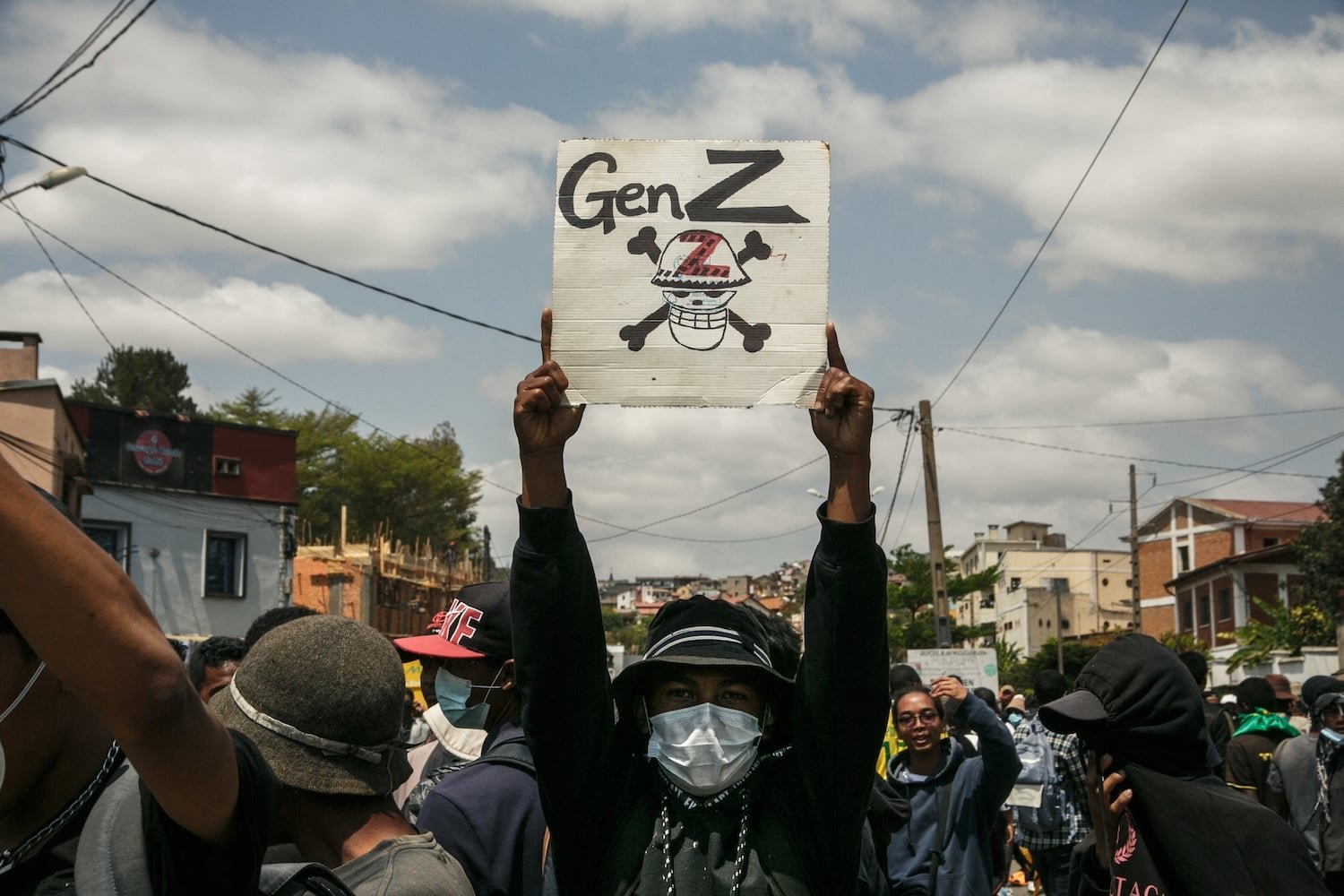
Madagascar’s election body announced Thursday that a constitutional referendum will take place in June 2027, followed by elections that October. The announcement came after fresh youth-led protests under the “Gen Z Madagascar” movement in early April, which demanded an election date amid rising discontent with the country’s military regime.
The Indian Ocean island made international headlines last October when an elite military unit seized power from President Andry Rajoelina following weeks of youth-led protests. (Rajoelina himself took power in a 2009 coup.) The demonstrations had initially begun in response to repeated power cuts and water shortages, but they escalated after security forces’ crackdown on protesters left at least 22 people dead.
While activists were glad to oust Rajoelina, many also feared what the military takeover would mean for the country’s future.
“Immediately after the military came to power, there were some visible short-term improvements. Power cuts became slightly less frequent, and some communities experienced longer access to running water,” said Velomahanina Razakamaharavo, a research fellow at the University of Reading and author of Peacebuilding in Madagascar: A Multi-Levelled Peace.
“However, these improvements have not translated into sustainable solutions,” Razakamaharavo added.
The junta’s elections announcement may be a cause for hope, but it “cannot yet be considered a clear sign of positive change in Madagascar’s civic space,” Razakamaharavo said. The military government, led by Col. Michael Randrianirina, is fulfilling the two-year transition timeline agreed with the Southern African Development Community to restore democratic governance, she explained, “rather than [showing] evidence of genuine democratic opening.”
As I suspected in October, the military may simply be following the new African coup playbook used by military leaders in Mali, Chad, Guinea, and Gabon: promising institutional reforms and a national referendum to establish a new constitution, which further entrenches their power over the legislature, followed by “tick-box” elections to legitimize that power grab.
Meanwhile, the crackdown on dissent has continued under military rule. As the military prepares for elections, “we’ve had arbitrary searches, arrests, detentions targeting the opposition (people from the former political regime that was deposed),” said Nciko wa Nciko, Amnesty International’s lead advisor on human rights in Madagascar.
According to Amnesty International, several protesters, including prominent Gen Z activist Herizo Andriamanantena, were detained on “vague charges” of criminal conspiracy and national security threats on April 12, shortly after taking part in protests in the capital of Antananarivo.
Other young people were arrested in late April alongside a Malagasy army officer and former French service member on charges of an alleged plot to destabilize the country and spreading false information. The French foreign ministry denied the accusations.
Despite the appointment of an anti-corruption chief as prime minister by the military in March, young activists say the space for political freedom is shrinking in the country. “It’s just a new face but the same mafia, the same oligarchs,” Malagasy activist Arimamy Todisoa told CBC Radio last month.
Meanwhile, the military government does not appear to be prioritizing everyday citizens’ needs in a country where three-quarters of the population lives in poverty. “Today, access to water remains one of the population’s biggest daily struggles. Many residents report going up to four days without running water. In some areas, people wake up as early as 2 a.m. to queue for water,” Razakamaharavo said.
As Nciko explained, government policies have largely focused on acquiring weapons rather than addressing water and electricity shortages. Last month, Randrianirina’s administration received arms and military equipment from Moscow, following talks between Randrianirina and Russian President Vladimir Putin, Bloomberg reported.
Nciko, for one, argues that the international community should not lose sight of the root cause of the Malagasy protests, which was corruption and the mismanagement of public funds. Gen Z activists are “saying still there’s degradation of public services. There’s still water problems, electricity problems,” he said. “That’s where the demands of Gen Z are.”
Thursday, May 14, to Friday, May 15: BRICS foreign ministers meet in New Delhi.
Sunday, May 17: Cape Verde holds parliamentary elections.
France-Africa summit. The Africa Forward Summit, co-hosted earlier this week by French President Emmanuel Macron and Kenyan President William Ruto in Kenya’s capital of Nairobi, resulted in around $27 billion in investments across Africa, $16.4 billion of which will come from French companies.
This was the first time that a French-African summit was held in an English-speaking African country, marking a strategic shift for France as it looks to secure closer ties with Anglophone Africa after facing growing criticism in former French colonies.
More than 30 heads of state and government attended the event. In a viral incident, Macron briefly interrupted the speakers during a youth forum to reprimand the audience for not remaining quiet, which drew mixed reactions online.
South African impeachment? South African President Cyril Ramaphosa rejected calls to resign on Monday, after the Constitutional Court in Johannesburg ruled last week that parliament should revive impeachment proceedings over a scandal involving the 2020 theft of $580,000 stored in a sofa at his Phala Phala game farm.
Ramaphosa has been accused of hiding the break-in and the money from police and tax authorities. He denies any wrongdoing: “The complaints against me are based on hearsay allegations,” Ramaphosa said in a televised address on Monday.
In 2022, South Africa’s parliament voted against an independent panel’s recommendation that Ramaphosa face impeachment proceedings. The recent legal challenge was brought by the left-wing Economic Freedom Fighters party, which argued the ruling African National Congress (ANC) party had used its parliamentary majority to shield Ramaphosa from accountability.
The ANC lost its majority in the 2024 elections and now rules as part of a 10-party coalition. In a Friday statement, the party said it would support “compliance with the judgment.”
The court ordered parliament to set up an impeachment committee to investigate the case. If the committee rules to proceed, Ramaphosa could be ousted if two-thirds of South Africa’s National Assembly vote to remove him. Still, South African analysts have suggested that Ramaphosa is unlikely to lose any such vote if ANC politicians back him.
Chadian repression. Eight Chadian opposition leaders were sentenced to eight years in prison on Friday on various charges including insurrection in a move that, critics argue, is the latest attempt by President Mahamat Idriss Déby’s administration to silence dissent.
The country’s Supreme Court also recently dissolved the Political Actors Consultation Group, or GCAP, a coalition of opposition parties and civil society groups. Succès Masra, a prominent opposition leader and former Chadian prime minister, was sentenced to 20 years in prison last August.
Nigeria-U.S. relations. Last week, Nigerian National Security Advisor Nuhu Ribadu met with U.S. Vice President J.D. Vance and Secretary of State Marco Rubio in Washington in Abuja’s latest attempt to mend ties with the White House.
Abuja has been trying to counter the Trump administration’s false claims of Christian persecution in Nigeria, while also battling armed groups and Islamists who are attacking Nigerians of all faiths in the country’s north. The U.S. conducted Christmas Day airstrikes against Islamic State militants in northwest Nigeria last year.
The recent talks centered on the Nigeria-U.S. Joint Working Group, which was established in January to support counterterrorism surveillance across West Africa. Detailed outcomes of the talks were not released. The talks were immediately overshadowed by the reported killing of more than 100 people on Sunday in airstrikes by the Nigerian military and more than 40 people in a separate incident by the Chadian military, both targeting Islamist groups.
Nigerian President Bola Tinubu, who attended the Africa Forward Summit in Nairobi, has separately strengthened economic and security ties with France since he entered office in 2023, including a critical minerals deal in 2024.
Russia’s Kenyan recruits. In Foreign Policy, Maurice Oniang’o reports on the more than 1,000 Kenyans recruited to fight for Russia in its war against Ukraine—soldiers who have often been deceived by false promises of lucrative civilian jobs in Moscow.
“Investigations by local media have documented bribery networks at Jomo Kenyatta International Airport involving airport staff, police, and immigration officers who allegedly facilitated departures knowingly, often in exchange for bribes,” Oniang’o writes.
Africa’s missing tours. Nigerian and South African artists such as Burna Boy, Wizkid, and Tyla have transformed African music, but their world tours often exclude African nations due to a lack of concert venue infrastructure, Mary Chiney reports in the Guardian.
“Music has played a central role in changing how young Africans are seen globally, replacing outdated narratives with a more dynamic representation of African life. But when an artist writes a song about the gritty realities of Lagos and only performs it in Berlin, a significant aspect of that connection is diminished,” Chiney writes.



