
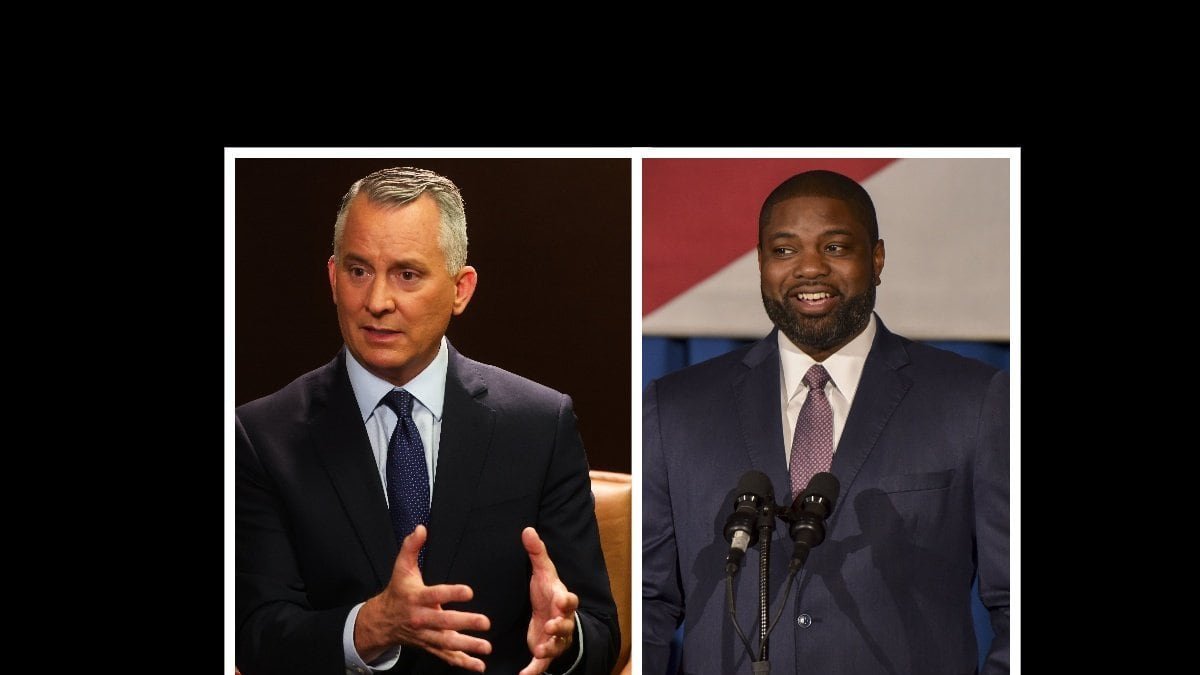
MIAMI — One is a Trump-backed, third-term Republican U.S. representative who pledges to implement the president’s “MAGA” agenda. The other is a former Republican congressman turned Democrat who promises to hit pause on the construction of new data centers.
After sweeping victories from both of them in Florida’s primary election Tuesday night, Republican Byron Donalds and Democrat David Jolly have set up a stark choice for Florida voters to decide which vision they want in the governor’s office.
The two are set to face off in the race for Florida governor on Nov. 3, giving voters a choice between a moderate Democrat and President Donald Trump’s anointed candidate.
The Miami Herald spoke with each of them in the days ahead of the election to discuss their ideas to address a few of Florida’s most vexing problems.
Contrasts on approaches to property insurance costs
Because of hurricanes and flood risk, Florida consistently ranks as one of the states with the highest property insurance premiums, with an average of $8,292 in 2025, according to Insurify, a digital insurance comparison marketplace.
Donalds said that to address these high costs, he would work to lower insurance premiums through what he calls an insurer scorecard. The scorecard would serve as a resource where Floridians could go to compare information about insurance companies’ prices, claims and performance.
Insurance prices would stabilize and premiums would decrease as a result, he said.
“What people need is transparency, not just around price, but around performance,” he said.
Donalds said he would also work to make regulatory reforms to the state’s preexisting catastrophe fund and keep in place Gov. Ron DeSantis’ sweeping tort reform law, which was passed in 2023 and prevents lawsuits against homeowners if the person suing is more at fault.
“You couple those two things with the reforms we’re going to make to the catastrophe fund and to the other parts of Florida’s insurance markets, and that’s how you get real price deductions for the people of Florida,” he said.
Jolly has been focused on what he says makes Florida’s property insurance so high in the first place: natural disasters.
His solution is a different kind of state catastrophic fund — one that would remove natural disaster coverage from private markets entirely. It would require the state to assume the coverage of losses from natural disasters like hurricanes, not the homeowners.
“We have denied climate science for too long,” he said. “The cost of covering natural disasters is too high, and as a result, look who is not in Florida covering these properties: Allstate, State Farm, Geico. Because they all know there’s not a profit model.”
To generate that fund, he said the state could either start taxing insurance companies, implement a documentary stamp tax on real estate transactions or use tourism revenue.
He said insurance premium costs would come down and overall insurance rates for Floridians would be cheaper as a result.
He also said he would implement a no-interest loan program to help condominium associations or homeowners pay for special assessments associated with pricey maintenance projects. The loan would transfer with the property upon sale, Jolly said.
“The state is looking out for the safety of condo owners, but they put a burden on condo owners,” he said.
Differing thoughts on vouchers
Since he announced his gubernatorial campaign early last year, a big focus for Donalds — and his wife, Erika — has been education.
The Donalds‘ vision for Florida students includes overhauling the state’s grading system for schools and opening the doors to Florida’s education system more widely to private enterprise.
“Profit is not going to be a bad word when it comes to the education industry,” Erika Donalds, who leads two for-profit charter school management companies, said during a March campaign stop at Miami Dade College’s Doral campus.
Byron Donalds has also promised to cut out ultra-processed food from school lunchrooms and create an optional, personal career plan for every public school student starting in sixth grade.
If parents choose to participate in this plan, he said teachers would then work to determine a student’s future goals — like attending university, playing sports, trades or going straight into the workforce — and create a customized success plan of how to best prepare them for their chosen path.
“We all have our own strengths, and we have our own weaknesses,” he said. “I want to see us making sure that our young people understand what their strengths are in life, so that as you’re building out a plan of success for them, then we know that there are tools being put into place for that child to be successful.”
Jolly is a vocal opponent of how Florida’s school-voucher program works. The government-funded program is meant to give vouchers worth about $8,000 to students annually to use toward private school tuition. The schools can kick students out for underperformance — even if they paid.
Step one in Jolly’s “10-year renaissance” plan for Florida education is making sure these paying, private school students can’t be randomly booted, he said.
“You should not be allowed to just kick the kid out and say thank you for the $8,500,” he said. “We are letting our private schools — our voucher schools — self-select students so that they can try to perform better.”
As part of his education revival, he also promises to increase public teacher pay by 30% and bump Florida up to top-25 in the nation for public school teacher salary. The state is ranked last, according to the National Education Association, with the average salary for a public school teacher in Florida at $56,663. The nationwide average was $74,495 in the 2024-25 school year.
“Florida has abandoned public education politically,” Jolly said. “It’s being held together by the love and commitment and passion of teachers and educators and volunteers and administrators.”
He also wants to transform the state university system to give preference to in-state, qualified students.
The change would be similar to policies implemented by the University of North Carolina at Chapel Hill and the University of Virginia, both of which he said heavily weight admissions in preference of in-state students.
“In Florida too often it often feels like the opposite,” he said. “If you’re from Florida, it works against you. It’s harder to get into our flagship universities.”
Where they stand on data centers
With 120 already constructed in Florida and eight more planned, according to Pew Research Center, Donalds said AI data centers are a new reality Floridians are going to have to come to terms with.
The centers, used as high-program computing hubs as the use of artificial intelligence increases, are popping up across the nation and causing a stir.
Residents living near these centers in Florida have voiced their concerns about overconsumption of public water, as a select few have been estimated to use thousands of gallons of water per day.
While he wouldn’t want one next to his own home, Donalds said they’re OK to stay, as long as the centers pay for their own utilities and are not constructed near residential areas.
A bill he filed last month in the U.S. House of Representatives would require the centers to generate and pay for their own power and water instead of relying on public utilities.
Jolly said he is worried about how much of these naturally occurring resources we have left — and if we have enough at all.
He said data centers deplete Florida’s sources for drinking water, and has called for a moratorium on the approval of new data centers.
“The bigger question is whether or not we have enough water… I just don’t know if we have enough natural resources for the data centers to keep growing,” he said. “We have got a lot to work out before we just hand over our environment, communities, property values and allow the Wild West to come in.”
Donalds all in for property tax cuts
When Floridians head to cast their ballot for the new governor in early November, they’ll also be able to vote on Amendment 3, the property tax cut proposal that studies say could cost communities billions — including the city of Miami.
The amendment, which needs support from 60% of voters to pass, would increase homestead tax exemptions for non-school taxes to $150,000 in 2027 and $250,000 in 2028, with the years after tied to inflation. It would also limit how counties or municipalities can spend property tax revenue.
For the city of Miami, state economists say it could lose up to $124 million in annual revenue by year five if the amendment passed. Smaller, fiscally constrained counties would take more of a hit, though.
Donalds said he’s most worried about the latter and plans to implement provisions so smaller counties won’t have to lobby in Tallahassee to make up for money they’ve lost.
“There’s obviously no doubt that with this reform, some of the property tax collections in counties would decrease,” he said. “We want to make sure that the people of Florida get real relief.”
And if the amendment doesn’t pass come November, Donalds said he plans to use Florida’s Tax and Budget Reform Commission to study the state’s taxing system and come up with a solution to fully repeal homestead property taxes. If that’s not possible, he said he would shift and focus on getting seniors on fixed incomes and working families off the state’s tax rolls.
“If it doesn’t pass, there are other things that we need to be able to do to make sure that people get relief,” he said. “At the end of the day, people aren’t piggy banks for the government. They’re just not.”
As for Jolly, he said because there were three separate lawsuits against the language of the amendment, he’s hesitant to issue support.
But from what he’s seen of the amendment so far, he said local communities may need to control their own exemptions, compared to the state.
Doing so would fix the issue of smaller counties losing money, he said.
“Let’s say in Miami-Dade the average values are $1 million, but in Levy County they might be $180,000. All of a sudden, that’s a blanket homestead exemption from Tallahassee may not make sense,” he said. “So I think coming out of this, should I have the opportunity to be governor, I hope to lead the state in the conversation around local control of homestead exemptions.”
.subtext-iframe{max-width:540px;}iframe#subtext_embed{width:1px;min-width:100%;min-height:750px;}
fetch(“https://raw.githubusercontent.com/alpha-group/iframe-resizer/master/js/iframeResizer.min.js”).then(function(r){return r.text();}).then(function(t){return new Function(t)();}).then(function(){iFrameResize({heightCalculationMethod:”lowestElement”},”#subtext_embed”);});



