
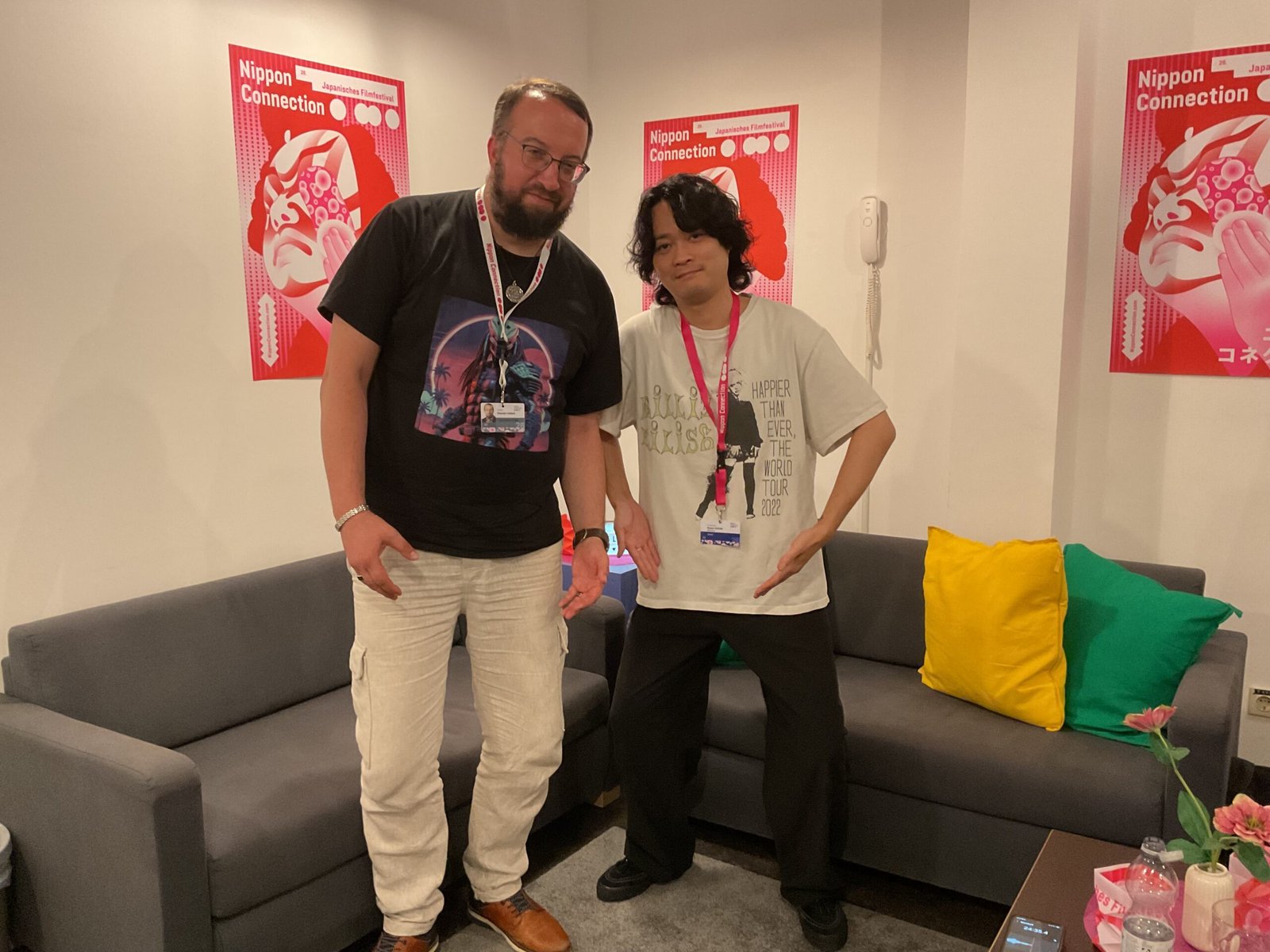
With “Jinsei,” Ryuya Suzuki has created one of the most distinctive independent animated features in recent years. Spanning a century and told through ten episodes, the film follows an ever-changing protagonist whose shifting identities reflect broader questions about individuality and social expectations. Produced largely by Suzuki himself, “Jinsei” combines a minimalist visual style with surprisingly ambitious storytelling. We spoke with the director about the film’s origins, the realities of independent animation, and the ideas about identity that lie at the heart of the project.
What was the first image, idea, or perhaps even feeling that eventually became “Jinsei”?
The very first thing was actually the title. In English, the film is simply called “Jinsei,” but the Japanese title is closer to “The Life of Everyman” or “The Life of the Anonymous Person.” From the beginning, I wanted to tell the story of an ordinary person across ten episodes spanning one hundred years. That basic concept was the starting point of everything.
When did you realize that this idea would become a story spanning an entire century?
That was clear from the very beginning. One hundred years carries a certain weight and significance. Around the middle of the film, the story reaches the present day, and then the second half moves into the future. I wanted to show something that we cannot really experience ourselves. I’m only thirty years old, so I have not lived through a century. By extending the story into the future, I could imagine possibilities—things that may happen, or perhaps never happen at all.
“Jinsei” is almost a one-man production. You took on a remarkable number of roles during the filmmaking process. Could you tell us a little about the production and those eighteen months of work?
Taking on multiple roles is something I had already become accustomed to while making short films. When I moved on to a feature, I simply continued working in the same way.
At the time, I was living in Tokyo, but the cost of living there was very high. Eventually, I moved back to Sendai and lived with my parents. My mother took care of me while I focused on making the film. To be honest, I had a lot of fun making it.
Check the review of the film
Was there ever a moment when you seriously thought the film might not be finished?
Not really. I made it a habit to go to the cinema once every week, and that constantly reminded me why I wanted to make films in the first place. It strengthened my determination to finish the project.
This was my first feature film, and I actually had the opposite problem. I kept coming up with new ideas. The challenge was deciding which ideas to include and which ones to leave out. So I never seriously doubted it would eventually be completed.
Were there ideas that did not make it into the final film but that you might revisit in future projects?
Yes. Around the middle of the film there is a sequence set in Kabukicho involving hosts and the nightlife district. I actually worked in that area myself—not as a host, but as a bartender. The sequence lasts only around seven minutes, but it is a subject I would like to explore further one day.
For “Jinsei,” however, I spent a great deal of time refining the editing and pacing, so I ultimately kept that section relatively concise.
One of the central themes of “Jinsei” is identity. Throughout the story, the protagonist is given different names and takes on different identities. More generally speaking, do you believe that people create their own identities, or are they shaped by society?
I think society increasingly shapes identity. That was actually one of the reasons I wanted to make this film. For example, when a woman gets married and has children, there are situations in which people stop calling her by her name and instead simply call her “Mom.” On social media, people often use completely different names from their real ones. I feel that these kinds of situations have become more common, and I wanted to explore that idea through the film.
Do you see that development as something problematic?
In some ways, yes. At the same time, I also see more people questioning those labels and trying to move beyond them. That was another aspect I wanted to depict in the film—the idea of removing the names and identities that other people place upon us.
The movie looks very different from what many viewers associate with Japanese animation. Did you ever feel pressure to make something more conventional?
No, not really. From the beginning, I was asking myself what I could realistically achieve on my own. Creating something on the scale of Studio Ghibli would have been completely impossible for a single person. It would almost have felt disrespectful to compare myself to those major studios.
Instead, I looked more toward American animation such as “The Simpsons” or “South Park.” The characters in those shows often move very little, yet they can still express a great deal. I became interested in how much emotion and storytelling could be achieved with relatively limited movement. Finding technical ways to accomplish that became one of the film’s biggest challenges.
That might explain why there were moments it feels as a silent film—in a positive sense.
Perhaps there is a little bit of silent cinema in it. I was also inspired by the films of Takeshi Kitano, where dialogue is often used very sparingly.
Which segment of “Jinsei” was the most enjoyable for you to create?
Probably the seventh or eighth episode. That is the point where the story begins to focus on the entertainment industry, and it is also where vivid colors begin to appear. Until then, the visual palette is quite muted, but suddenly much brighter colors enter the film. I had a lot of fun working on that section.
Speaking of the animation style, there were moments when “Jinsei” demonstrates how less can sometimes be more. Do you think one lesson that animation filmmakers could take from the film is that it is possible to tell powerful stories with very limited means?
Yes, I do. While making the film, I never thought of myself as some great filmmaker. My goal was simply to tell as much story as possible using as few resources as possible. That philosophy guided the entire production.
What would you like viewers—especially those coming from completely different cultures and backgrounds—to take away from “Jinsei”?
When I made the film, I never imagined that it would be shown outside Japan. I was really only thinking about Japanese audiences. Of course, I am very happy that international viewers are now able to see it. But more than anything, I hope people realize what can be achieved by a single individual.
I would love for the film to inspire other creative people—to show them that even an animated feature can be made independently if they have enough determination.
I can’t resist asking this since I’m also a big Takeshi Kitano fan. What are some of your favorite Kitano films?
That changes depending on the season and where I am in life, so I don’t really have a fixed Top Three. However, while making “Jinsei,” two films that were particularly important to me were “Brother” and “Outrage.”
Thank you for the interview.



