
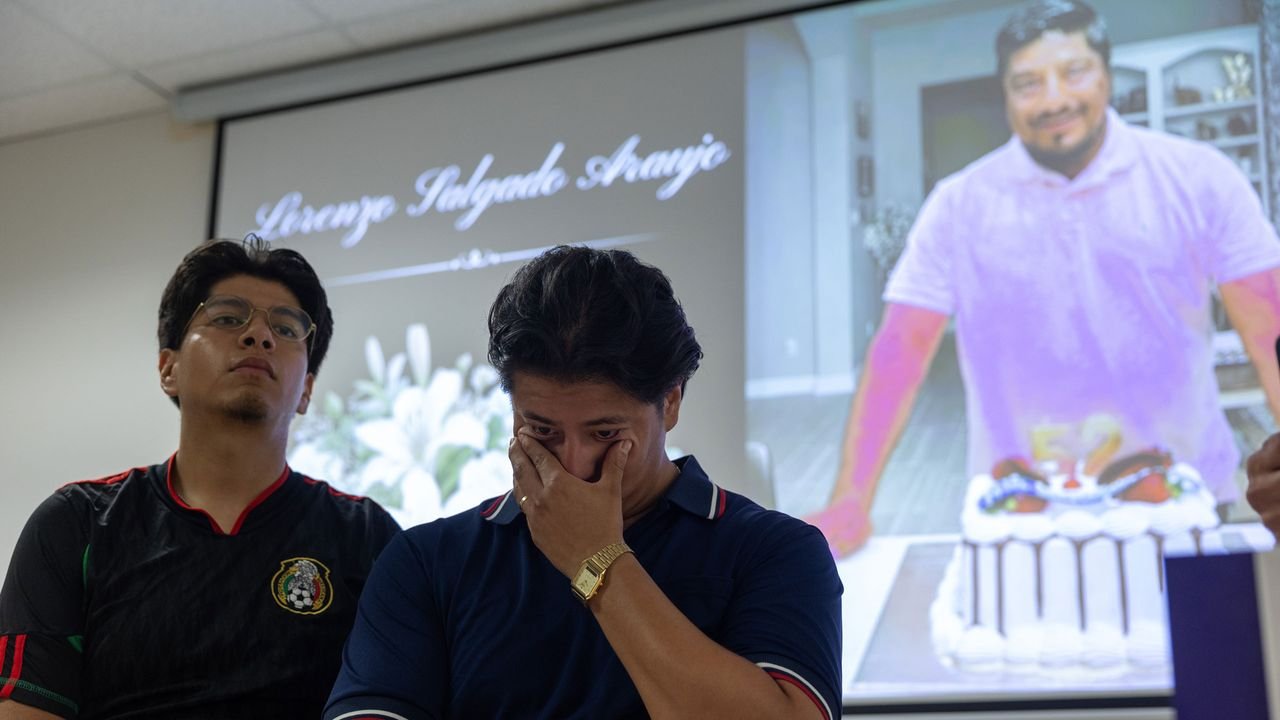
This was not the plan that Salgado and his family had devised for what to do if he was detained by ICE: he’d make sure not to sign any papers, and he’d place a call to his family. “Lorenzo Salgado believed there was a process that would allow him, one way or another, to find his way home,” David Donatti, a senior staff attorney at the A.C.L.U. of Texas, which is representing Salgado’s family, said. “The key assumption that separates 2026 from 1910 is an assumption of process. And this case is an example of that breaking down.”
In fact, ICE was already in the process of covering up facts. It issued a statement declaring that Salgado had been pulled over and tried to evade capture: he had “rammed an ICE law enforcement vehicle, refused to follow multiple verbal commands, and weaponized his vehicle in an attempt to run over an ICE law enforcement officer.” ICE insisted that the agent had fired his weapon in self-defense, even though there was no body-camera footage to support that claim.
As the F.B.I. opened an investigation, the case’s material witnesses—the three men riding in the car with Salgado—had been removed to a detention center outside of town. The congresswoman Sylvia Garcia, who represents Magnolia Park, warned that the men were being pressured to self-deport to Mexico. But, through their lawyers, they began trying to correct the record.
Salgado’s brother, Victor Hugo, had been riding in the van’s passenger seat that morning. As they headed toward the interstate, unmarked vehicles began tailing them, driving recklessly. It was impossible to tell who was behind the wheel—the cars’ windows were tinted—but there were no sirens. After about twenty minutes of pursuit, Salgado decided to pull over. One of the men who’d followed them ran up to Victor’s window and yelled, “Stop!,” before quickly firing his gun. The bullet apparently whipped across the cab and struck Salgado in the stomach. As blood poured from Salgado’s body, other men swarmed the van, and Victor was yanked outside. That was when he saw that the shooter wore an ICE lanyard. Soon afterward, he noticed that the shooter had switched guns with another agent.
Victor was handcuffed and forced to kneel. An agent shoved his hand into Victor’s pocket, pulled out his I.D., and examined it, declaring, “Mexicans!” On the other side of the car, another ICE agent was restraining Salgado against the ground, handcuffing him. Victor could hear his brother’s cries for help: “Me están matando”—they’re killing me. When an ambulance arrived, more than twenty minutes later, Salgado looked unconscious. Sometime later, he died.
The case attracted scrutiny from the press and local officials, and in less than forty-eight hours ICE was hedging its story: Salgado wasn’t the man the agents were targeting, after all. They were looking for two Guatemalan men, who presumably owned a white van similar to Salgado’s. In cases involving a fatal engagement with law enforcement, it is common for local authorities to carry out their own investigation, to determine whether state criminal laws were violated. But, when Harris County began investigating, the Department of Homeland Security operated like a “black box,” according to the district attorney, Sean Teare. It cut off access to basic physical evidence, including the weapon that was fired. Teare questioned the van mixup: ICE, he said, would have had a license-plate number for whatever vehicle it was looking for.
The F.B.I. obtained a search warrant for Salgado’s van, claiming that one of its agents had spotted small bags of a “white crystal-like substance” inside. In an apparent effort to link Salgado to narcotics, the F.B.I. immediately made the warrant public—something that Teare had not seen in two decades in law enforcement. Salgado’s family heard the news as they were making preparations for his funeral. They responded that the substance in the bags was salt. Salgado’s wife would mix it with baking soda, for him to pour into jugs of water and lime juice—a homemade electrolyte to help him work through hot summer days. The F.B.I. tested bags recovered from the van, but the lab results came back negative. This time, the Bureau did not publicize its findings.



