
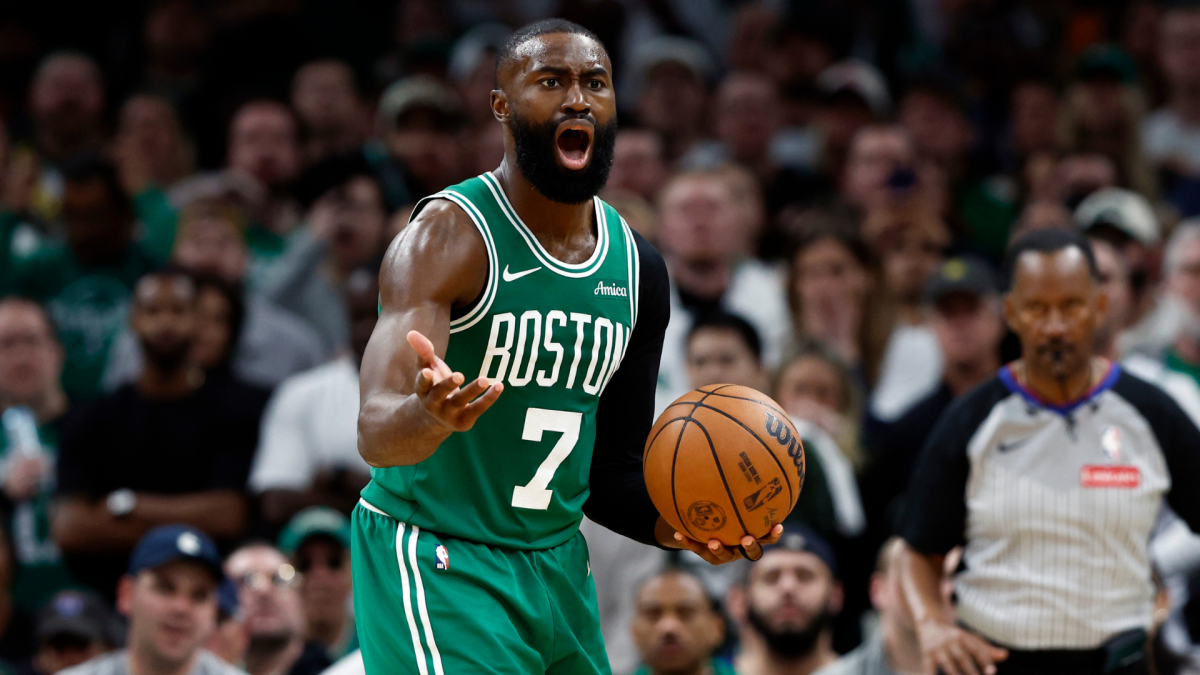
Jaylen Brown is a great NBA player. Let’s establish that from the start. He’s clearly insecure about the degree to which his superstar status is externally acknowledged, and we’ll get into that, but he’s a great player. Anyone who knows anything about basketball should agree on that.
That said, enough with the victim routine.
I will say up front, I give Brown ample leeway here. Feeling sorry for yourself is a human condition. We all do it from time to time. But in Brown’s case, he’s been on a woe-is-me crusade for years now, and it continued on Sunday — a day after his Celtics were eliminated in Game 7 of the first round by the 76ers — when he took to a live Twitch stream to present play-by-play evidence of what he insists is an officiating “agenda” against him. It’s a stream that ended up costing him $50,000 as the NBA issued a fine on Tuesday.
Brown whining about not getting the same whistle as other stars is nothing new. He’s been at this routine for some time. In this case, Brown believes he was targeted in the Sixers series, during which he was called for 10 offensive fouls, for a space-creating tactic that he states “every good basketball player does.”
The tactic in question, of course, is Brown’s use of his off arm, which he regularly extends into his defender before pushing back to create separation. He’s right, just about every one-on-one player does this to some degree when operating in tight quarters. But some do it more consistently and egregiously, and Brown is one of them.
“I’ve actually spoken to some refs, and they said it was an agenda going into each game … Any time Jaylen brings his arm up, just from reputation, just call it,” Brown said during the stream.
So officials have openly admitted to Brown that the league has an agenda against him? I don’t think so. What is believable is that the league, in communication with its officials, declared Brown’s off-arm use as a point of emphasis.
An agenda, in the way Brown is implying, is a manipulation. It’s “we don’t like this guy, so let’s go out of our way to make life difficult on him, even to the point of officiating him unfairly.” A point of emphasis is: “Hey, we’re seeing a lot of these offensive stiff arms, and Jaylen Brown is one of the prime offenders, so let’s make sure we’re watching for it.”
Jaylen Brown calls out Joel Embiid for flopping, says NBA refs have ‘agenda’ against him during Twitch stream
Sam Quinn
Brown was whistled for this particular variety of foul all season, not just in this series. And they are fouls. No question about it. In that same Twitch stream, Brown said that Joel Embiid “knows” he’s a flopper, and by the same token, Brown, a very smart guy, knows he’s a stiff-armer. What he’s saying is he shouldn’t be called for this maneuver because other guys get away with the same thing.
It’s true. A lot of players get away with this all the time, including Brown. If he didn’t, he would foul out of every game. This is a tactic he deploys regularly. It’s basically his go-to move. During the regular season, he played in 71 games and was called for 40 offensive fouls of all varieties. Even if every one of those was a stiff arm, which they weren’t, that would be a little more than one foul for every two games played. One.
Brown gets away with this move plenty. It’s just a numbers game. You do it more often, you’re going to get caught more often. This, of course, is where the “what about” police are going to flip on their sirens. What about Shai Gilgeous-Alexander? Yes, he’s another egregious offender. And yes, the fact that he was only whistled for 12 offensive fouls during the regular season is laughable.
I would submit that part of the reason Brown gets whistled for this particular move more frequently is that he’s a rougher one-on-one player in general. He’s not creating as much smooth space as Gilgeous-Alexander, for example, and then clearing room at the end. Brown is more of a bully creator. He starts most of his moves by getting his body into his defender, then finishes them by pushing away.
Brown’s body doesn’t move as fluidly, either. Gilgeous-Alexander is more of a dancer, and in all the gyrating, it can be harder in real time to tell whether he’s created his back-step space primarily by way of the stiff arm. With Brown, it’s obvious. And officials react to the obvious.
That would be my primary take on the matter, but I’m not naive either. Everyone knows that superstars get the benefit of more friendly officiating, and Brown has made it clear he thinks he doesn’t get the respect he deserves as one of the league’s true superstars.
Brown frequently plays the disrespect card
Brown can say he doesn’t care if he doesn’t get the level of superstar respect he believes he deserves, but he clearly does. He brings it up a lot. This isn’t a one-time comment by any stretch — all season, he was basically running a “World’s Best Player” presidential campaign.
- On New Year’s Eve, he tweeted: “Best 2 way player in the game.”
- After he went for 50 points against the Clippers a couple of days later, he said, “I believe I’m the best two-way player in the game” and that “it’d be nice to get some respect.”
- After Jalen Brunson was named Eastern Conference Player of the Month for December, Brown tweeted “Smh” (shaking my head, for the non-modern acronym crowd), which is basically calling it a joke that he didn’t win the award.
- In March, he called himself the “best human player” with the comical caveat being that Spurs giant Victor Wembanyama is “not even human.”
The interesting part about this last comment was the timing. One day earlier, Jayson Tatum, Brown’s Celtics teammate, made his season debut after a long rehab from a ruptured Achilles. Again, Brown is a very smart guy — smart enough to know that calling yourself the world’s best (non-Wemby) player is by proxy calling yourself the best Celtics player. That’s a pretty tone-deaf declaration to make when the guy most people believe to be Boston’s best player has just rejoined the team.
It’s not that Brown shouldn’t believe he’s the best on his team, or hell, in the world. All of these players are incredible and, deep down, have every right to believe they are the best. Even if it isn’t true, that confidence is instrumental in becoming that great in the first place. You can bet that Kevin Durant believed he was the best player on the Warriors, and Stephen Curry did too. But while you’re wearing the same uniform and there’s an open dialogue about who is even the best player on your own team, you don’t say it. It’s only inviting drama.
Luckily, Tatum doesn’t seem like the kind of insecure superstar to care about such a thing, and he and Brown have always had each other’s backs. I would be remiss if I didn’t recognize that Brown actually contradicted his own “I’m the best player” claim a few days earlier, when he actually made a point to call Tatum Boston’s best player.
Tatum is a better player, but Brown is so great himself and was so great this year that it can be an honest debate on any given night. Either way, the bottom line is that he and Tatum have been great together. They won the title in 2024. Which is what made it so strange that, on the aforementioned Twitch stream, Brown declared this season — not the one in which the Celtics won the championship — “my favorite year of my basketball career.”
On the surface, a lot of people took this to mean that Brown enjoyed a season in which he was able to be the 1A alpha player on his team (with Tatum out most of the year), even with the Celtics losing in the first round, more than he did a season in which he was regarded as the No. 2 guy, but his team won the championship.
I’m going to defend Brown again here. For starters, telling others how to feel is ridiculous. Just because the delicate sensibilities of basketball bloggers are offended by the idea that winning a title may not be the most important thing in the world to a person (when really it’s the most important thing to them and all their dumb ring-count player rankings), doesn’t mean Brown said anything wrong.
Jaylen Brown for Giannis Antetokounmpo? Why one side probably says no to NBA’s hottest trade rumor… for now
Sam Quinn

It’s entirely understandable that a season in which Brown and his team faced extreme adversity, and had to beat the odds for the first time in a while, and largely did so by achieving the No. 2 seed in the East, would qualify as a highly rewarding experience.
Imagine you’re a sales manager, and your team ends the year with fewer sales than two years earlier, despite having a diminished staff. Personally, you stepped up as a leader and your team rallied around each other to find a way to outperform expectations in spite of those trying circumstances.
Would it be unreasonable to call that a more rewarding year at work than one in which everything ran smoothly and, on paper, yielded more impressive results? Have some perspective. This, on its own, does not define Brown as a selfish player more interested in individual recognition than team success.
But taken as part of this ongoing pattern of Brown seeking the spotlight and whining whenever he doesn’t feel like he’s getting enough of the shine, it’s also fair to simply point out that Brown is starting to sound like a crybaby who’s gotten a little too high on his “I’m the best player and should be treated as such” horse.
Naturally, fans are going to go in search of ways to knock a guy like that back down.
The numbers don’t paint a pretty picture
In Brown’s case, there are some pretty glaring numbers to point to that would, to whatever degree you value on/off splits, seem to indicate he’s not quite as great as he thinks. Consider this: During the final three games of the Philly series, the Celtics were minus-66 in Brown’s minutes and plus-26 when he was on the bench.
This has been a consistent theme. Believe it or not, the Celtics were actually 5.6 points per 100 possessions worse this season when Brown was on the court, per Cleaning the Glass. During the championship season? Minus-8.9 with Brown on the court in the regular season, and a minus-13.8 in the playoffs, per CTG. These numbers are messy. Derrick White has negative numbers next to his name depending on how you filter the lineups, and everyone knows White is the definition of a winning player.
Still, when you’re touting yourself as the best in the world, you’re going to have a hard time explaining these kinds of splits. Just as Brown’s crying about not getting superstar respect from the officials falls flat when you realize that he actually received a whistle for a defensive shooting foul committed against him on 15% of the possessions he was on the floor for this season.
There’s some pace stuff baked into that metric, but ultimately that’s a higher percentage of calls than plenty of superstars received this year, including Anthony Edwards, LeBron James, Jalen Brunson, Victor Wembanyama, Nikola Jokic, Stephen Curry, Cade Cunningham, Kevin Durant, Kawhi Leonard and Donovan Mitchell, and it’s not too far off Gilgeous-Alexander’s 17.8% shooting foul rate, or Luka Doncic’s 17.0%.
These are the facts. What Brown is dealing with is perception. He might say he doesn’t care how he’s perceived, but his consistent comments suggest he very much does. And all the whining isn’t going to help.



