
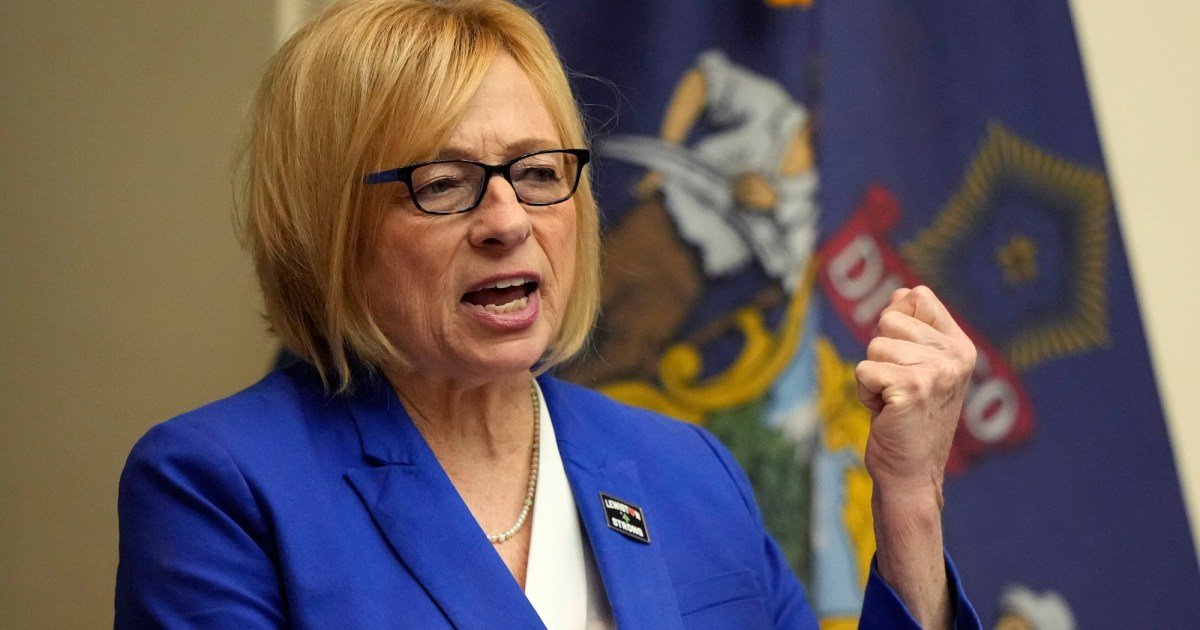
Gov. Janet Mills in 2024Robert F. Bukaty/AP
Until yesterday, it looked like Maine would enshrine the country’s first state-level hyperscale data center moratorium into law. But late on Friday, Democratic Gov. Janet Mills announced she would veto the bill. Though a statement she issued claimed that she agreed a “moratorium is appropriate” in theory, Mills wrote that she would not sign the one passed by legislators in order to avoid jeopardizing a single data center being built in the town of Jay, which she said would bring 800 temporary and 100 permanent jobs to the area.
The data center industry’s lobby welcomed the move. “Enacting a statewide moratorium on data centers would have discouraged investment and sent a signal that Maine is closed for business—both for data centers and economic development projects involving other industries,” said Dan Diorio, a spokesperson for the Data Center Coalition. “Critically, it would have denied local communities the opportunity to compete for investment and jobs involving data center projects they found suitable.”
Instead, Mills ordered a study on “the potential impacts of large-scale data centers in Maine.”
Environmental advocates were less thrilled. “With this veto, Governor Mills has demonstrated a shocking disconnect with the people of Maine, their elected legislators, and a large and growing national movement against the reckless explosion of this highly problematic industry,” said Mitch Jones of Food and Water Watch, a nonprofit focused on climate and corporate accountability. “Mainers and people across the country are becoming increasingly fed up with the skyrocketing electricity rates, false jobs promises, and harmful industrialization of small-town communities that hyperscale data centers bring wherever they land.”
Rather than pause their construction altogether, Mills’ statement said she will issue an executive order to establish a council studying “the potential impacts of large-scale data centers in Maine.”
But as I reported last week, data center moratoriums are gaining public support in Maine and beyond. With Mills set to compete in a hotly-contested June Senate primary against Graham Platner, who supported the moratorium, her veto decision could become a political liability. Platner currently leads Mills in the polls by double digits.
Beyond Maine, twelve states are considering legislative moratoriums on data center construction, and dozens of municipalities have already passed such laws. Sen. Bernie Sanders (I-Vt.) and Rep. Alexandria Ocasio-Cortez (D-N.Y.) introduced a proposal for a nationwide moratorium in March. “A year ago, nobody was entertaining a moratorium,” says Greg LeRoy of the watchdog group Good Jobs First. “Now a fourth of the states are.”



