
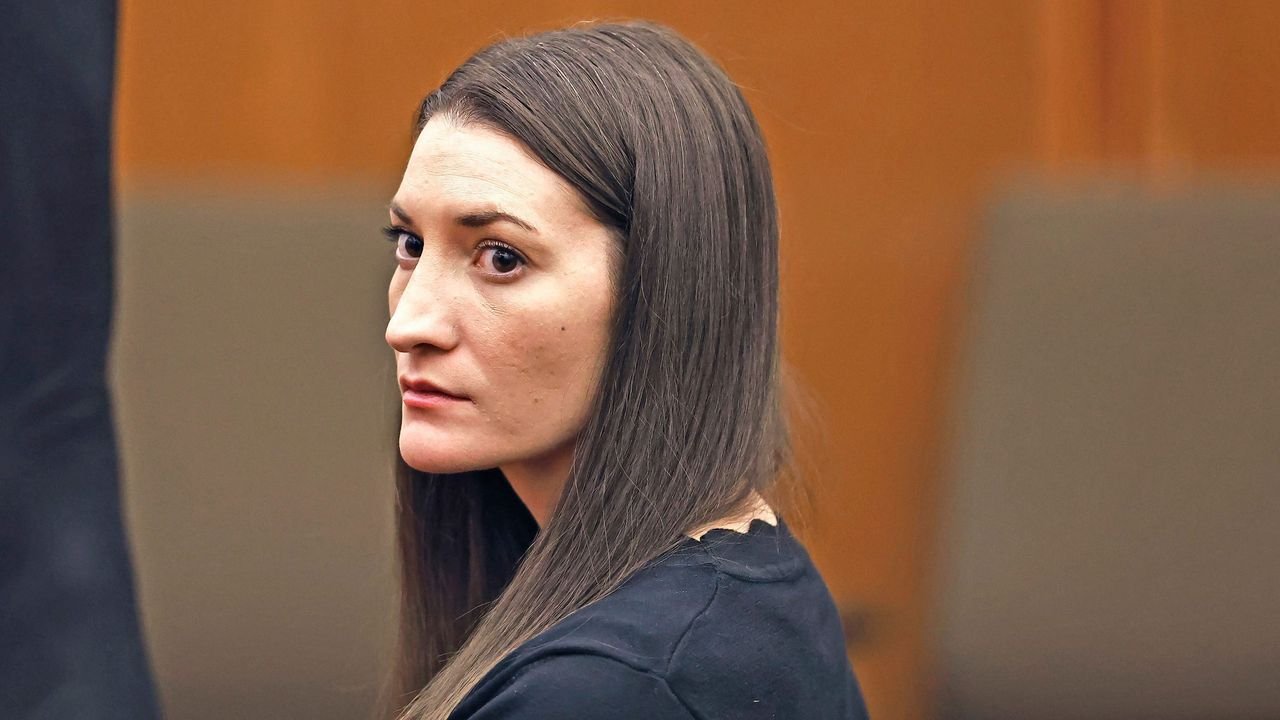
Near the start of the year, Lindsay Clancy, the woman at the center of the criminal trial in Massachusetts that has mesmerized many chambers of social media, filed a civil action against eight health-care providers and facilities. The suit alleged that “each failed to properly diagnose Lindsay’s bipolar disorder with postpartum onset and instead subjected her to a disorganized, uncoordinated course of polypharmacy that exacerbated her condition and precipitated a severe psychotic break.” On January 24, 2023, allegedly in the grip of this psychosis, Clancy strangled her three children, who were five years, three years, and eight months old, in the basement of their home in Duxbury, Massachusetts, an affluent suburb of Boston. Clancy then ingested prescription medication, slashed her wrists and neck with a knife, and apparently threw herself head first out of a second-story window, resulting in permanent paralysis from the sternum down. Her then husband and the father of her children, Patrick Clancy, was out picking up dinner and stopping at a nearby CVS. The complaint goes on, “Lindsay now faces a lifetime of physical disability, psychological trauma, and the unbearable grief of waking up every day knowing she killed her children—all of which could have been prevented had Defendants provided competent medical care.” (Patrick Clancy has also filed a wrongful-death suit against two physicians and two facilities involved in his former wife’s care.)
Clancy’s lawyers argue that their client is not criminally culpable for her children’s deaths because she was suffering from undiagnosed postpartum psychosis, an uncommon and poorly understood condition that can cause hallucinations, delusions, and dissociation; it poses a known risk of suicide and, in exceedingly rare cases, filicide. The attorney in her civil suit acknowledges that she committed the physical act of killing her children. So does Kevin Reddington, the formidable defense attorney who is representing Clancy in her criminal trial, taking place in Plymouth, which is being live-streamed on the Internet and heavily covered on local news. Clancy faces three counts of first-degree murder and, if convicted, the prospect of life in prison without parole. She has entered a plea of not guilty by reason of insanity.
Yet, on TikTok, on Threads, and, presumably, in innumerable group texts, a contrarian consensus has flourished. An army of trial watchers purports, without proof, that Clancy is entirely innocent—that she was somehow framed by Patrick, who has testified in her defense. This algorithm-driven court of opinion is a frequently ghoulish fever dream, where defense exhibits can range from clumsily A.I.-enhanced CVS security-camera footage to Zapruder-film analysis of old Instagram posts.
It was inevitable, owing to our present political and sociocultural moment, and to the bottomless horror of the facts of this case, that the Clancy trial would inspire outlandish counternarratives. The American public distrusts its legal institutions and media outlets, creating a vacuum in which wild conjecture can bloom. True-crime brain is a national epidemic. And trying to comprehend how an outwardly loving and devoted mother could asphyxiate her own children, one by one, using exercise resistance bands, while her husband ran errands, might trigger a kind of bewitched disbelief—one that expresses itself in perverse acts of fixation-by-deflection, including, to cite one example, staging a speculative reënactment of the crime scene using Bratz dolls and then posting it to TikTok.
Often, the conspiracy theories around this case—like most conspiracy theories—are premised on rational questions. For example, the Commonwealth has never delineated the exact interval of time between Patrick leaving the home and Clancy falling out the window. Clancy was severely hypothermic when she arrived at the emergency room, with a core body temperature of just eighty-two degrees. This reading may be plausibly explained by the winter weather and by the effects of a catastrophic spinal-cord injury. But the question of how long it took for Clancy’s temperature to drop so perilously low further highlights the uncertainty of the time frame in which the events occurred—a material fact of the case. Internet sleuths, predictably, have seized on this ambiguity as proof of malfeasance.



