
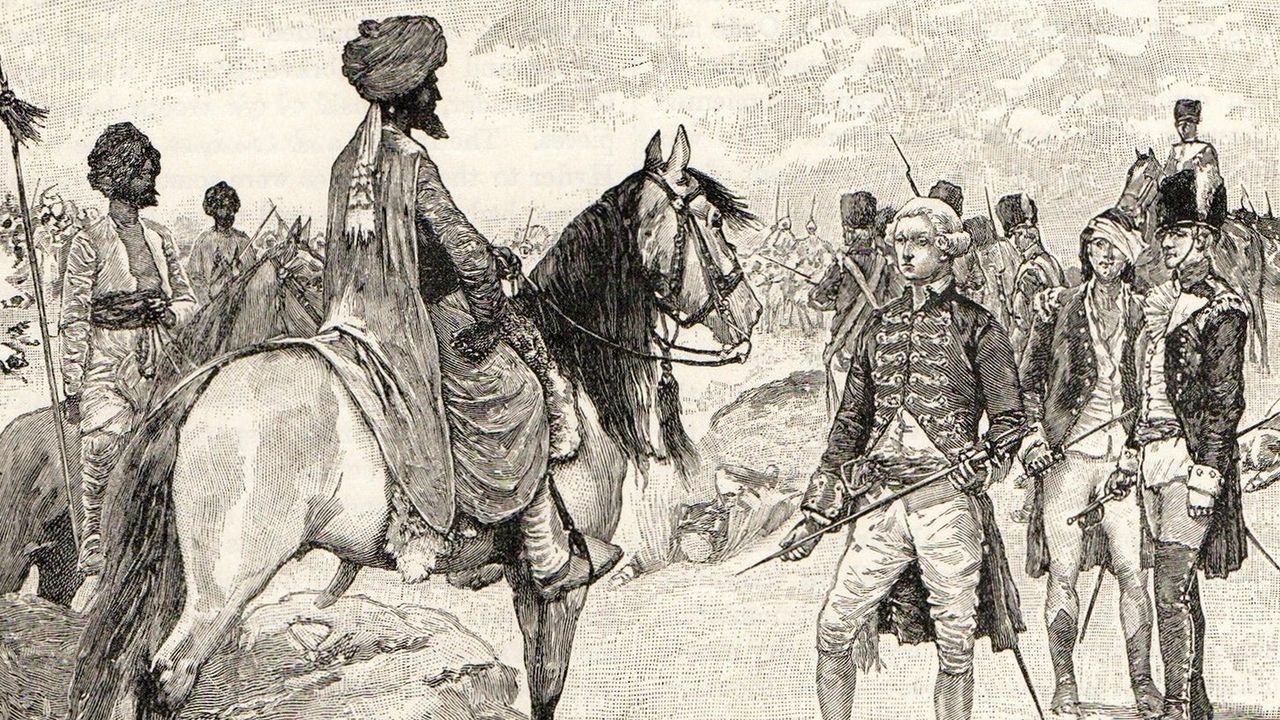
As the name of Barney’s ship suggests, the struggles in Mysore stirred the American imagination. Hyder Ali’s decisive victory at the Battle of Pollilur, in September, 1780, in which he routed a column of British troops, was documented and discussed by the Founding Fathers. Edmund Jennings Randolph, a Virginia delegate at the Continental Congress, wrote to John Adams, then posted in Europe, in April, 1781, of how Hyder Ali’s “Army of 80000 Horse” had “totally defeated” its British quarry. John Quincy Adams, a teen-age student in the Netherlands at the time, wrote excitedly to his mother, Abigail, about “the check the English have had in the East Indies,” where they had “lost a great number of men.” In a letter written in the summer of 1782, James Madison praised Hyder Ali’s “superiority” over his most implacable foe, Sir Eyre Coote, the British general tasked with pushing back Mysore’s forces from the East India Company’s southern Indian stronghold in what is now the major coastal city of Chennai. Nine days after the British surrendered at Yorktown, in October, 1781, a group of notables in Trenton, New Jersey, made a series of triumphant toasts that were accompanied by artillery fire; one of those toasts hailed the “great and heroic Hyder Ali, raised up by Providence to avenge the numberless cruelties perpetrated by the English on his unoffending countrymen, and to check the insolence and reduce the power of Britain in the East Indies.” (Hyder Ali died, of an apparent tumor, at the end of 1782, and his son, Tipu Sultan, followed as his successor.)
Even after John Adams and his colleagues helped broker a preliminary peace deal with the British in the autumn of 1782, in Paris—a few months later, Britain would forge a separate set of deals with Spain and France. But combatants in the subcontinent were unaware of the initial truce that had been made in the West, and dozens more battles took place around the world. The last clash of the American Revolutionary War, some historians suggest, occurred along India’s Coromandel Coast, in June, 1783; as the British laid siege to a fort in Cuddalore, then occupied by a joint Franco-Mysorean force, a smaller French fleet scored a naval victory nearby. Around the same time, the siege was finally lifted.
What solidarity Americans had with Mysore proved fleeting after independence. France withdrew direct aid to Mysore following the 1783 Treaty of Paris, at a moment when Mysore’s forces could have pressed their advantage. In the years thereafter, Hyder Ali’s son, Tipu, would likely rue having allied with the wrong European power; the French, struggling financially and on the verge of their own revolution, could do little to support his kingdom against the emboldened British. In 1788, Thomas Jefferson, who was then the U.S. Ambassador to France, wrote of the arrival of a number of diplomats from Tipu’s court, and noted that he would attend their reception in Versailles, but was unsure what any of it would achieve. “If their mission has any other object than that of pomp and ceremony, it is not yet made known,” he wrote in a letter. As early as 1792, the U.S. sent an American consul to Calcutta, the East India Company’s main port in Asia—an implicit recognition of the growing power of the British in India, and a sign of how the U.S. saw its early trade interests in Asia best served.
Cornwallis, the British general who surrendered at Yorktown, may be remembered as a loser in America, but he was an empire builder in India, serving as governor-general in Bengal and chief commander of the East India Company forces. In the early seventeen-nineties, he campaigned against Tipu Sultan, capturing Bangalore and a huge chunk of Mysorean territory. Tipu’s kingdom finally fell in 1799, when British and allied forces overwhelmed his fortress at Seringapatam, a few hours’ drive from present-day Bangalore.
These battles have completely receded from the American imagination, even though, in some ways, the American rebellion was a sideshow to a far greater imperial drama. Britain, arguably, decided to cut its losses with the unruly thirteen colonies to better safeguard its more lucrative possessions in the Caribbean and South Asia. Meanwhile, every Indian schoolkid knows of Tipu Sultan’s last stand, and generations of Britons were raised on tales of colonial derring-do and the menace of the “tiger of Mysore,” Tipu’s sobriquet. (An ornate automaton that Tipu once possessed, of a tiger eating a British soldier, is probably the most well-known object in London’s Victoria and Albert Museum.) In more recent years, the culture wars waged by India’s ruling Hindu nationalists have complicated the image of Tipu and his father, who some now have recast as bloodthirsty Muslim warlords rather than icons of national resistance. But that was not the case when, as a teen-ager, multiple decades ago, I went with my family on a tour of the ruins of Tipu’s fortress. Guides spoke of the monthlong siege that ended only because of the treachery of a local noble who turned on the sultan and allowed British troops to scale the walls. Tipu himself was found slain near a passageway once used to bring water into the fort; it’s dubbed the Water Gate. “First Watergate, Seringapatam,” the guide told us, elongating the consonants in melodious, if broken, English. “Second Watergate, Washington.” ♦



