
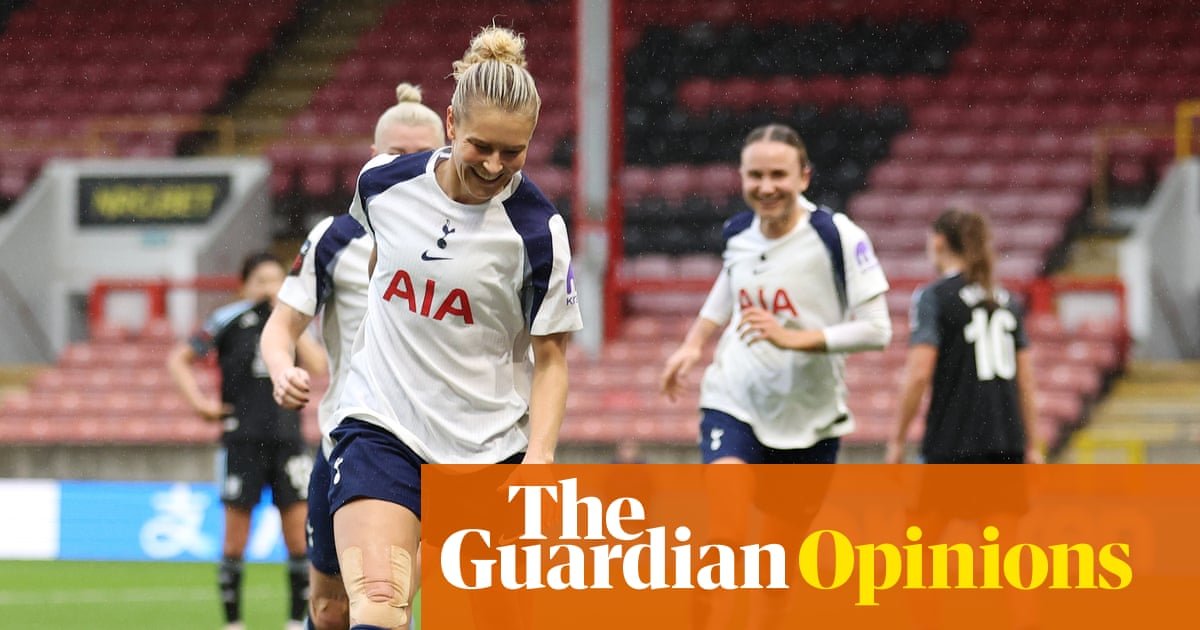
The exciting football played by Tottenham’s women last season provided a much-needed antidote to the dreadful men’s team, who not only flirted with relegation but took it out on a dinner date, looked deep into its eyes and started to plan a future together.
Fortunately, that relationship fizzled out and fans were able to “celebrate” at the end of the season as Premier League status was secured. Meanwhile, Spurs achieved their highest points tally in the Women’s Super League. Highlights included a 7-2 goal-fest against Aston Villa, a mind-bending FA Cup penalty shootout win against London City Lionesses (where the first 17 penalties were successfully slotted home) and a stream of wonder goals including a 40-yard screamer from Cathinka Tandberg.
As the men crumbled and the prospect of Lincoln visiting the Tottenham Hotspur Stadium loomed, my Spurs men’s WhatsApp group of season-ticket holders and members went into meltdown. “Spurs crisis hotline,” I’d answer, before being unable to provide answers to pressing questions: are all those passes around the penalty area really necessary? Why aren’t Spurs signing players to plug the injury gaps?
Thankfully, there was a distraction from the gloom because three years ago my wife, son and I became Tottenham Women season-ticket holders. This move was inspired by England’s Lionesses reaching the World Cup final in 2023. We were visiting family in Australia and when England beat Colombia 2-1 in the quarter-finals, several of Colombia fans made detours to shake our hands in the Brisbane fan zone. There were about 2,000 of them and approximately 20 England fans. This, I thought, is the sort of football experience I want my son to enjoy.
That positive vibe has continued as we’ve followed Tottenham. So what explains their recent improvements? The first factor was Martin Ho’s appointment as the head coach last year. Before joining he had been an assistant at Manchester United and the head coach of the Norwegian side Brann. Behind-the-scenes chatter suggests players like and respect him.
He has connected with supporters by wandering occasionally through the “Legends Lounge” at Leyton Orient (where Spurs play most of their women’s home games) for pre-match chats. But the most important part is that Ho has Spurs playing attacking and organised football. The players look certain of their roles and clear on how they can support each other.
Another factor has been the players who joined. The midfielder Olivia Holdt was Spurs’ top scorer last season and Toko Koga has been a stalwart in central defence. Then came the squad augmentation in January with the arrival of Signe Gaupset, who loves to charge through the midfield with the ball.
The way Ho worked with the existing players has also been key. In 2024-25 the team significantly underperformed, finishing one place above relegation, which led to the departure of then-head coach Robert Vilahamn. Last season Spurs won five of their first six games. It is unknown what Ho said to encourage established players back to their best, but it was likely not an Igor Tudor-like speech where he told them they couldn’t attack, couldn’t defend and couldn’t run.
Tottenham were good at attacking, defending and running all season, and it was a pleasure to watch Eveliina Summanen, Amanda Nildén, Lize Kop, Drew Spence and Clare Hunt.
There were a couple of games where they were thumped by Manchester City, but City have Khadija ‘Bunny’ Shaw, who has a better goals-per-game ratio than Erling Haaland. They also won the league ahead of Arsenal, Chelsea and Manchester United. These four clubs dominate the WSL and Spurs finished fifth behind these heavyweights. Breaking into the top four seems a real possibility in the next year or two.
Within days of last season ending, Spurs signed the highly-rated Netherlands international Caitlin Dijkstra from Wolfsburg to bolster the defence and Germany’s Shekiera Martinez, who impressed as a clinical striker at a mediocre West Ham. Other proven players have followed, including Kirsty Hanson from Aston Villa and Alice Sombath from OL Lyonnes.
It has been sad to say goodbye to Bethany England and lAshleigh Neville. Neville’s desire to move closer to home by transferring to Leicester was understandable but it is perplexing that England, Spurs’ record goalscorer, wasn’t given at least a one-year extension.
after newsletter promotion
The side at the start of the season will look very different from the one we began supporting three years ago but what remains constant is the friendship and passion of our fellow season-ticket holders.
Their knowledge of football is extraordinarily deep. Many have been Spurs men and women fans for years, writing blogs, recording podcasts and punishing themselves by going to West Ham to stand in the rain and wind. These fans have loved Spurs women from the days when a smattering of them watched Broxbourne Ladies, as the club were then, working their way up the leagues.
Another bonus of watching the women’s game is the atmosphere. Fans will vent their frustration and respectfully inquire whether the referee has recently attended a well-known high street opticians, but the swearing and anger often exhibited at the men’s games is largely absent.
Before each game fans decorate the stands with banners of Spurs players adorned with the Progress Pride flag. This visualisation of LGBTQIA+ identity shows that everyone is welcome. I hadn’t paid much attention to this until starting to support Spurs Women and it has made me much more aware of football’s potential as a positive agent for change.
Women’s football may be fractionally slower than the men’s but the games are fast-moving and VAR-less. This results in the occasional refereeing howler but it is preferable to waiting in the stands for five minutes wondering what is going on.
This season, hopefully there will be even more people going to matches and enjoying the experience of supporting the women’s game. It is difficult to recommend coming to Spurs more highly, but other women’s football teams are available.
Mark Burton is a Tottenham Women season-ticket holder



