
Ben Hickey
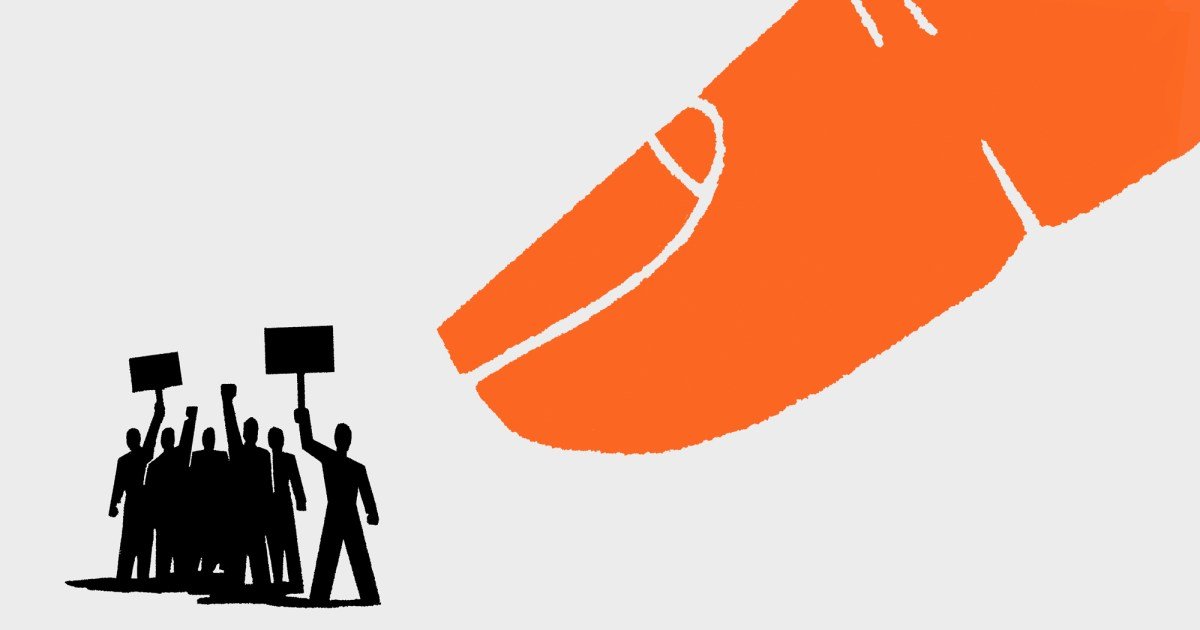
According to President Donald Trump’s Justice Department, you may be a member of a criminal conspiracy if you have done any of the following: worn black to a demonstration, given face masks to protesters, joined a book club, distributed a zine. Recently, federal prosecutors have cited these actions as evidence that activists protesting Trump’s deportation machine are part of an organized criminal enterprise. Call it antifa, domestic terrorism, the radical left—in Trump’s eyes, dissent is never organic. It’s all just part of one big “conspiracy.”
Over the past year, prosecutors have increasingly levied conspiracy charges against activists in federal indictments from Chicago to Spokane, Washington. Some of these cases crumbled quickly; others, like the government’s attempt to paint leftist activists in Texas as an “antifa cell,” resulted in shocking convictions. According to Steffen Seitz, a litigation fellow at the University of Denver’s Sturm College of Law who has studied conspiracy law, this isn’t a haphazard strategy. “I think they are trying to explicitly go after social movements, and conspiracy is something that allows them to do that particularly effectively,” Seitz told me.
It’s no surprise that protest conspiracy charges have surged as conspiracy theorists have become entrenched in our federal government.
“Conspiracy” comes from the Latin conspirare, or “to breathe together.” Under US law, a conspiracy is just an agreement between two or more people to commit an illegal act. Criminalizing conspiracy is supposed to allow law enforcement to disrupt criminal plots before they occur and prosecute groups acting in concert—the idea being that organized crime poses a greater threat than individuals acting alone. G. Robert Blakey, the principal author of the 1970 Racketeer Influenced and Corrupt Organizations Act, said he designed RICO to make “the fight a fair fight between the Davids of this world and the twin Goliaths of organized crime and white-collar crime.”
And yes, many criminal conspiracies do exist: the Mob, drug cartels, Enron. But far too often, the government uses conspiracy law to punish organizers. In the late 19th and early 20th centuries, prosecutors brought conspiracy charges to crush the labor movement by framing strikes as illegal agreements. The US government brought them against communists in the 1940s and ’50s and Vietnam War dissidents in the ’60s and ’70s. In 2023, Georgia’s attorney general provided a 21st-century blueprint for the Trump administration when he used the state RICO statute against 61 “Stop Cop City” activists, alleging the community organizers and concerned citizens who’d protested against a $90 million police training center in Atlanta had actually been engaging in a sweeping criminal enterprise. (A judge dismissed the charges in December 2025.)
Conspiracy law poses a special threat to social movements because it “drastically increases the universe of evidence that might be relevant” to prove that people coordinated with each other, Seitz said. Tacking on a conspiracy charge to a protest case does a bit of bibbidi-bobbidi-boo: Suddenly, two people who attend the same demonstration become co-conspirators. ICE watch group chats become fertile ground for FBI investigation. And a sweatshirt that archly says “I’m Antifa!” becomes evidence of violent intent, as the DOJ claimed in its June indictment of 15 Minnesota anti-ICE activists. Benign statements are interrogated, paranoid connections are drawn from mere proximity, and disparate facts are pulled into a single narrative, offered up to judges and juries as proof of synchronized criminal activity.
Perhaps it’s no surprise that protest conspiracy charges have surged as conspiracy theorists have become entrenched in our federal government. Trump and his allies frequently accuse their political foes of conspiratorial plots: “rigging” an election, being part of “the deep state,” sending “paid professional agitators” to protests.
In the US, conspiracy theories have long targeted marginalized groups, from Catholic immigrants to Jews. But as federal bureaucracy expanded after World War I, conspiracy theories about the US government became increasingly popular, according to Kathryn S. Olmsted, author of Real Enemies: Conspiracy Theories and American Democracy, World War I to 9/11. These fears were rooted in legitimate concern: The state was building out a secret surveillance apparatus—as the Edward Snowden leaks eventually made clear—and enacting real abuses.
But Trump has stoked this deep state paranoia to further his own agenda. His winks at Pizzagate and QAnon have grown into an outright embrace of the people promoting the conspiracy theories. And he’s scapegoated minorities by linking them to alleged plots perpetrated by powerful Democratic institutions: Thanks to the liberal elite, immigrants are eating your pets, and trans people in prison are taking your tax dollars.
Benign statements are interrogated, paranoid connections are drawn from mere proximity, and disparate facts are pulled into a single narrative.
When Trump lost the election in 2020, former Trump lawyer Sidney Powell appeared on Fox News and claimed that the manipulation of voting machines was “one huge, huge criminal conspiracy that should be investigated by military intelligence.” In 2023, before he was the head of the FBI, Kash Patel promised to “go out and find the conspirators, not just in government, but in the media” who had helped Joe Biden “rig” the presidential election.
Now that he’s back in the Oval Office, Trump continues to claim victimhood while bringing the full force of the security state to bear against his opponents. Trump designated “antifa” a domestic terrorist organization and released a new playbook for investigating and disrupting groups engaged in “anti-Americanism, anti-capitalism, and anti-Christianity.” People who warn their undocumented neighbors about the presence of ICE, or college students who call on their universities to divest from weapons manufacturers, could now be considered “participants in…criminal and terroristic conspiracies.”
On July 16, the US State Department convened an international summit on “left-wing terrorism,” during which White House Deputy Chief of Staff Stephen Miller declared—without evidence—that ICE agents have been subject to “repeat, systemic, organized, funded insurrection.” And later that evening, Trump revived claims of another criminal conspiracy targeting his administration: During a primetime speech, the president announced he’d reviewed “significant evidence” of widespread voter fraud. ABC News, NBC News, “and others in the media are part of a plot,” Trump said, “to continue this fraud” and “protect the radical left.”
This administration’s embrace of conspiracy theories mirrors the growing weaponization of conspiracy charges: Both obfuscate where true power lies. Trump—one of the most powerful men on Earth—is not being persecuted by a deep state conspiracy. Nor are the ICE officers who have brutalized protesters and terrorized immigrant communities. But by calling acts of civil disobedience against state repression a “conspiracy,” Trump and his allies seek to make themselves look like they are just one of us—and the true threat is a much more powerful force, composed of anyone and everyone who dares disagree.



