
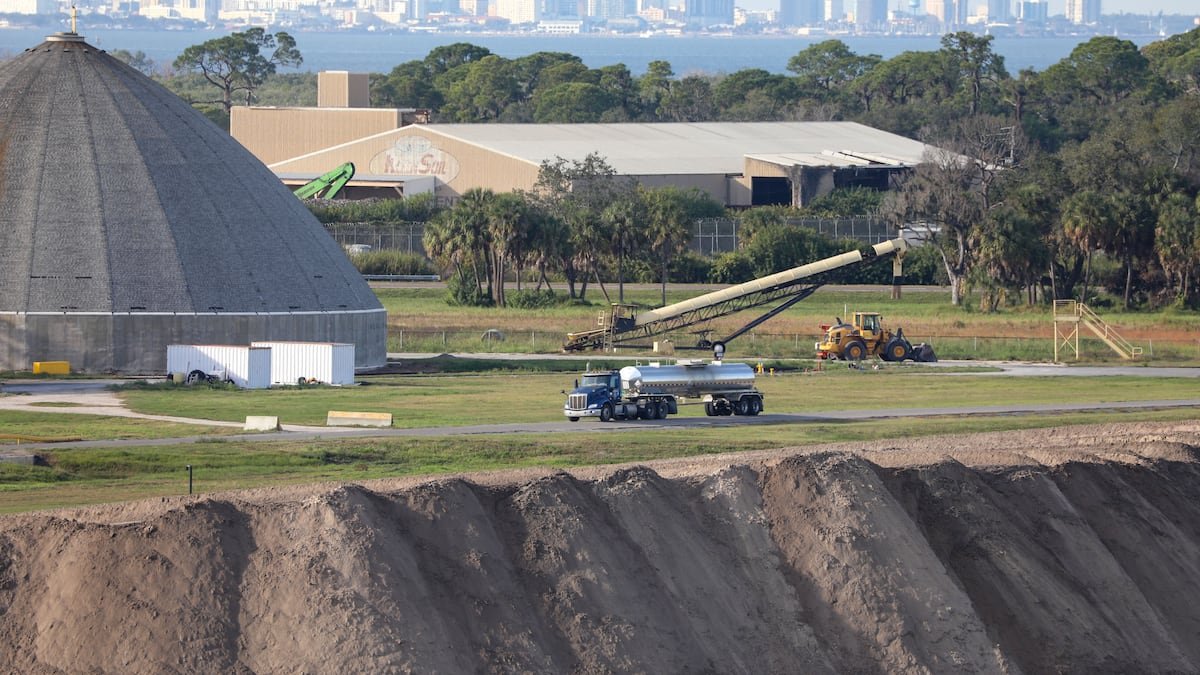
Manatee County leaders are debating whether to continue the county’s role in the cleanup of Piney Point, a toxic industrial site near Tampa Bay that’s in the midst of lengthy closure process.
When a catastrophic breach at Piney Point threatened Manatee County homes with a toxic flood and fueled an environmental disaster five years ago, state leaders promised to clean up the mess with up to $200 million. Manatee County Government agreed to help too, establishing a well to dispose of polluted water from the site.
But county officials say they expected the state to refund most of its costs. Instead, Manatee County has so far absorbed about $23 million in unrepaid expenses, staff said.
“This project … has been shown to be a lot more expensive than originally thought,” said Claudia Campos, the county’s interim chief financial officer, at a board meeting last week. “We were supposed to get something from the state, yet we haven’t received anything additional.”
With decades to go before Piney Point’s remediation is complete, some commissioners say they want assurances that the state will pay the county back before they commit any more money.
“I didn’t cause Piney Point. Those people did. They should be paying for it,” Commissioner Tal Siddique said.
What is Manatee County’s role in Piney Point cleanup?
The county’s water treatment facility, located adjacent to Piney Point off of Buckeye Road, has been used to clean and dispose of polluted water for the last several years, and is expected to play a crucial role in the site’s long-term closure.
But Manatee County commissioners and staff said they expected to be reimbursed by the state for the costs of operating the facility. Staff said the county has only recovered about $19.5 million of $43 million spent. The money has been reimbursed through the court-appointed receiver who is overseeing Piney Point’s closure.
As Piney Point enters the next phase in its closure, the costs are set to go up. The contractor that operates the facility for the county, CIP Solutions, says the next phase will be more expensive to manage and requested that commissioners approve a rate increase.
The county has about $6.5 million remaining that it can draw on from the receiver for the operation of the treatment facility and well, according to Christian Collins, the county’s deputy director of water utilities. After that, they will need more funding.
Collins said the current contractor is doing a good job, and finding a new one could take up to a year. In the meantime, the current operator could walk away from the job if they aren’t being paid, a situation that Collins warned board members to avoid.
“If we don’t continue on operating and getting water down that well … those stacks could fill back up again, and we could be in a world of hurt,” Collins said.
At the board meeting, county staff advised commissioners to approve the rate increase and continued operation of the facility for now and continue seeking reimbursement from the state.
“The question really comes down to how do we pay for it after that $6.5 million runs out in the long-term care phase of the next portion of the project,” said Deputy County Administrator Corey Stutt. “We do need to figure that out. I think we need to continue to have discussions with folks up in Tallahassee about this to figure out how to pay for this.”
Why did Manatee County take on Piney Point responsibility?
But some commissioners questioned why past board members agreed to take on the responsibility of operating the well in the first place.
Commissioner Tal Siddique argued that the problem should have been left to the state and the company that owned Piney Point, HRK Holdings LLC, and said he would like a legal review and more information before moving forward.
“…Specifically, what agreements have been signed or not signed between Manatee County Government, the state and the receivership that controls this property and maintains the goal of shutting it down,” Siddique said.
Commissioner Bob McCann agreed.
“It’s kind of getting bothersome to the public to keep writing blank checks for things that we may or may not be responsible for,” McCann said. “We need to get more information.”
But Commissioner George Kruse, the only board member who was on the commission at the time of the Piney Point crisis, argued that county leaders volunteered to operate the well for a good reason.
Kruse said that county operation of the well gives local officials and residents direct control and oversight of what goes into the aquifer. He said county leaders feared the well could be used to dump chemicals and pollutants without public oversight and potentially stay in use for other purposes long after Piney Point’s closure.
“All the environmentalists, all the public and everyone on the board at that time said we do not want that to happen,” Kruse said. “It was a decision to not turn over a well that we felt could be detrimental to our future water quality as someone tries to recoup their money.”
Kruse said county ownership allows the well to be shut down as soon as work at Piney Point is complete.
“It sucks, I don’t disagree,” Kruse added. “Hopefully we can work out something with the state and remind them of their promise. This was always going to be an expensive process. That’s why previous boards kicked it down the road for decades.”
County leaders debate funding for Piney Point cleanup
While commissioners agreed that the county needs to seek additional funds from the state, they disagreed about whether the county should keep paying for now.
“We have to do this. We can’t walk away from Piney Point,” said Commissioner Mike Rahn, who supported continued funding. “We’re still working with the state, we’re still trying to get what’s owed to us. But we still have to operate this well.”
“This is a wicked problem. We are in a really tough situation and I think that not going forward with this … could cause a lot more damage than the money that we stand to lose if the state doesn’t come through on their end of the bargain,” said Commissioner Amanda Ballard, who also supported continued funding.
A motion to immediately approve an amended agreement with the contractor and continue operating the facility died after a 3-3 tie, with Commissioners Kruse, Rahn and Ballard in favor and Siddique, McCann and Jason Bearden opposed.
Instead, the board unanimously passed a motion to seek clarification about the state’s funding commitment to the project and reconsider the issue at the board meeting scheduled for June 16.
Commissioners also agreed that they would consider approving a contract that allows them to use up the remaining $6.5 million in funding available through the receiver without committing any more dollars from the General Fund. That could potentially allow the facility to operate for another year while the county seeks additional help from the state, staff said.
“This is not good,” Siddique said about the possibility of spending more money from the General Fund on Piney Point. “I don’t disagree that we as a county should do everything to protect our citizens water supply … our coasts. But this is a fundamental question of fairness, and I feel that the state is forgetting that. The state has far more resources than Manatee County does. We’re short $23 million on this already. How much more short do we want to be?”



