
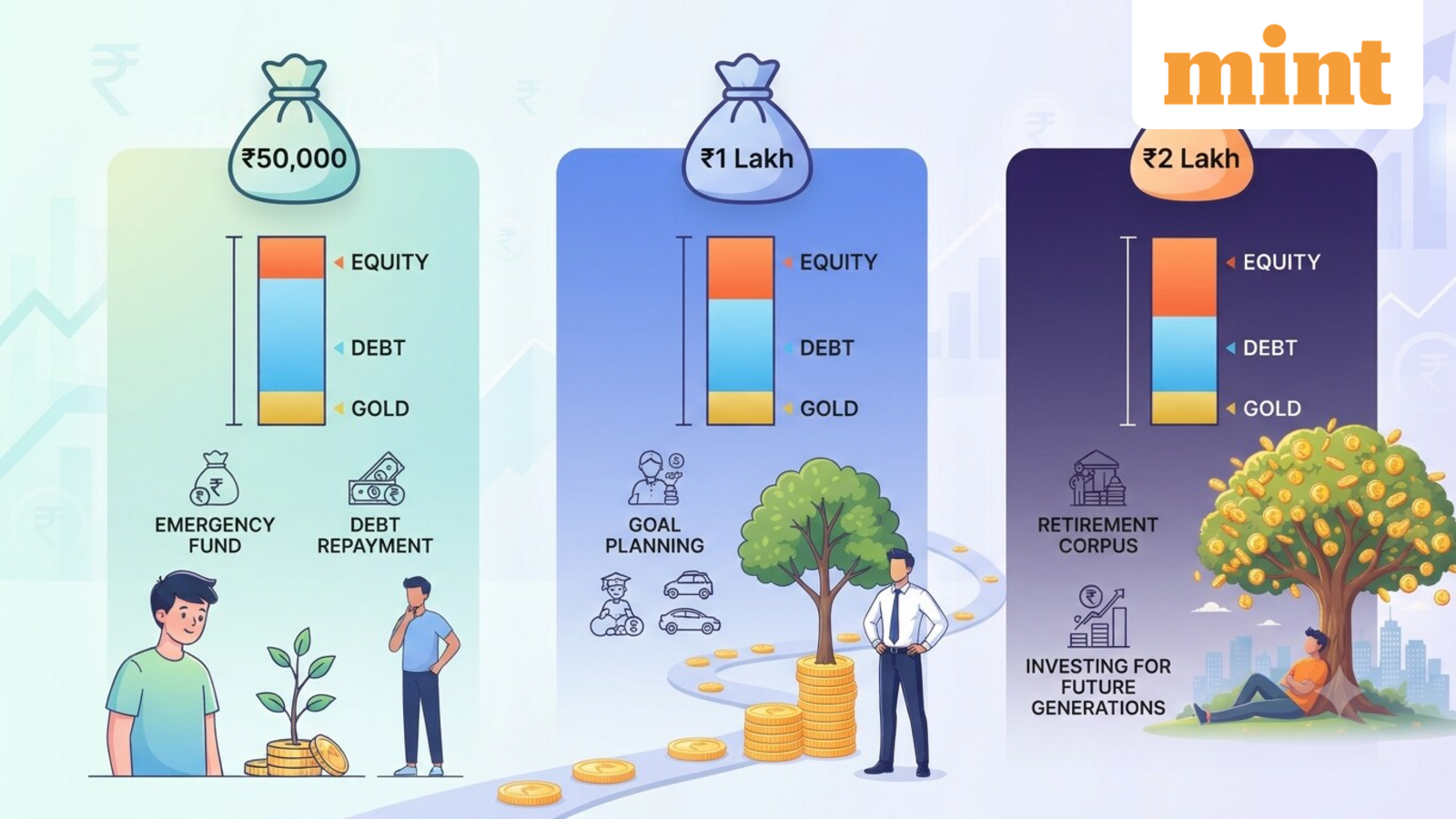
How much you earn each month can influence how much you invest, but a higher salary does not automatically mean you should take more investment risk or build a more complicated portfolio. Someone earning ₹50,000 may have fewer financial commitments and more money available to invest than someone taking home ₹2 lakh, depending on their household expenses, loans and dependents.
The key is to build an investment strategy around financial goals, monthly obligations and investment timelines rather than salary alone, said Neeraj Mahajan, Chief Business Officer at Godrej wealth.
Mahajan suggested that individuals earning ₹50,000 a month could consider investing 10-15% of their take-home income. For those earning ₹1 lakh, the indicative allocation could be 15-20%, while individuals earning ₹2 lakh could potentially invest 20-25%, depending on their financial commitments. These are broad illustrations rather than fixed targets, he said.
How much should you invest on a ₹50,000, ₹1 lakh or ₹2 lakh salary?
The amount available for investment depends on how much an individual spends on essential expenses and financial responsibilities. Two people earning the same salary could have very different investment capacities because of differences in rent, family support, loan repayments and other obligations.
Based on Mahajan’s suggested investment ranges, the monthly investment amounts could look like this:
Monthly take-home salary | Indicative investment percentage | Monthly investment |
| ₹50,000 | 10-15% | ₹5,000-7,500 |
| ₹1 lakh | 15-20% | ₹15,000-20,000 |
| ₹2 lakh | 20-25% | ₹40,000-50,000 |
These figures should not be treated as mandatory savings targets. Someone earning ₹1 lakh while supporting parents, paying rent and servicing a home loan may have less money available than someone earning ₹50,000 and living with their family.
Mahajan believes consistency matters more than starting with an ambitious investment amount. For instance, beginning with a monthly investment of ₹5,000 and increasing it regularly as income rises could be more sustainable than committing ₹20,000 every month and struggling to maintain the investment.
Lifestyle inflation is another factor investors should watch. Salary increments often lead to higher discretionary spending, but allowing every increment to get absorbed into lifestyle upgrades can restrict long-term wealth creation. Investors should consider increasing their monthly investments whenever their income improves.
Emergency funds and debt repayment remain important at every income level
A common assumption is that someone earning ₹50,000 should focus primarily on financial security, while someone earning ₹2 lakh can concentrate on wealth creation. However, Mahajan cautioned against treating financial priorities as a function of income alone.
A higher salary does not necessarily mean someone is financially secure. Larger home loan repayments, higher household expenses and more dependents can leave high-income earners with limited financial flexibility.
For someone earning ₹50,000, the first step should be to calculate essential monthly household expenses and build an emergency reserve accordingly.
For example, if a household needs ₹30,000 every month to meet its essential expenses, an emergency fund covering three to six months would amount to ₹90,000- ₹1.8 lakh. Those who are the sole earning members of their families or have dependents may need a larger reserve.
Clearing expensive debt should also be a priority, particularly credit card dues and personal loans, where interest costs can accumulate quickly. Investing while carrying high-interest debt can put additional pressure on monthly finances.
As income increases, investors may have more room to plan for long-term financial commitments such as children’s education, buying a house and retirement. However, emergency savings, insurance and debt obligations should not be overlooked, even by someone earning ₹2 lakh a month.
The difference across income brackets is primarily the amount of money available to meet these goals and the pace at which investors can work towards them, Mahajan said.
Should your equity, debt and gold allocation change with salary?
A higher monthly salary does not automatically justify taking more equity exposure. According to Mahajan, investment allocation should depend on an individual’s financial goals, risk appetite and the time available to achieve those goals.
Consider two investors. One earns ₹50,000 a month, is 28 years old and is investing for retirement. The other earns ₹2 lakh but wants to purchase a house within the next two years.
Despite earning less, the first investor has a longer investment horizon and may be better positioned to withstand short-term market fluctuations. The second investor has a near-term financial commitment and may need greater stability and liquidity.
Equity investments can help build wealth over longer periods, while fixed deposits and suitable debt instruments can provide greater stability and easier access to money for shorter-term goals. Gold can also play a role in portfolio diversification.
Mahajan cited a 60:30:10 allocation across equity, debt and gold as one possible diversification approach. However, he cautioned against applying the same allocation to every investor.
Someone earning ₹2 lakh may have a larger investment surplus but could also have substantial loan repayments or upcoming household expenses. Rather than automatically increasing portfolio risk or adding more asset classes, investors should first assess whether they can increase their monthly investments.
Do higher earners need more mutual funds?
Investors often assume that a higher salary requires a larger and more diversified mutual fund portfolio. However, the number of funds an individual owns should depend on their financial goals and investment requirements, not their monthly income.
According to Mahajan, someone investing ₹5,000 a month could build a diversified portfolio with just a couple of mutual funds. The same could apply to an investor putting ₹40,000 into mutual funds every month.
For someone starting their investment journey, a broad-market index fund or a diversified flexi-cap fund could be considered for long-term goals. As income grows and investors take on different financial commitments, other categories such as hybrid, mid-cap and debt funds may also be considered, depending on their investment horizon and risk tolerance.
However, adding more funds does not necessarily improve diversification. An investor holding six mutual funds could still have overlapping portfolios if those schemes invest in many of the same companies.
Similarly, investing in small-cap or sectoral funds simply because more money is available could expose investors to risks they may not fully understand or be comfortable taking.
Mahajan’s broader advice is to maintain a manageable portfolio in which every investment serves a clear financial purpose. As salaries increase, investors should focus on raising their investment contributions and aligning their portfolios with changing financial goals rather than continuously adding funds.
Ultimately, whether someone earns ₹50,000, ₹1 lakh or ₹2 lakh a month, the objective should remain the same: build financial security, invest consistently and take risks according to the time available to achieve each goal.