
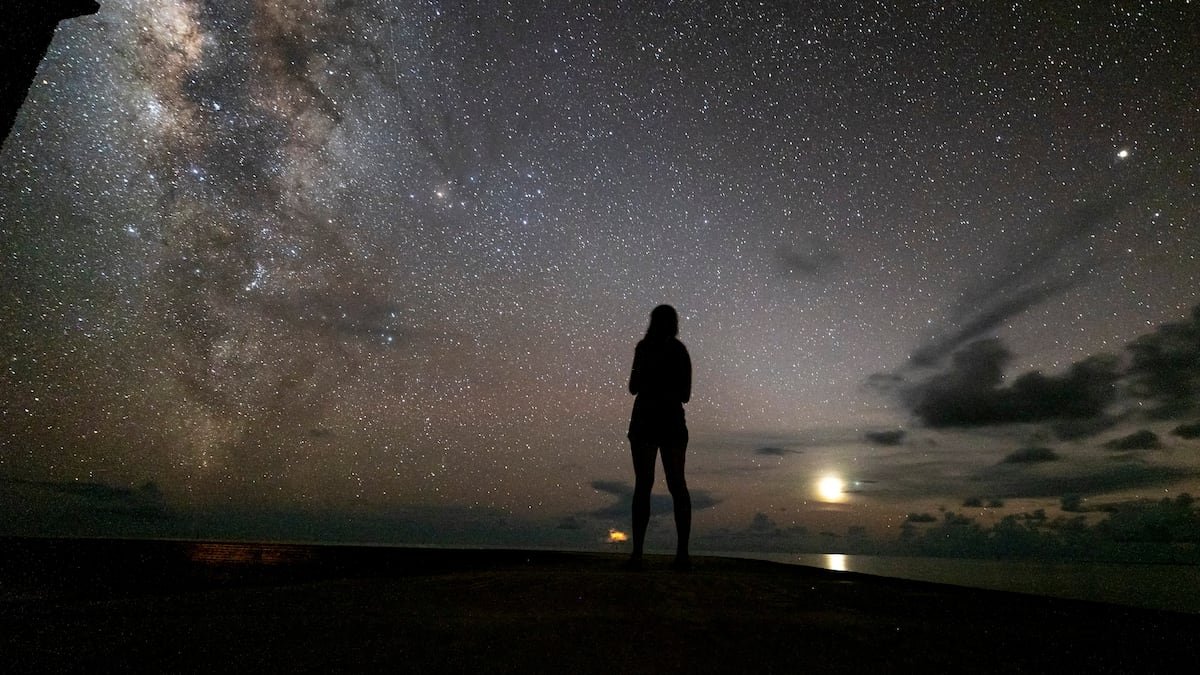
The rhythm of a day moves differently on island time, especially during a visit to Dry Tortugas National Park. Rather than the monotony of a 9-to-5 workday, it’s the sunrise, the stunning sunsets, the starry night sky and the tides that govern life and transcend time on these remote islands 70 miles from civilization.
The main island, 16-acre Garden Key, is the landing spot for most visitors arriving from Key West via the Yankee Freedom ferry, private boat or seaplane — the only means of getting to this remote national park in the Gulf of Mexico.
Visitors won’t find cell service, internet or fresh water at the remote destination, but they will behold natural beauty both on land and under the sea. There’s also Fort Jefferson, a Civil War-era construction that represents the largest masonry structure in the Americas.
Camping at Dry Tortugas has been on my bucket list for several years. Six months before our trip, on April 1, I logged onto the Yankee Freedom website right at 8 a.m. and prepared myself to lock down two nights of camping. While day trips on the ferry are fairly common, camping is very limited due to the ferry’s space constraints and the park’s small campground.
After months of anticipation, my partner Karissa and I awoke hours before dawn to drive to Key West with our camping gear to board the ferry and cruise to our remote paradise.
Sun-soaked splendor
Excitement overpowered the feeling of fatigue after a short night of sleep as we waited at sunrise to board the Yankee Freedom for the journey to Dry Tortugas, located 70 miles west of Key West. On the back of the ship, the crew loaded our camping gear packed in plastic storage totes, backpacks and coolers, plus a tandem kayak rented from Tracy’s Traveling Kayaks in the lower Florida Keys.
While the ferry can hold up to 175 passengers, our trip on the Thursday before Labor Day had only 120 people, meaning we had room to spread out on board. The vessel has indoor air-conditioned spaces and complimentary breakfast and coffee on the outbound trip, which we happily enjoyed while soaking in the views from the upper outside deck.
About halfway through our 2.5-hour journey, the small keys that lie beyond Key West disappeared into the horizon, leaving nothing but open ocean around us. As the wind whipped through our hair, we squinted excitedly as Fort Jefferson soon came into view in the distance. Just before 10:30 a.m., we arrived.
As daytime visitors fanned out to the snorkeling beaches, eager to take advantage of their four hours on the island, we gathered our camping gear in a provided cart and wheeled it to the campground. Our trip had eight other campers, so we were eager to pick out a prime spot.
We found our spot underneath a buttonwood tree facing toward the dock, a site that provided us with much-needed shade and the chance of a sea breeze at night. Our camp neighbors were three South Florida locals on a fishing trip who had arrived on their own boat and brought back the catch of the day each night for dinner.
We also had company from the island’s many hermit crabs, a few invasive iguanas and a stray pigeon who kept sauntering into our camp. In the distance, we could see gulls and magnificent frigatebirds soaring in the sky. The latter are known for their impressive 7-foot wingspan and the males’ scarlet throat pouches; the birds have their only known regular breeding colony and nesting rookery just off Garden Key.
Dry Tortugas is also an important stopover point for migratory birds traveling between North and South America, including the estimated 100,000 sooty terns that nest on Bush Key each spring.
After making camp, we explored the fort and the island’s beaches, making ourselves at home on Garden Key. Before we knew it, the day trippers were boarding the ferry once again, departing and leaving us with a national park mostly to ourselves — something I’m almost certain will never happen again.
Starry night skies
I had pictured the feeling of watching the sunset from the uppermost third tier of the fort, but the mental photograph I had didn’t even begin to touch the reality of seeing the most spectacular sunset bursting through the clouds.
With about 20 minutes to spare, we made it to our prime viewing spot and saw the fiery orb lighting up the sky before it dipped below the horizon behind Loggerhead Key, another island in the park with a lighthouse about 3 miles away.
We had a feeling the show was just beginning at sunset, and we were exactly right. With no light pollution in any direction, the stars shone in a spectacular display, twinkling in the night sky by the millions. We agreed we had never seen so many stars at once, making for an emotional moment as we beheld the infinite expanse of the universe overhead.
Venus was especially bright, glowing into the night like a beacon just above the water. We could also see the beautiful Milky Way, clear as day. As a bonus, we saw bioluminescent marine worms glowing in the water, creating little blue trails as they squirmed.
The following night, we laid out a blanket on the beach and put on Pink Floyd’s “The Dark Side of the Moon,” an enhancement to the already phenomenal ambiance of the best night sky we had ever seen.
Snorkeling abound
While the seven small islands are the main part most visitors see, the 100-square-mile park is 99% open ocean and coral reefs, representing a sweeping marine sanctuary.
During our first day on the island, we donned our snorkeling equipment and explored the vast world under the sea at Dry Tortugas National Park. During a swim near the fort’s moat wall and dock ruins, we saw a barracuda and then glimpsed an anhinga swimming under the water before popping up to see a brown pelican perched on a dock piling above the surface.
The second day, we paddled our tandem kayak 3 miles to Loggerhead Key, where we had the island all to ourselves for most of the day. There we snorkeled at the pristine Little Africa Patch Reef, where we saw many varieties of colorful coral.
We also spotted a grouper, parrotfish, a trunkfish and an angelfish. While lounging on the beach and walking the islands were a treat, a visit to Dry Tortugas is not complete without seeing the world under the water’s surface.
A fascinating history
Why is there a United States fort 70 miles from Key West in the Gulf of Mexico? During the War of 1812, when Great Britain threatened the newly independent America with its Navy, the U.S.began fortifying its east coast as a first line of defense.
Construction on Fort Jefferson didn’t begin until 1846, and it was built from 16 million imported bricks to protect shipping lanes in the Gulf of Mexico. Fun fact: The fort has more than 2,000 arches within its massive brick walls.
During the Civil War, hundreds of military personnel and civilians were stationed at the fort, bringing the total population to nearly 2,000 during the 1860s.
As a Union outpost, the fort took on prisoners who replaced slaves as construction continued. The most notable prisoner was Dr. Samuel Mudd, who was accused of conspiring with John Wilkes Booth in the assassination of Abraham Lincoln.
During Mudd’s time at Dry Tortugas, he stepped up to treat prisoners and soldiers sickened by yellow fever, which plagued the island in the late 1860s. He was later pardoned by President Andrew Johnson.
The fort also notably had room for 400 cannons and heavy guns across its three tiers; only about 141 guns made it to the fort. A shift toward rifled artillery made the fort obsolete.
The U.S. Army officially abandoned Fort Jefferson in 1874 after hurricanes and yellow fever epidemics made the fort’s continued operation unsustainable. The U.S. Navy continued to use Garden Key as a coaling station until 1906, when the fort was again abandoned.
In 1935, President Roosevelt designated Fort Jefferson as a national monument, and in 1992, Dry Tortugas was established as a national park.
As for the name, Spanish explorer Juan Ponce de León discovered the islands in 1513 and named them “Las Tortugas” after seeing large sea turtles on his visit. Later explorers and merchants added the word “dry” to indicate the lack of fresh drinking water.
Visiting paradise
For those wishing to visit Dry Tortugas, the easiest way is to take a day trip by ferry ($260 per adult) or by seaplane ($527 per adult for a half-day). Day trips on the ferry leave at 8 a.m. and return to Key West by 5:30 p.m.
Daytime visitors should plan to pack reef-safe sunscreen, snacks, water and a towel.
Camping reservations open on the first weekday of each month at 8 a.m. for the month that is six months away. Dates fill up quickly once released, so reserving a spot takes planning.
The overnight experience is also primitive, meaning campers must bring everything they need, including fresh water. Camping items must fit into a plastic storage tote, a backpack and a cooler. Open flames are not allowed, and compressed gas is prohibited on the ferry, meaning the only fuel allowed is self-lighting charcoal or Sterno canisters.
For more information, visit drytortugas.com or keywestseaplanecharters.com.



