
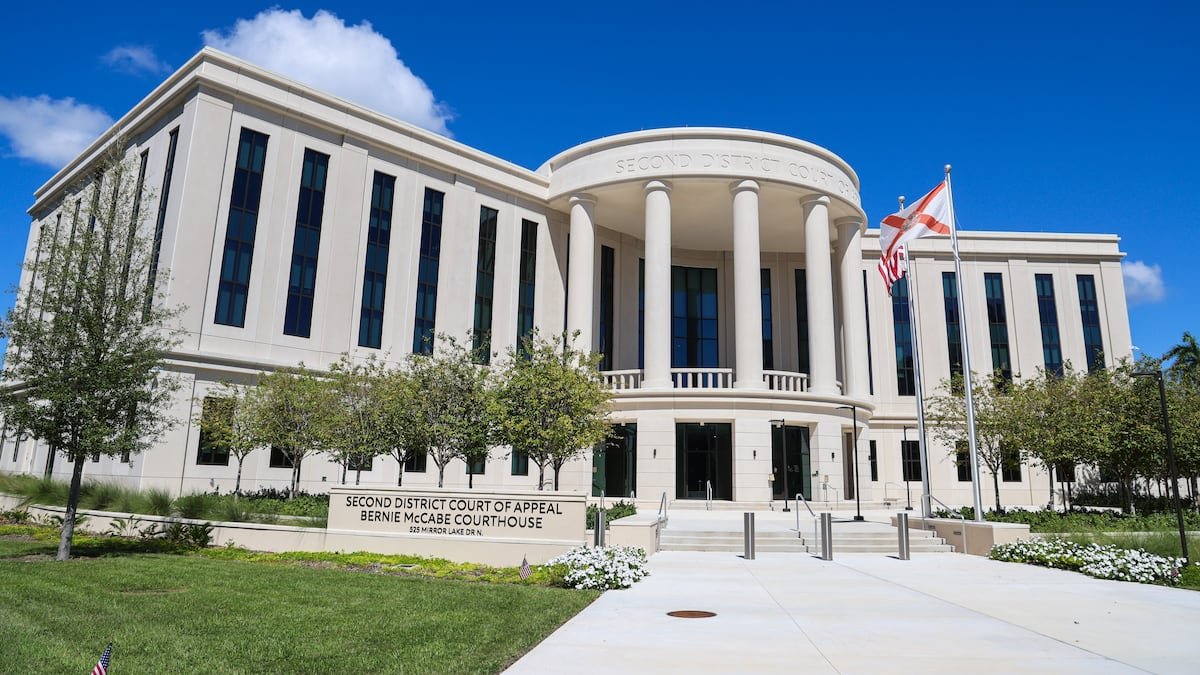
Tampa Bay-area voters will decide this year whether four appeals court judges and one Florida Supreme Court justice get to keep their jobs.
The five judicial officers on the ballot for what’s known as merit retention races might be considered the VIP club in this year’s elections. Unlike partisan political races, these offices are not open to challengers and feature no significant campaigning.
Merit retention races instead ask voters for a yes or no on each judge. A simple majority vote allows the judge to remain in office. If the judge secures less than 50%, the governor appoints a replacement. It’s an electoral practice that dates to the 1970s, when scandals in the Florida Supreme Court led to judicial reforms, including the abandonment of competitive elections for appellate court seats.
How, then, should one judge the judges? You might look to their individual backgrounds, experience and opinions. You might also look at how lawyers in the past have assessed their work.
In the spirit of maintaining an informed democracy, the Tampa Bay Times presents here a breakdown of the judges up for merit retention on this year’s ballot.
Florida Supreme Court Justice Carlos Muñiz
Carlos Muñiz joined the Florida Supreme Court in 2019, when he was appointed by Gov. Ron DeSantis. He is one of seven justices on the state’s highest court, all but one of whom were also appointed by DeSantis.
Muñiz, 57, has been in the majority in the court’s most recent controversial decisions. In 2024, he concurred in a decision that nixed a privacy provision of Florida’s Constitution, which was seen as protecting the right to abortion. The ruling effectively allowed Florida’s six-week abortion ban to take effect.
He was also in the majority in rulings that favored gerrymandered congressional district maps that some said were drawn to diminish Black voter representation and favor Republicans.
His fellow justices in 2022 selected him to serve as chief justice, a position that made him the face of the state’s court system. He was reelected as chief justice in 2024 to another two-year term, which ended this year.
Before joining the court, Muñiz worked as general counsel in the U.S. Department of Education during President Donald Trump’s first term. He earlier worked as an assistant general counsel to former Gov. Jeb Bush and served stints as an attorney for the Florida House of Representatives and as a general counsel to Pam Bondi when she was the state’s attorney general.
Muñiz received his law degree from Yale in 1997.
Judges on the 2nd District Court of Appeal
The 2nd District Court of Appeal hears appeals from the trial courts in six Florida counties, including Hillsborough, Pinellas and Pasco. Based in St. Petersburg, the court previously oversaw a larger swath of Southwest Florida. That was until 2022, when the Legislature created a new appeals court and shifted the district’s geographic boundaries.
It is often seen as a venue of last resort for litigants in the lower courts. The court’s 15 judges each serve six-year terms.

J. Andrew “Drew” Atkinson was appointed to the court in 2018 by Gov. Rick Scott. He previously worked as a government lawyer, including a stint as an assistant general counsel in the governor’s office. He also worked for the private firm Broad & Cassel.
Like most appellate judges, his tenure has been low-key, though at least one high-profile case in recent years fell to him. Atkinson authored an opinion in the case of Howell Donaldson III, who was accused of four murders in Tampa’s Seminole Heights neighborhood. Writing for a three-judge panel, Atkinson reversed a trial court’s decision to limit the evidence a jury could hear in four separate trials. (Donaldson later pleaded guilty and received four consecutive life sentences.)
Atkinson, 53, earned his law degree from Nova Southeastern University.
Morris Silberman has been on the appeals court the longest of the four judges up for a vote this year, having been appointed by Gov. Jeb Bush in 2001.
He served as the court’s chief judge from 2011 to 2013. His resume touts extensive experience in various legal organizations. He’s a member of the American Law Institute, a nationwide group of judges, lawyers and scholars, whose stated aim is to clarify and simplify the law.
Before he became a judge, Silberman, 69, practiced business litigation and appellate law in Clearwater. He earned his law degree from the University of Florida in 1982. He is married to Nelly Khouzam, who is also a judge on the appeals court.
Daniel Sleet joined the appeals court in 2012 when he was appointed by Scott. He served as the court’s chief judge from 2023 to 2025.
Before joining the appeals court, Sleet was a trial court judge in Hillsborough County, having been appointed by Bush in 2008. He began his career as a prosecutor in Tampa, handling serious felony cases, and went on to practice personal injury defense.
Sleet, 65, received his law degree from Cumberland University in 1987.
Andrea Teves Smith joined the appeals court in 2019 when she was appointed by Scott.
Before ascending to the appeals court, Teves Smith, 57, was a trial court judge in Polk County. Before that, she spent nearly 20 years with a Lakeland firm practicing commercial litigation and appeals in state and federal court.
What lawyers have said
The Florida Bar used to conduct a semiannual poll on whether individual judges up for retention votes should keep their seats. The poll’s participants included hundreds of lawyers who were at least somewhat familiar with the work of the judges on the ballot. Typically, the results strongly favored most judges to remain on the bench.
The Bar’s Program Evaluation Committee discontinued the poll last year.
Nevertheless, past polls offer a glimpse at how the judges are regarded among the legal community. In 2022, the last time this year’s four appeals court judges were on the ballot, all of them scored at least 76% support for merit retention in the Bar’s poll.
All four easily won another six years on the bench with the support of no fewer than 70% of voters. None have since been subject to disciplinary proceedings by the state Judicial Qualifications Commission.
Tampa Bay Times Election Coverage
2026 midterms voter guide: Get information on candidates in Tampa Bay and across Florida
A property tax proposal and more: All 3 Florida amendments on the ballot, explained
Governor candidate stances: Clashing ideas of David Jolly and Byron Donalds put Florida at crossroads
3 reasons: Here’s why David Jolly could win the governor’s race, and here’s why Byron Donalds could
Florida polling averages: Governor and Senate
Redistricting: A snapshot of each of Tampa Bay’s new congressional districts
St. Pete mayor’s race: 5 takeaways from the primary results
On St. Petersburg ballots: A breakdown of referenda and charter amendments coming before city voters



