
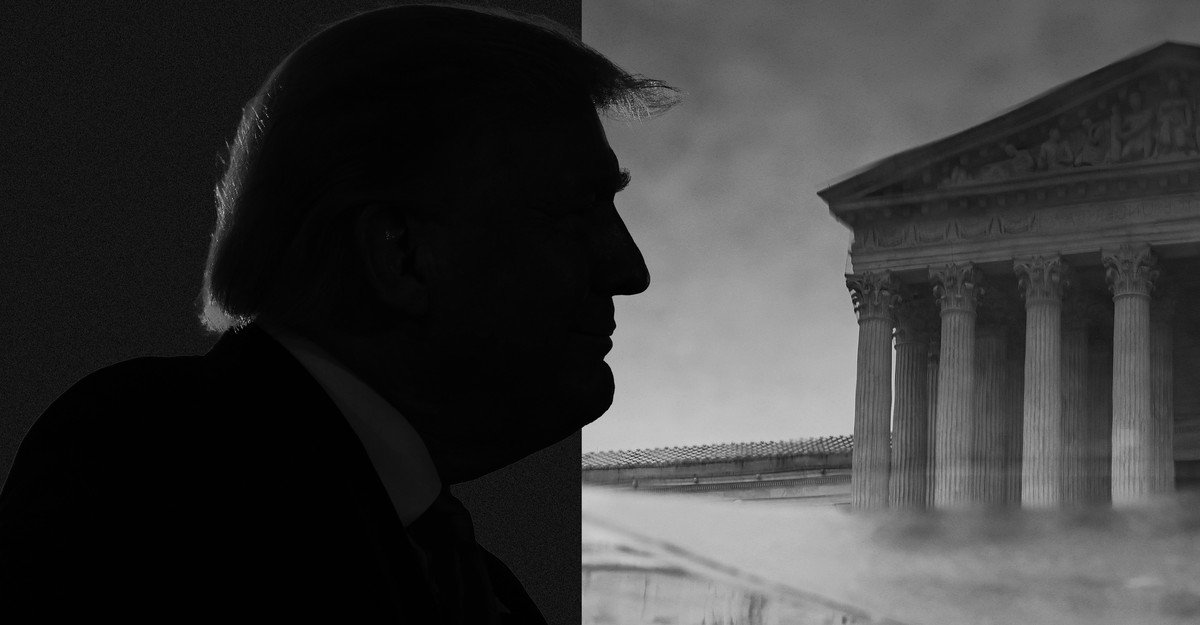
In the 1630s, King Charles I tried to tax English people without the consent of their legislature. He lost his head.
In the 2020s, Donald Trump tried to tax Americans without the consent of Congress. He just lost his case.
A tariff is a tax. The Trump tariffs imposed in and after April 2025 were projected to raise as much as $2.3 trillion over 10 years. The Constitution assigns authority over taxes, including tariffs, to Congress. It does so for reasons that date back to English constitutional history: An executive who can tax without permission from elected representatives is on his way to becoming a tyrant.
President Trump has had lots of ideas for how to spend the money he collected without Congress. He has offered it to farmers. He has mused about direct cash payments to taxpayers. He has speculated about creating a sovereign wealth fund to invest in companies. He has disregarded the fundamental principle that spending, like taxing, is a power the Constitution assigns to Congress, not the president.
Now we may be on the verge of a regime-changing war against Iran. War-making is also supposed to be a congressional power—but there’s no sign that Trump will allow Congress to vote on his war. In the past, the ultimate check on the president’s war-making powers was Congress’s power over the purse. When President Clinton intervened in the former Yugoslavia in 1999, Congress deadlocked over a vote of authorization, but approved the appropriation to pay for it, an authorization by a different name. But if Trump were allowed to tax without Congress, then he might reasonably conclude that he could fight wars without Congress.
Trump’s tariffs were advertised as a revenue source liberated from the restraints imposed by Article I of the Constitution. Had the Supreme Court upheld the tariffs, it would have wrought a constitutional revolution. Instead, the court quashed Trump’s scheme. Like every president before him, if he wants money—for an Iran war or any other purpose—he will have to ask Congress for it.
Trump’s theory was that an emergency-powers law passed in the 1970s allowed him to impose permanent revenue-raising tariffs on anyone for any reason. This argument was always far-fetched. The law, the International Emergency Economic Powers Act, was part of the post-Watergate reform to reduce presidential emergency powers. The IEEPA reformed the Trading With the Enemy Act passed during World War I. President Franklin Roosevelt had used that law to ban most private ownership of gold bullion in 1933, which even supporters had to concede was a fantastic legal reach. After Watergate, Congress sought to restrain the president by limiting the IEEPA to “unusual and extraordinary” threats to “the national security, foreign policy, or economy of the United States.” The law’s powers can be invoked only after a formal declaration of national emergency, and the word tariff appears nowhere among the powers conferred upon the president by the law. To put it another way, a permanent 25 percent tax on Canadian maple-syrup-tapping technology is not what the authors of the IEEPA had in mind.
Trump gets very impatient when he’s asked about “affordability.” You can understand why he squirms. The price increases Americans have felt in 2025 and 2026 can be blamed in no small part on Trump’s tariffs. Power bill up? Trump imposed a tariff on the equipment used to generate and transmit electricity. Six-pack of beer more expensive? Trump taxed the beer cans. Kids need new shoes? Trump’s tariffs raised the cost.
The ironic political question for 2026 is whether the U.S. Supreme Court acted in time to save Trump from himself. Whether or not it was the justices’ intention to help Trump, a generally Trump-friendly Supreme Court has offered the president an exit from one of his most unpopular domestic policies. Will he accept the handout? Acceptance would be smart, but humiliating. Trump holds other legal means to disrupt international trade, some of which he used in his first term. But those powers have tighter legal limits than Trump wants. They don’t raise the kind of lawless revenue he plainly hoped for, but they can still cause havoc until their abuse is checked—and the federal courts have thus far flinched on supplying such checks on the president’s power. Until and unless a future Congress acts to protect Americans from Trump protectionism, the outlook for U.S. prosperity and security will remain clouded.
While shadows dim the future, the sun shone today. U.S. stocks surged after Trump’s Supreme Court defeat. American consumers may soon feel the benefit. Liberated from this approach to economic warfare, relations with allies may recover some of their former cordiality. And unlike the case of Charles I, all of this was accomplished while allowing America’s president to lay his unsevered head on his pillow tonight.



