
Gerontocracy has always thrived in undemocratic places—Communist people’s republics, Gulf monarchies—where only death could pry power from the ruling elders. American gerontocracy is exceptional for being freely elected. Donald Trump will soon be an octogenarian, and is president in part because the preceding octogenarian, Joe Biden, did not want to admit his senescence. The median senator is 65, and the oldest, 92-year-old Chuck Grassley, has not ruled out running for reelection in 2028. The typical general-election voter is a spry 52, but in primary elections, which decide the majority of political contests, that number rises to 59. Half of all the money donated to political campaigns comes from Americans age 66 and older.
Although political gerontocracy has operated overtly, the rising economic power of the elderly has escaped much notice. Over the past 40 or so years, American wealth has grown ever more concentrated among the oldest generations. In 1989, Americans over age 55 held 56 percent of it; today they hold 74 percent. During that same period, the share of wealth held by Americans under 40 has shrunk by nearly half, from 12 to 6.6 percent. The color of money is now gray.
Much of this shift is the result of demographic change: 18 percent of Americans are senior citizens today, up from 13 percent in 1990. But even at the household level, Americans over 55 have accrued wealth more rapidly than those who are younger. Among those 75 and older, the numbers are particularly striking. In 1983, their household net worth was only slightly above the national average; by 2022, it was 55 percent higher.
For nearly a century, some of the central debates in American politics have been over inequalities—between rich and poor, male and female, Black and white. When the Baby Boomers were children, older Americans were widely viewed as vulnerable. “Fifty percent of the elderly exist below minimum standards of decency, and this is a figure much higher than that for any other age group,” Michael Harrington wrote in his 1962 book The Other America, often credited with inspiring the War on Poverty. “This is no country for old men.”
Three years later, in 1965, Medicare was created. A major expansion of Social Security followed in 1972. These changes were remarkably effective: The share of elderly people living in poverty dropped by more than one-third within a decade. But because these programs are broad-based entitlements, they have transferred huge sums to the prosperous, too. The portfolios of that latter group, meanwhile, have been swelled by a rising stock market and rising home values, outcomes that may not be entirely replicable for younger generations. As a result of all of these factors, intergenerational inequality between old and young has not merely reversed. It has accelerated.
Most current Social Security and Medicare beneficiaries will receive more from the program over their lifetime than they paid in taxes, and the extra money will necessarily come from the pockets of younger generations. The two programs now pay out more than $2 trillion a year, more than one-third of all federal expenditures. Their sustainability was a subject of major debate during the Obama years, when the national debt was much lower than it is today and interest rates on that debt were close to zero. Financially, the matter is more urgent now. The trust funds for Social Security benefits and Medicare’s hospital insurance are projected to become insolvent in roughly seven years.
Yet even noticing the looming threats has become taboo for the two major political parties. One of Trump’s shrewdest political realizations was that entitlement reform—once a priority for fiscal conservatives—was a losing issue. Instead, he has pledged not to touch entitlement spending and lavished seniors with even more government money. His One Big Beautiful Bill Act created a special $6,000 tax deduction for seniors, which will cost taxpayers $91 billion over the next four years. The same bill cuts $1 trillion in spending on Medicaid, which is expected to leave some 5 million working-age Americans uninsured.
This bodes poorly for intergenerational peace. Respect for elders is being replaced by resentment of elders. A majority of young Americans no longer believe in the American dream. Many Millennials and Gen Zers expressly blame the Boomers for that, accusing them of hoarding wealth, jobs, and power. Many of these accusations are inchoate, but they are not entirely baseless.
The best rebuttal to the gerontocratic critique is that young Americans do not appreciate how good they have it. Although people of working age possess a smaller share of the national wealth, they are richer in absolute terms than Boomers were at their age. The median 35-year-old Millennial earns 38 percent more in post-tax, inflation-adjusted income than the typical Boomer did at the same age, according to research by the economist Kevin Corinth. Gen Zers have only begun their careers, but so far they are earning more than their Millennial predecessors. This trend shows up in wealth statistics, too. When Boomers were between the ages of 25 and 43, they had a median net worth of $58,000 (in 2022 dollars); Millennials at the same stage of life had a net worth of $85,000. So why are young Americans so depressed about their economic future?
The pathologies of the housing market are one reason. The typical home today costs five times the median annual income, up from 3.5 times the median annual income in 1984. Boomers got lucky: When they were young, they could afford to buy houses that then appreciated fantastically in value. But that luck was arguably manufactured by Washington, which engineered the rise of 30-year, fixed-rate mortgages and created tax deductions for mortgage interest and property taxes.
These government subsidies still exist today. But even with them, younger Americans cannot buy houses at the same rate that Boomers did. In a paper titled “Giving Up,” the economists Seung Hyeong Lee and Younggeun Yoo predicted that Millennials will enter retirement with much lower homeownership rates than the generations before them—74 percent compared with 84 percent for Boomers. Some 15 percent of Millennials, they noted, had already given up on homeownership by age 30. These Millennials, they found, work less, spend more on credit, and are more likely to buy cryptocurrency or make other risky investments. Feeling locked out of owning a house casts a malaise—one made worse by the anxiety that the welfare state they currently support will become stingier when they eventually need it.
Older generations used the levers of government to create this situation. In high-cost cities, the building of new homes and apartment complexes is often derailed in local planning and zoning-board meetings. In 2019, the political scientists Katherine Levine Einstein, Maxwell Palmer, and David Glick published a study examining who attended such meetings in the Boston area. The attendees, they found, were likely to be longtime homeowners who oppose new development. Preventing construction kept the value of their assets high—at the expense of younger, prospective homeowners.
Homeowner preferences hard-coded into state constitutions decades ago now further sustain the gerontocracy. In 1978, Californians voted by referendum for Proposition 13, which severely limited the property taxes that existing homeowners would have to pay—so long as they remained in place. In one study, the law was estimated to have caused a 15 percent increase in California housing prices all by itself. As longtime homeowners profited, the lost tax revenue forced reductions in school spending.
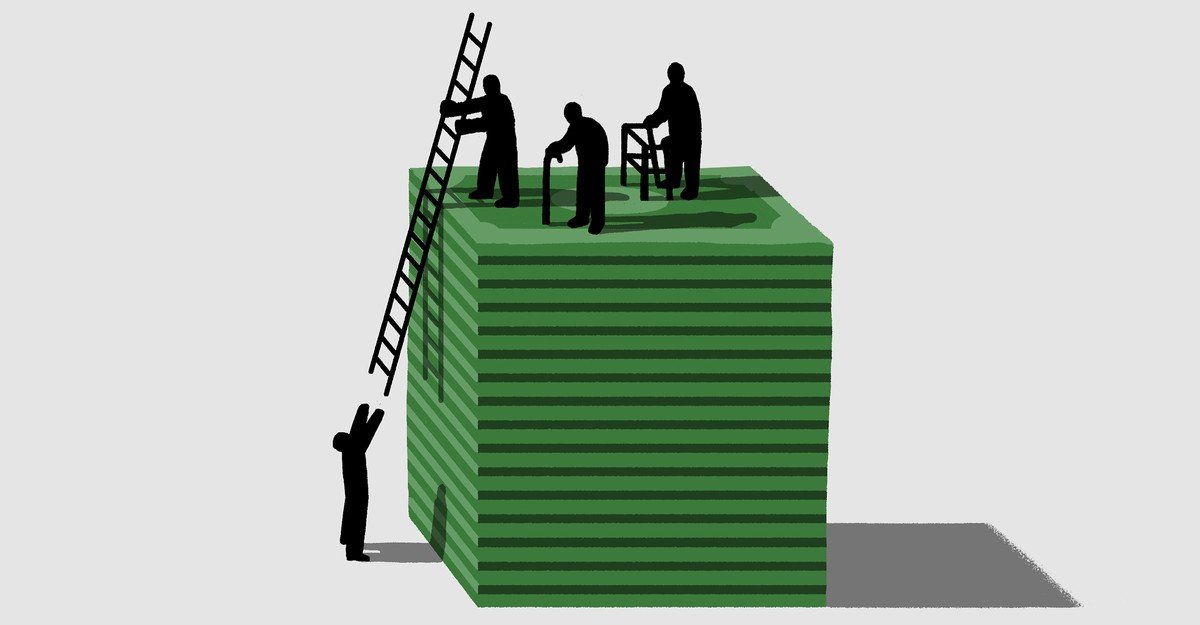
California is not unique, and housing is not the only means by which the older generations have effectively pulled up the ladder behind them. Preferences for the elderly over the young are a fixture of public budgets nationwide. Across all government programs—federal, state, and local—$2 are now spent on seniors for every $1 spent on children.
According to Tim Vlandas, an Oxford political economist, advanced democracies around the world are reaching the point of “gerontonomia”—his term for a stagnating political economy set up to prioritize elderly citizens. These citizens punish their elected governments for inflation, which lessens the value of savings and pension payments. They are much more tolerant of unemployment, because they no longer work; slow growth, because their wealth has already accumulated; and high public debt, because their descendants will pay it. The result, Vlandas argues, is lower wage growth for those still working, and also worse outcomes for their children, as a result of lower social investment over the course of their lives.
Graying democracies everywhere have made generous pension commitments that they are struggling to maintain. In the United Kingdom, the “triple lock,” a rule that in most years mandates that state pension payments increase more than inflation, seems politically impossible to change. In France, people protested for months against Emmanuel Macron in 2023 over the raising of the retirement age from 62 to 64.
Yet these challenges are especially acute in America. Because Social Security still has a trust fund to draw on, voters may not realize that benefits already exceed contributions. But this fund, which stood at $2.9 trillion in 2021, is on pace to dwindle to zero by about 2033. The Trump administration’s immigration crackdown will hasten the arrival of exhaustion day by cutting the number of tax-paying workers who support retirees’ benefits. Once that trust fund is gone—absent a tax increase on current workers or some other change—beneficiaries would suffer an immediate 23 percent cut in payments. A similar process would leave the Medicare Part A program, which covers hospital stays for the elderly, insolvent at about the same time.
The national debt will by then be gargantuan. Previously unthinkable ideas—such as means-tested Social Security benefits, confiscatory wealth taxes, even health-care rationing—might be contemplated. The bill coming due for the senior welfare state might not trouble this president, but it could well be the defining problem for the next one.
Some people would like to start the fight over how to resolve it now. Among them are radical thinkers who contend that in order to defeat economic gerontocracy, Americans must first defang the elderly ruling class. In his forthcoming book, Gerontocracy in America, the 54-year-old Yale law and history professor Samuel Moyn calls for destroying this “tyranny of the minority,” set up by “old people with enormous private power who hold society in chains.” Power, he argues, needs to be seized back, leaving “the elderly divested of political power, wealth, and property.”
Moyn wants to create mandatory retirement ages, perhaps starting as low as 65, for elected officials and people with some desirable private-sector jobs. Then he would come for the money, increasing taxes on both income and accumulated assets to dilute the share of elderly wealth. Most astonishingly, he proposes diluting older Americans’ political power too, by literally valuing the votes of young people more, on the theory that the latter will suffer the consequences of political decisions for much longer. (This proposed social engineering is both harsh and vanishingly improbable. The modern legal principle of “one person, one vote” exists for good reason.)
Still, Moyn’s ideas underscore the need for an equitable post-Boomer settlement, one that will be easier to find if we start the search sooner rather than later. In the 20th century, the United States realized it was too rich and too decent a country to allow its elderly citizens to live in penury. And it made an enduring commitment to address that problem, one that has unequivocally succeeded: There has never been a better time to be a senior citizen in America. And yet the U.S. has made no comparable commitment to working families, who are stymied not only by expensive housing but also by child-care and higher-education bills. Child poverty in America persists at levels alarmingly higher than in other advanced democracies.
Initiatives such as Franklin D. Roosevelt’s New Deal and Lyndon B. Johnson’s Great Society established what current workers in a decent country owed to retirees. A new social contract can be struck that would deliver at least some optimism for today’s workers. Curing gerontonomia would require redirecting some public funds from programs aimed at the elderly, such as Social Security, to family benefits, education, and infrastructure. But an intergenerational recalibration can come about in gentler ways than Moyn’s: The wealthiest Social Security recipients, for instance, could forgo some of their scheduled benefits, which could instead be contributed annually to “baby bond” accounts for America’s children, a source of capital to be used in adulthood.
And not every solution rests with the welfare state. Cutting through housing restrictions would generate enormous social benefit, if America’s elderly ruling class were to allow such a feat. Today’s gerontocrats will eventually die. But their legacy will be a mess to sort out.
This article appears in the May 2026 print edition with the headline “A Fine Country for Old Men.”



