
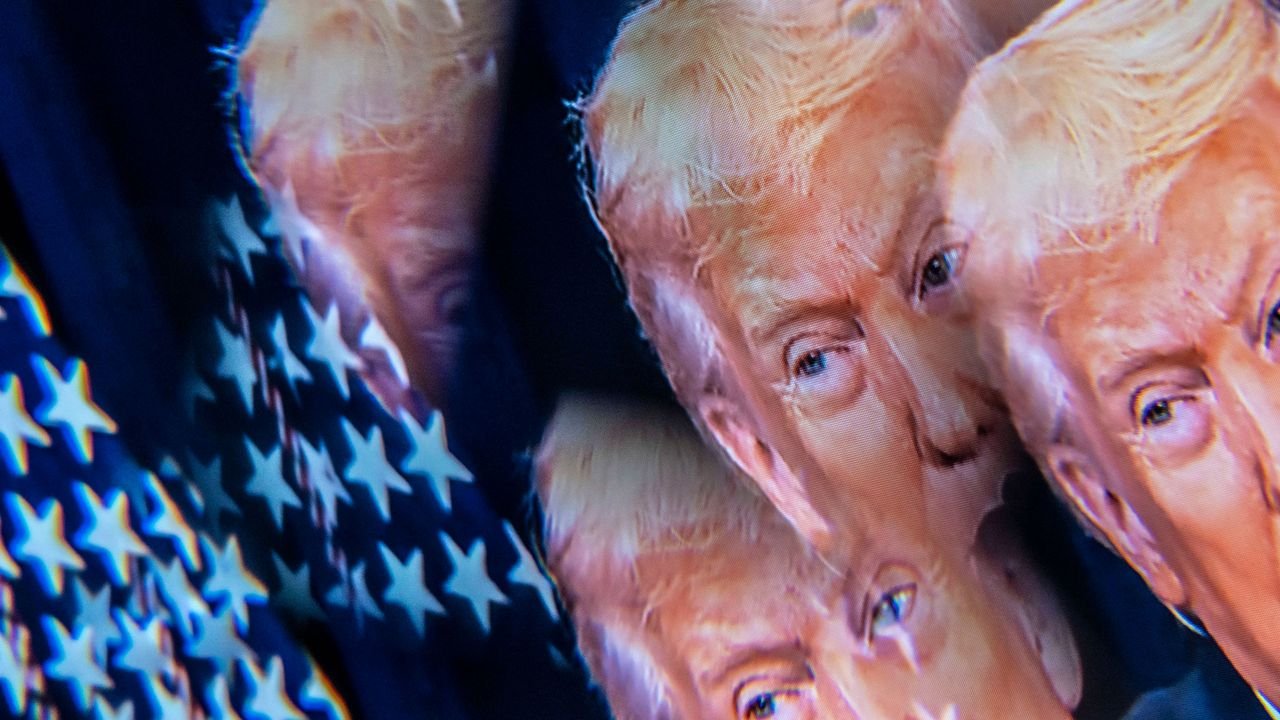
That night, Trump was back online, this time launching a tirade against the first American Pope, Leo XIV. Earlier in the week, the President had claimed that God supports the U.S. and Israel in their war against Iran. At a prayer vigil at St. Peter’s Basilica on Saturday, the Pope warned about the “delusion of omnipotence that surrounds us and is becoming increasingly unpredictable and aggressive.” He did not mention Trump by name, but it wasn’t hard to infer. “Enough of the idolatry of self and money!” Leo said. “Enough of the display of power! Enough of war!” Among those in attendance at the service was the Archbishop of Tehran.
En route back to Washington from Florida, Trump issued a blistering attack on the Pontiff on Truth Social. Leo was “terrible” on foreign policy for not supporting the U.S. military operation in Venezuela, in January, or the war in Iran, he said. “I don’t want a Pope who criticizes the President of the United States because I’m doing exactly what I was elected, IN A LANDSLIDE, to do.” Leo was only elected to the papacy, Trump charged, because the Church thought that an American would know how to deal with Trump. “If I wasn’t in the White House, Leo wouldn’t be in the Vatican,” he said. The Pope should “get his act together” and “stop catering to the Radical Left,” the post went on. “It’s hurting him very badly and, more importantly, it’s hurting the Catholic Church!” Later, Trump posted an A.I. image of what appeared to be himself as Jesus Christ.
On Monday, Leo, who was starting a four-nation tour of Africa, said that he had no fear of the Trump Administration. When pressed by reporters on his plane about Trump’s remarks on Truth Social, he replied, “It’s ironic—the name of the site itself. Say no more.”
As the shaky ceasefire enters its second week, the U.S. blockade, now under way, changes the dynamics in the Persian Gulf. Since the war began, Iran has choked off most maritime traffic through the Strait of Hormuz, letting only some “friendly” ships pass through. Now the U.S. will block all ships bound for or coming from Iran or its coastal areas.
The strategic calculus, for both countries, is about holding out longer than the other. “The United States and Iran are drifting into a familiar and dangerous pattern: a war of attrition where each side believes it can impose more pain than it can absorb,” Danny Citrinowicz, the former head of Iran analysis in Israeli military intelligence who is now at the Institute for National Security Studies, warned on Monday. “This is a recipe not for resolution, but for escalation.” He also wrote, “Closing the Strait of Hormuz will not force Iran into submission, at least not from Tehran’s perspective. What did not work after five weeks of sustained aerial pressure is unlikely to succeed through maritime pressure alone.”
The markets agreed. On Monday, the price of oil quickly surged above a hundred dollars a barrel. In the U.S., the cost of gas had already topped four dollars a gallon. That, along with continued volatility in the stock market, has led many Republicans to fear consequences in the midterm elections in November. An English-language post on X, which purports to be from Ghalibaf, responded to Trump’s blockade announcement with a quip, “Enjoy the current pump figures. With the so-called ‘blockade’, Soon you’ll be nostalgic for $4–$5 gas.” Ghalibaf is emerging as the most powerful politician in Iran after the death of Supreme Leader Ayatollah Ali Khamenei—and the reported injuries to his son Mojtaba, the new Supreme Leader—in U.S. and Israeli air strikes on the first day of the war.
Iran, whose infrastructure has been hard hit by more than thirteen thousand U.S. air strikes and more than ten thousand Israeli strikes, may suffer huge financial losses, too. A blockade could cost the nation more than four hundred million dollars a day in lost trade, or some thirteen billion dollars a month, according to Miad Maleki, an Iranian American sanctions expert formerly at the Treasury Department and now at the Foundation for Defense of Democracies. The Iranian rial is already verging on collapse. On the eve of the talks in Pakistan, it traded at 1.5 million to the dollar. “The blockade makes continued resistance economically impossible,” Maleki said.



