
Welcome back to World Brief, where we’re looking at the current status of the Strait of Hormuz, the reauthorization of a controversial U.S. surveillance tool, and calls for British Prime Minister Keir Starmer to resign.
Open … With Conditions?
One of the world’s busiest shipping lanes is supposedly back in business. For weeks, Iranian forces have effectively stopped all traffic in the Strait of Hormuz—through which one-fifth of the world’s oil normally transits—in response to U.S. and Israeli strikes. The resulting chaos has sparked an unprecedented global energy crisis that raised crude costs and upended financial markets.
On Friday, though, the United States and Iran both announced that the strategic thoroughfare had been reopened. “Iran has agreed to never close the Strait of Hormuz again,” U.S. President Donald Trump wrote on Truth Social. “It will no longer be used as a weapon against the World!”
Iran said the Strait of Hormuz was “completely open” to commercial vessels in line with the Israel-Hezbollah cease-fire in Lebanon, which went into effect at midnight on Friday. However, Iranian Foreign Minister Abbas Araghchi wrote on X that the waterway would be open “for the remaining period of ceasefire”—not indefinitely. He did not specify whether this cease-fire is the 10-day Israel-Hezbollah truce or the U.S.-Iran deal, which is scheduled to end on April 21.
Trump, for his part, stressed in a separate post on Friday that Hormuz’s reopening was “not tied, in any way, to Lebanon.”
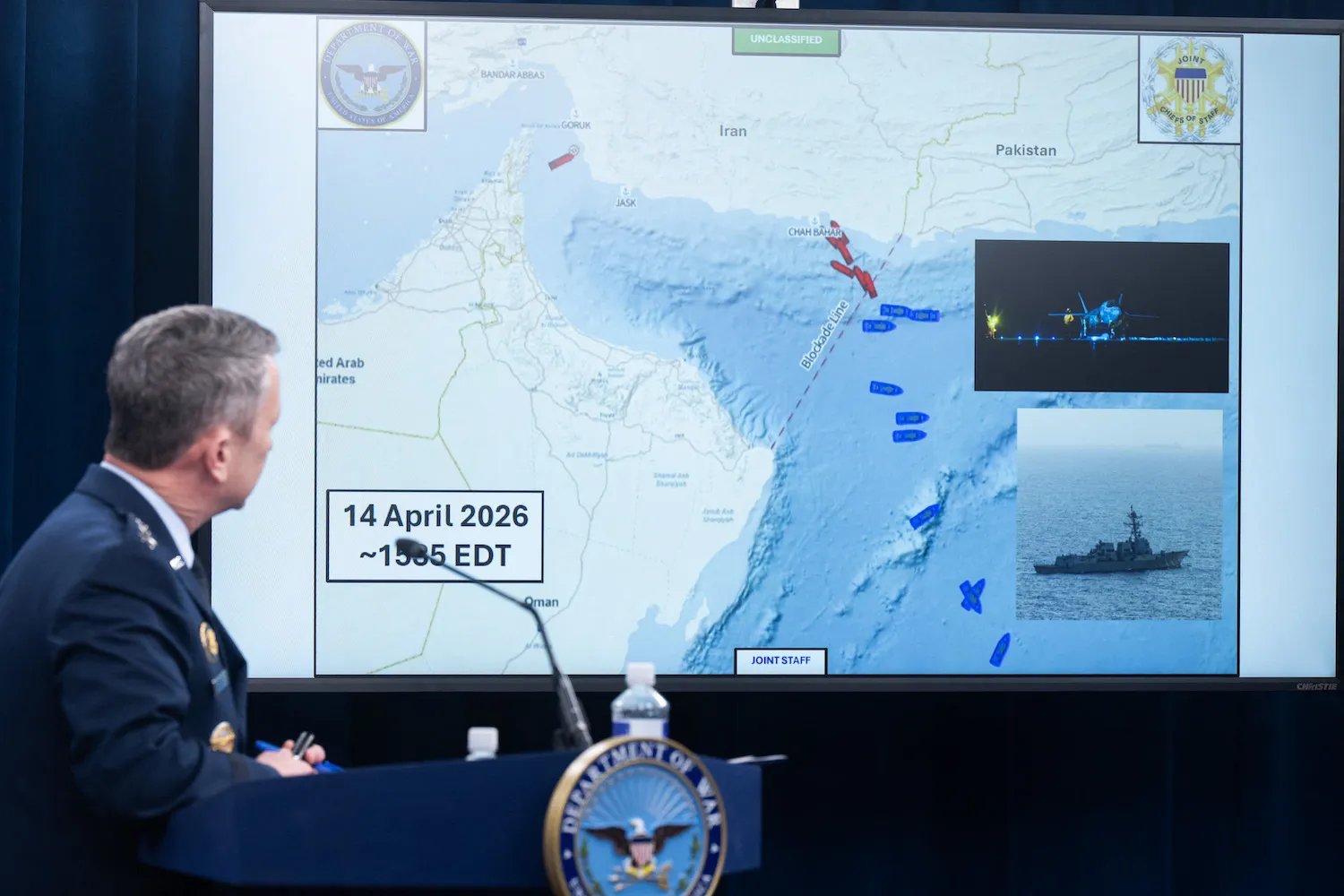
Further confusion emerged when Trump wrote that the U.S. blockade of Iranian ports in the strait would remain in place. “THE NAVAL BLOCKADE WILL REMAIN IN FULL FORCE AND EFFECT AS IT PERTAINS TO IRAN, ONLY, UNTIL SUCH TIME AS OUR TRANSACTION WITH IRAN IS 100% COMPLETE,” Trump posted.
It is unclear to what extent U.S. troops will enforce the blockade and what that will mean for global shipping. However, several Iranian state-affiliated news outlets have already condemned Trump’s statement, including the Tasnim news agency, which claimed that Hormuz’s reopening would be reversed if the U.S. blockade continued. On Wednesday, Tehran warned that it would retaliate against international shipping in the Middle East if the blockade remained in effect.
According to U.S. Central Command on Friday, the U.S. military has blocked 19 ships since the blockade went into effect on Monday. “ZERO vessels have evaded U.S. forces during the blockade,” Centcom wrote on X.
Still, global markets appear optimistic about Hormuz’s declared reopening. Brent crude fell more than 10 percent on Friday to below $90 per barrel, its lowest level in more than a month. West Texas Intermediate crude also fell more than 10 percent, hitting below $84. Meanwhile, financial markets expressed cautious enthusiasm, with the S&P 500 going up 1 percent during Friday morning trading.
Foreign leaders similarly welcomed news of the strait’s reopening during a meeting of some 50 countries and organizations in Paris on Friday. Yet many attendees, including co-hosts French President Emmanuel Macron and British Prime Minister Keir Starmer, continued to push for a lasting peace.
“We all demand the full, immediate, and unconditional reopening of the Strait of Hormuz by all parties,” Macron said, with Starmer adding that the coalition is still planning an international mission to restore regional maritime security. Military planners are expected to convene in London next week.
Today’s Most Read
What We’re Following
U.S. spy tool extension. Both chambers in the U.S. Congress on Friday approved the short-term renewal of a controversial espionage tool. Section 702 of the Foreign Intelligence Surveillance Act permits the CIA, FBI, National Security Agency, and other government agencies to conduct electronic surveillance of non-U.S. persons outside the United States without a warrant. Although some U.S. officials have argued that this authority is necessary to combat security threats, others warn that Section 702’s ability to gather data on Americans who communicate with foreign nationals encroaches on civil liberties.
Section 702, first established in 2008, was set to expire on Monday. This week, Trump and Republican leaders pushed for an 18-month renewal. “I am asking Republicans to UNIFY, and vote together on the test vote to bring a clean Bill to the floor,” Trump wrote on Truth Social. “We need to stick together.”
However, late Thursday, several House Republicans broke ranks to unveil a revised five-year extension. Both stopgap measures were ultimately rejected due to divisions within the party, delivering a key win for Democrats, who had condemned Republicans’ efforts to push through a new extension in the middle of the night. Section 702 will now be continued until April 30.
Mandelson fallout. Starmer resisted calls on Friday to resign over new revelations concerning the appointment of former British diplomat Peter Mandelson.
Last September, leaked emails revealed that Mandelson, the British ambassador to the United States at the time, had maintained close ties with convicted sex offender Jeffrey Epstein. Starmer has since tried to survive the political fallout by firing Mandelson, publicly apologizing to Epstein’s victims, and launching a criminal investigation into Mandelson’s potential sharing of government information with the disgraced financier.
On Thursday, Starmer also fired Olly Robbins, the most senior civil servant in Britain’s Foreign Office, after it emerged that the agency had granted clearances to Mandelson despite him failing a top-secret security vetting process. Starmer said he was “absolutely furious” that he was not informed of this issue, calling it “unforgivable” and vowing to “set out all the relevant facts in true transparency” to Parliament on Monday.
Yet opposition Conservative leader Kemi Badenoch argued on Friday that Starmer’s claims that he did not know were “completely preposterous.” “This story does not stack up. The prime minister is taking us for fools,” Badenoch said. “All roads lead to a resignation.”
Upcoming vote. Bulgaria is preparing to hold snap parliamentary elections on Sunday, in what will be the country’s eighth such vote in just five years. According to local polling published on Friday, nearly 50 percent of Bulgarians hope to avoid a governing coalition by having just one party obtain a majority in the National Assembly.
Bulgaria has a history of failed coalition governments. In January, then-Bulgarian President Rumen Radev called for snap elections after leading parties were unable to secure a mandate to replace the previous administration, which resigned just minutes before the legislature was set to vote on a no-confidence motion following widespread anti-corruption protests.
Radev, a pro-Russian lawmaker, is running again—this time for prime minister. Local polling predicts his Progressive Bulgaria party to win 34.2 percent of the vote, far ahead of the second-place GERB-UDF, a center-right group led by former Prime Minister Boyko Borissov. However, this would still not be enough to secure a single-party majority, thereby requiring Radev to try to form another coalition. Already, though, Radev has ruled out working with the GERB-UDF as well as another major opposition party, the Movement for Rights and Freedoms.
What in the World?
Hungarian Prime Minister Viktor Orban and his Fidesz party lost the country’s parliamentary elections on Sunday for the first time since 2010. Orban was also elected prime minister once before his 16-year rule. When was that?
A. 1984
B. 1998
C. 1990
D. 2002
Odds and Ends
South Korean authorities safely captured an escaped 2-year-old wolf named Neukgu on Friday after he broke out of Daejeon’s O-World zoo nine days ago. Neukgu’s daring escapade prompted a sweeping search-and-rescue operation involving drones, police, emergency workers, and veterinarians. Ultimately, Neukgu was found on a hill near an expressway and brought back to O-World—to cheers on social media for his safe return.
And the Answer Is…
B. 1998
Fidesz suffered a crushing, historic defeat despite rigging the electoral playing field to its advantage—offering lessons to Republicans and Democrats in the United States as midterm elections approach, Thomas Carothers writes.
To take the rest of FP’s weekly international news quiz, click here, or sign up to be alerted when a new one is published.



